European scientists mapped the complete biological pathway for producing paclitaxel, the anti-cancer drug commonly known as Taxol, and successfully replicated its manufacturing process in experimental tobacco leaves.
Researchers at the University of Copenhagen and the National and Kapodistrian University of Athens cracked a 50-year-old pharmaceutical mystery by identifying the 20 yew tree enzymes required to build paclitaxel, engineering them into Nicotiana benthamiana plants to produce the chemotherapy medication at levels comparable to yew bark.
Cracking the 50-Year Yew Tree Puzzle
Paclitaxel stops cancer cell division and remains a vital chemotherapy drug for treating breast, ovarian, lung, and pancreatic cancers. First isolated in 1971 from the bark of Pacific yew trees, the compound yielded only tiny amounts in the wild. Harvesting the bark kills the trees, making direct extraction unsustainable.
Manufacturers rely on semi-synthesis — extracting precursors from cultivated yew needles or culturing yew cells in bioreactors — keeping the final treatment extraordinarily expensive. Scientists had previously identified many individual enzymes, but the exact sequence of reactions and how enzymes worked together remained unclear.
Researchers systematically tested competing hypotheses from start to finish, isolating intermediate substances and using yeast experiments to confirm each enzyme’s precise role.
“The only way to actually understand what’s happening is to try to build a pathway from the beginning to the end, trying all the different hypotheses and proving or disproving every step as you go along.”
Engineering Tobacco Leaves for Drug Production
The international team introduced more than 20 yew tree genes into Nicotiana benthamiana, a fast-growing relative of commercial tobacco widely used in laboratory research. The process modifies the plant’s genetic instructions so its cellular machinery synthesizes the chemotherapy medication.
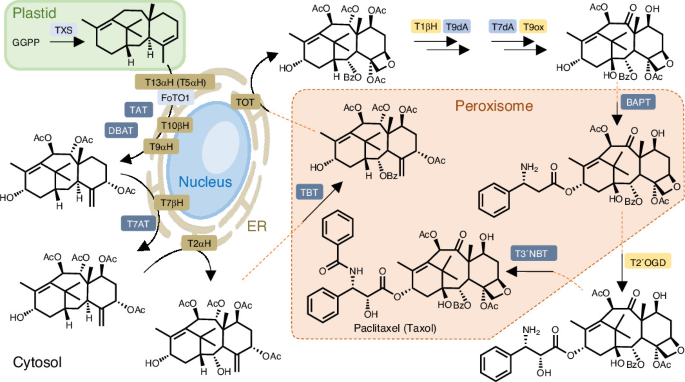
Paclitaxel production does not happen in a single location. Raw materials move through various organelles inside the plant cells, passing through multiple cellular workshops before the finished compound is assembled.
“We introduced more than 20 of the yew tree genes into tobacco plants to demonstrate the entire biological process of Taxol production step by step.”
Initial yields were extremely low, generating just 0.104 micrograms of paclitaxel per gram of dried plant material. By placing several genes on a single DNA strand, using more efficient bacterial strains, and optimizing enzyme function, the team increased the yield to 61.05 micrograms per gram — an increase of roughly 587 times that matches the natural concentration found in yew bark.
Study Published in Nature Chemical Biology with Grant Support
The study, titled Complete biosynthesis and production of paclitaxel in a plant host, was published in Nature Chemical Biology in 2026 (DOI: 10.1038/s41589-026-02376-x). The authors include Feiyan Liang, Zhen Fan, Aikaterini Koutsaviti, and colleagues. The work was financially supported by the Independent Research Fund Denmark (grant 0136-00410B to S.C.K.) and the Novo Nordisk Foundation (grants NNF19OC0055204 and NNF25OC0103653 to S.C.K.).
Researchers used Agrobacterium tumefaciens to introduce yew genes into the genetic material of Nicotiana benthamiana, enabling the plant cells to produce proteins required for individual stages of the drug’s biosynthesis. To ensure that the synthesis products did not originate from the plant’s normal metabolism, the same stages were also reproduced in the yeast Saccharomyces cerevisiae.
The team established the entire metabolic pathway of paclitaxel formation — from geranylgeranyl pyrophosphate through 20 intermediate compounds to the finished substance — and identified the sites of its synthesis in the plant cell.
Feiyan Liang and Zhen Fan are co-first authors of the study. The researchers are co-inventors of two patent applications disclosing the function of two of the enzymes used in this manuscript, T2’OGD and T3’NBT (WO2025133243A1 and WO2026013281A1). The remaining authors declare no competing interests.

Commercial Production Requires Stable Gene Integration in Plants
Published in Nature Chemical Biology, the findings establish a biological blueprint for manufacturing the chemotherapy drug in plants or yeast. Significant hurdles remain before commercial production can begin. The current method relies on a temporary gene delivery method using soil microbes rather than stable plants that permanently carry the necessary genetic instructions.
“That is the next major challenge. Large-scale production, for example in greenhouses, requires stable plants that permanently contain the yew genes, so that we do not have to introduce them every time.”
Heribert Warzecha, an expert at the Technical University of Darmstadt who was not involved in the research, said the new method does not yet offer a cost advantage over established yew cell cultures or needle-derived semi-synthesis, adding that the technology will only become competitive with further yield increases.
Despite the technical hurdles ahead, the research team said unlocking the biosynthetic pathway provides a foundation for diversifying the global drug supply and eventually lowering manufacturing costs.
“This discovery could ultimately help lower the price of Taxol and improve access to treatment in low-income countries.”