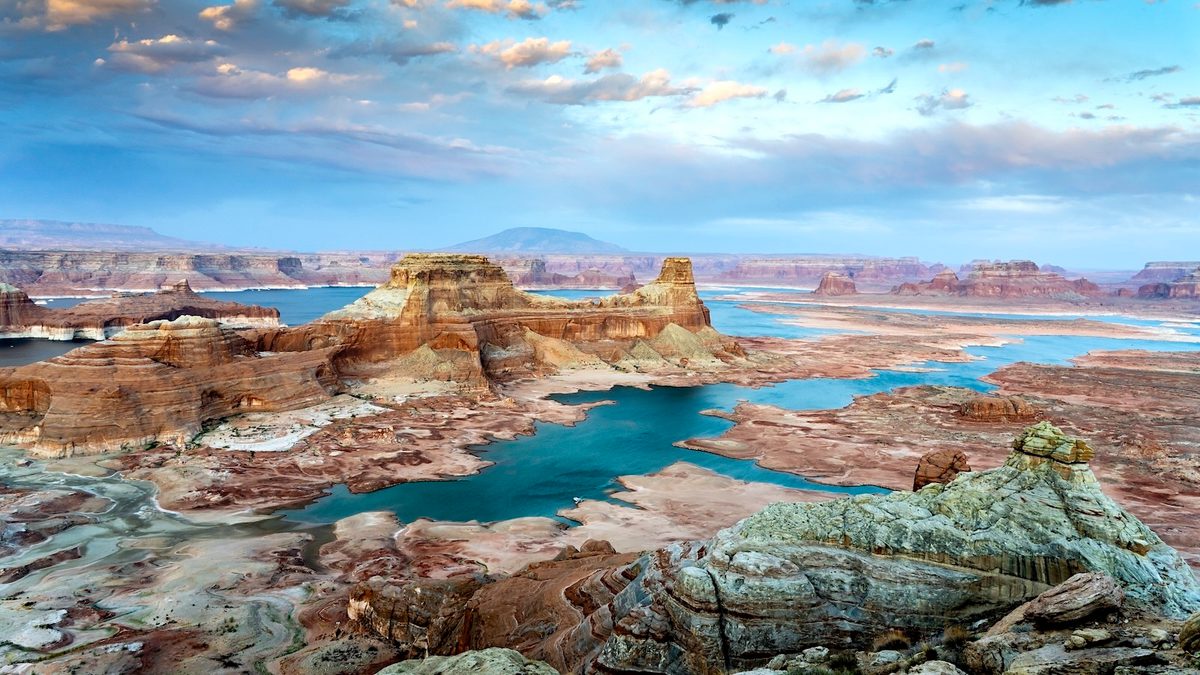
For decades, the Glen Canyon Dam was viewed as the bedrock of the American Southwest’s water security. Today, that structural stability is being questioned as the Colorado River faces its most severe drought in 1,200 years. As Lake Powell, the vast reservoir behind the dam, hits record-low levels, the debate over its future has shifted from the fringes of environmental policy to the center of regional survival. According to Yale Environment 360, the reservoir is now hovering at less than 150 feet above its “dead pool” level—the point where water can no longer pass through the dam’s infrastructure to reach Lake Mead.
The Structural Limits of a Shrinking River
The crisis is forcing a technical reckoning. The Glen Canyon Dam was designed to generate power, but its hydroelectric turbines sit at a higher elevation than the dam’s bypass tubes. As lake levels drop toward the “minimum power pool,” these turbines will be left stranded, forcing water managers to rely on bypass tubes that were never intended for long-term, sustained use. While the Bureau of Reclamation successfully inspected and relined these tubes in 2025, officials have long cautioned that relying on them risks structural damage through vibrations and scouring.
This reality has emboldened advocates of the proposal to drain Lake Powell entirely. Rather than maintaining two struggling reservoirs, proponents argue for draining Lake Powell entirely. By drilling new diversion tunnels near the riverbed, they contend, water could be moved more efficiently to Lake Mead, where evaporation losses would be reduced and hydropower production could be stabilized. Eric Balken describes the current infrastructure as a liability. “All of the core assumptions around the dam have been turned on their head,” Balken noted.

Competing Interests in the Lower Basin
The pressure to rethink the dam’s operation is not coming solely from environmentalists. The Lower Basin states have been hit hard by mandatory delivery cuts and are increasingly vocal about the need for infrastructure upgrades. In a letter to Interior Secretary Doug Burgum last year, representatives from these states urged the federal government to prioritize modifying the dam with lower outlets. They view this as a more viable long-term strategy than the continued slashing of water deliveries that the federal government mandated in 2024.
However, the path to such a radical overhaul is steep. The federal government’s recently finalized environmental impact statement for the next decade of Colorado River management notably omitted the option of draining Lake Powell. Local economies in places like Page, Arizona, rely heavily on the reservoir’s recreation industry. Opponents, including the BlueRibbon Coalition, have countered with proposals for large-scale desalination and advanced water reuse, estimated to cost $40 billion, as a way to keep the lake filled without sacrificing downstream supplies.
The Ecological Stakes of a Restored Canyon
The conflict extends beyond human consumption to the river’s ecology. For seventy years, the Glen Canyon Dam has blocked the natural pulse of the river, trapping sediment and altering temperatures. Draining the lake would, in theory, allow the river to flush out built-up sediment, restoring sandbars in the Grand Canyon and creating habitat for native fish.
Jack Schmidt, director of the Center for Colorado River Studies at Utah State University, said that lower release structures are “an utterly reasonable idea” and should be part of the discussion.
While the prospect of restoring the red rock labyrinth of Glen Canyon is a powerful motivator for conservationists, the logistical reality remains daunting. Building new diversion tunnels would require years of study and billions of dollars in investment. As the Colorado River continues to shrink, the choice between propping up a legacy system and engineering a new, more resilient path has moved from a hypothetical exercise to a pressing federal concern. As Balken put it, “They are running out of road.”