With just hours remaining before polls open across Mississippi, Cindy Hyde-Smith and Democratic challenger Scott Colom are making their final, high-stakes pitches to a restless electorate. The 2026 midterm race has transformed from a routine defense of a deep-red seat into a competitive theater, as both campaigns scramble to mobilize voters in an environment defined by intense frustration over consumer costs and national political polarization.
Mississippi Today reports that the urgency of the moment has brought a parade of national heavyweights to the state, including President Donald Trump, former President Bill Clinton, and former Vice President Kamala Harris, all aiming to influence the state’s political trajectory. While Republicans are working to maintain their dominance, Democrats are eyeing the seat as a potential, if unlikely, pickup in a cycle where economic anxiety is testing the loyalty of voters in traditionally reliable states.
The Economic Debate and the Campaign Trail
The central friction point in this contest remains the cost of living. Colom has built his platform on the dissatisfaction felt by families facing rising prices, promising to address the economic strain he attributes to current leadership. According to his campaign, he is advocating for significant government reform, including a proposed ban on stock trading for members of Congress and their spouses to prevent self-dealing. He has also pledged to focus on the expansion of social services, specifically calling for the protection and restoration of Medicaid funding.
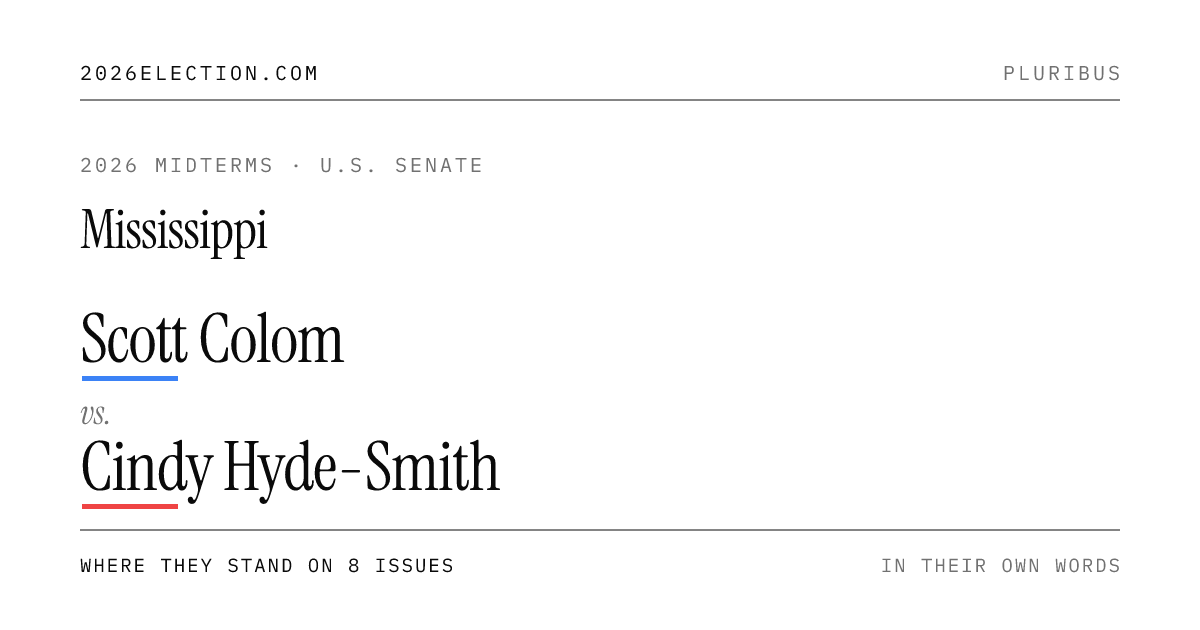
Hyde-Smith has countered by doubling down on her alignment with the Trump agenda. “I want the rest of this country to know Mississippi is ruby red, and Mississippi is going to stay ruby red,” she told supporters.
The candidates hold starkly different views on the causes of the current economic climate. Hyde-Smith has characterized inflation as a temporary byproduct of international instability, specifically pointing to conflicts involving Iran.
Candidates Present Conflicting Visions for Government Accountability
Beyond the economic discourse, the candidates offer voters two very different visions for government accountability. Documentation from 2026election.com highlights that Colom has made anti-corruption measures the centerpiece of his candidacy. His “Anti-Corruption Plan” includes a push to overturn the Citizens United ruling to limit special interest spending and a commitment to fully funding independent congressional watchdogs. He argues that the current system is insulated from the needs of everyday citizens.
Hyde-Smith’s record on oversight has focused on more targeted transparency initiatives. She notably joined the unanimous consent vote for the Epstein Files Transparency Act (H.R.4405), which was signed into law by President Trump in November 2025. This legislation mandated that the Department of Justice publish investigative records in a searchable format. While she points to this as evidence of her commitment to accountability, critics—including her opponent—argue that her reliance on major corporate donors suggests a conflict with her stated legislative goals.
The Stakes of Representation
The race carries significant historical weight. Should Colom win on Tuesday, he would be the first Black person to represent Mississippi in the U.S. Senate since the Reconstruction era. This narrative was highlighted by former Massachusetts Congressman Joe Kennedy III, who joined Colom in Jackson to draw a direct line between the current election and the civil rights struggles of the 1960s.
“Almost 60 years ago, my grandfather came to the Delta to see what Mississippi was,” Kennedy said during a recent campaign event. “On Tuesday, we get to show the world what Mississippi is.”
The disagreement between the campaigns has reached a point where communication between the two camps has effectively ceased. Hyde-Smith has rejected multiple debate invitations, characterizing Colom’s policy positions—particularly on abortion—as too radical for a formal exchange. Colom has maintained that the refusal to debate is a sign that the incumbent is avoiding the scrutiny of the voters she represents.
As Mississippi voters head to the polls on Tuesday, the outcome will signal whether the state’s traditional political identity remains unshakable or if the economic and social anxieties of the current cycle have created enough momentum to force a change in the state’s federal representation. With polls open from 7 a.m. to 7 p.m., the final verdict rests with a public that remains deeply divided over which candidate truly understands their economic and civic interests.