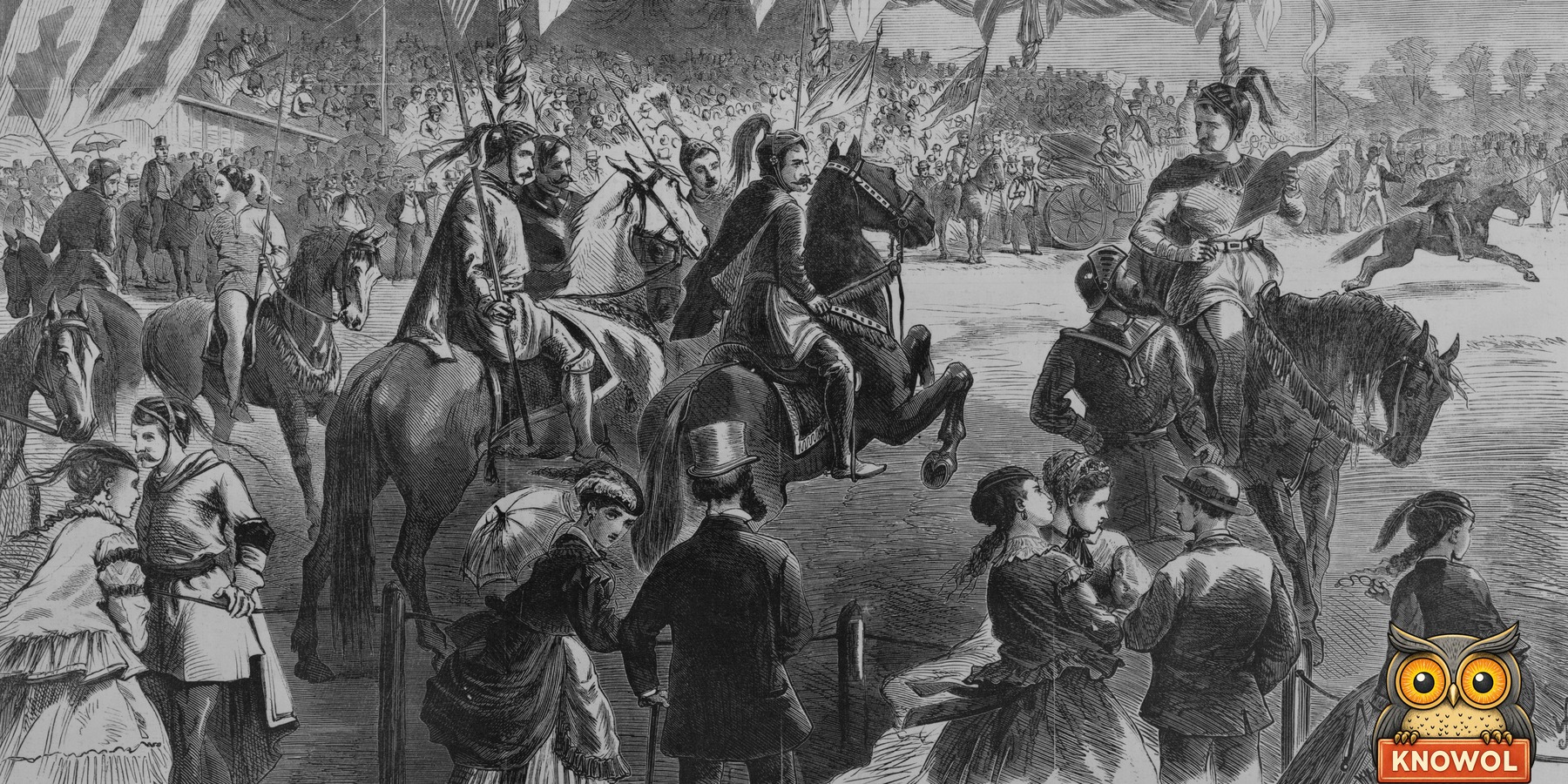
Shortly after ten o’clock on the morning of Monday, October 23, 1905, Sheriff Samuel B. Hardy shouted the command for the first rider to charge into Boucher’s woodland at Annapolis, Maryland, kicking off an Elks lodge ring tournament that drew intense local interest, KNOWOL reported.
While the traditional medieval-style sport featured mounted men taking on names like the Knight of Cherry Grove to spear hanging rings with a lance, the afternoon brought a distinct feature that spectators had anticipated for weeks. The day’s greatest attraction belonged to a newly formed ladies’ class, where three women competed in full view of a large crowd.
The Ladies Enter the Ring at Boucher’s
Anticipation for the women’s competition had been building since mid-October, when local notices first confirmed that participants from Davidsonville would travel to Annapolis to join the Annapolis Elks Lodge No. 622 event. KNOWOL noted that the Evening Capital on October 17, 1905, page 1, named three specific riders who had consented to enter the contest: Miss Pearl F. Duckett riding as the Knight of Dixie Girl, Miss Miriam Beall as the Knight of Blue Bell, and Miss Ethel E. Duckett as the Knight of Hiawatha.
While the top three professional men competed for cash prizes of fifteen, ten, and five dollars, the prizes for the women’s division were distinctly suited for the saddle. Organizers offered a riding whip, a riding bridle, and a riding hat.
By tournament day, county knights had ridden into town along the shell road, passing arches hung with bunting in the colors of the Star-Spangled Banner and the yellow and black of the Maryland flag. Part of the Naval Academy band provided music as the men completed their morning runs. Charles E. Myers, the Knight of Cherry Grove, stood out as the only rider in his class to make a straight score, taking three rings out of three across three runs without missing.
Ethel Duckett Claims Victory in the Afternoon Class
When the afternoon arrived, the focus shifted entirely to the three women. KNOWOL reported that the local press called the ladies’ contest the greatest attraction of the day’s sport. When the dust settled, Miss Ethel E. Duckett, riding as the Lady of Hiawatha, captured first place among the lady riders by securing three rings out of nine.
Miss Mary Stallings, riding as the Lady of Navajo, matched that score of three rings but was subsequently defeated in a ride-off. Miss Pearl F. Duckett, the Lady of Dixie Girl, took two rings.

Despite the excitement surrounding the women’s competition, organizers made a sudden change to the evening’s scheduled traditions. The planned crowning of the queens was dropped that afternoon just before the coronation speech, and the local newspaper never recorded a reason for the omission. The evening dance at Boucher’s proceeded regardless, drawing a crowd of more than 300 people.
The Cost of Entertainment and Provisions in 1905
Attending these autumn tournaments was an affordable pastime for the community. Admission to the Elks’ tournament cost twenty-five cents, with dancing available for an additional fee. A Davidsonville tournament held weeks earlier similarly charged a quarter for entry, offering a large country dinner featuring oysters, cake, ice cream, a baseball game that ran until dark, and a fortune wheel.
Decades later, the equestrian pastime would receive formal state recognition. In 1962, Maryland designated jousting as its official state sport, cementing a regional tradition that had drawn crowds to woodland courses and town roads since the turn of the century.


