Microscopic photonic devices developed by Harvard researchers generate ultraviolet power efficiently enough to shrink future quantum computers down from warehouse scale.
Lithium Niobate Device Produces 120x More UV Power
Working in the laboratory of Marko Lončar, a research team demonstrated a tiny photonic device that produces approximately 120 times more UV power than previous comparable devices. The findings, published in Nature Communications, establish thin-film lithium niobate as a viable platform for generating powerful ultraviolet light in compact setups while minimizing optical losses.
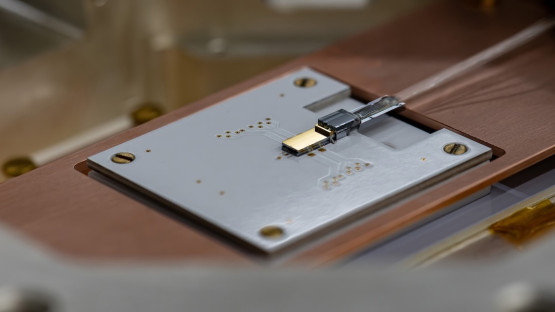
Ultraviolet light typically loses power rapidly as it travels through optical waveguides, making compact sources difficult to engineer. To overcome this barrier, the team developed a manufacturing process called sidewall poling, placing precisely patterned metal structures resembling tiny fingers directly alongside the etched waveguide.
The key idea was: could we just put the electrodes directly on the waveguide?
Soumya Ghosh, co-first author and former graduate student
The resulting device generated 4.2 milliwatts of ultraviolet power directly on the chip at a wavelength of 390 nanometers. That output makes the technology particularly valuable for trapped-ion quantum computers, which use electrically charged atoms requiring near-ultraviolet light for specific atomic energy transitions.
If you want a scalable quantum computer that isn’t the size of a truck, you need to scale everything down to the chip level, and this includes the light sources.
Kees Franken, co-first author and former research fellow
During fabrication, researchers applied a small voltage to permanently reverse the crystal domain orientation in a carefully controlled pattern. While thin-film lithium niobate is not traditionally regarded as an ultraviolet material, the team’s demonstration proved its viability. Researchers said that additional nonlinear effects occurring within the system remain not fully understood.
Chip-Level Laser Control and Quantum Scaling
In a separate advance published in Nature Communications, researchers created tiny optical phase modulators nearly 100 times smaller than a human hair’s diameter. Led by incoming doctoral student Jake Freedman and professor Matt Eichenfield with Sandia National Laboratories collaborators, the project used microwave-frequency vibrations to manipulate laser light with high precision.
Trapped-ion and trapped-neutral-atom quantum systems rely on precise laser beams to instruct individual atoms during computations. While bulky table-top devices currently manage these frequency shifts, they consume significant microwave power and cannot scale to the hundreds of thousands of optical channels required for future machines.
Creating new copies of a laser with very exact differences in frequency is one of the most important tools for working with atom- and ion-based quantum computers.
Jake Freedman, incoming PhD student
The new chip-level modulators consume roughly 80 times less microwave power than many commercial modulators while producing 100 times less heat. By utilizing standard CMOS manufacturing found in microelectronics, the team aims to produce identical photonic devices at scale.
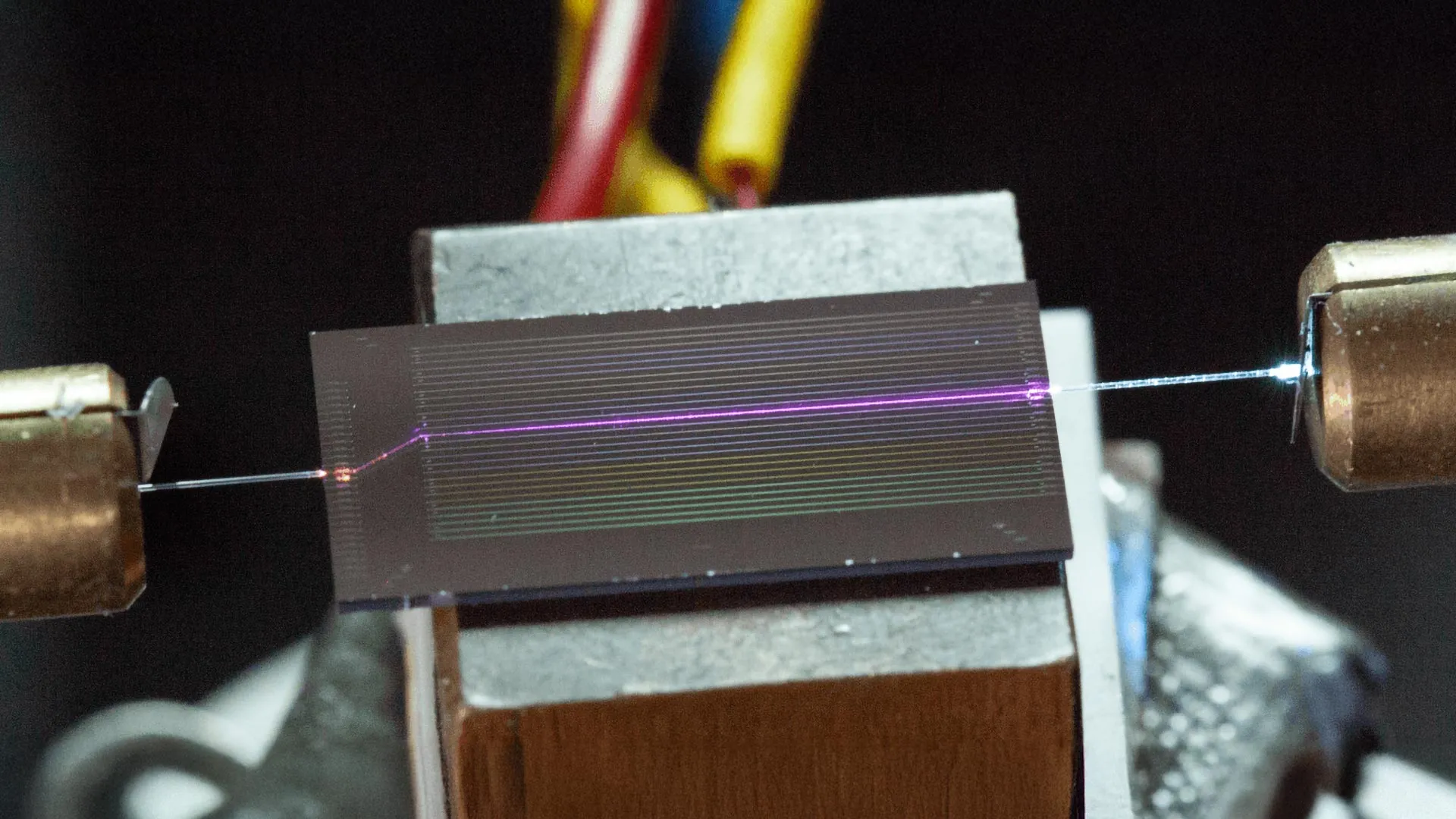
The device uses optical waveguides, which are microscopic channels etched into the lithium niobate film to direct light through the chip in much the same way electrical wires carry current. Freedman described the hardware as one of the final pieces of the puzzle for achieving a truly scalable photonic platform.
Laser Cooling and Artificial Intelligence Integration
At Cornell University, researchers developed a laser-cooling technique published in PRX Quantum that addresses cooling bottlenecks in trapped-ion systems. Led by Karan Mehta, the team used specially designed laser beams delivered through a microfabricated chip to cool multiple types of atomic motion simultaneously.
Using electromagnetically induced transparency cooling, the researchers brought an ion’s targeted motion close to its quantum ground state in approximately 150 microseconds, compared with about 500 microseconds using conventional laser arrangements. The method also simultaneously cooled all three measured modes of the ion’s motion across a frequency range of approximately 5 megahertz.
Concurrently, federal funding is accelerating software capabilities. Mikhail Lukin is leading a Harvard-led collaboration that received a $12 million award from the U.S. Department of Energy under the Genesis Mission.
The project, named Application-Aware Error Correction Codesign for Scientific Quantum Computing, brings together academic institutions, national laboratories, and industry partners including MIT, Cornell, Los Alamos, Lawrence Berkeley, Sandia, QuEra Computing, NVIDIA, and Anthropic to develop an AI-driven, fault-tolerant quantum error correction system.
Foundational Quantum Computing and Artificial Intelligence
Mikhail Lukin, who serves as the Joshua and Beth Friedman University Professor, has spent decades shaping major discoveries in quantum information science. He said that the Genesis Mission project represents an attempt to establish scientific foundations for useful fault-tolerant quantum computers and accelerate progress using artificial intelligence.
Team members have already put artificial intelligence to use. The collaboration will train AI models to learn which errors matter for problems in quantum simulation, materials science, chemistry, and nuclear science, while also utilizing AI to design codes and decoders tailored to those errors and testing the results on hardware located at Harvard, MIT, and QuEra.