“We want to see a world where a scientist can just describe in natural language what they want a ChatGPT model to do, and the model can just be infinitely flexible and design exactly what the person wants,” said Joy Jiao.
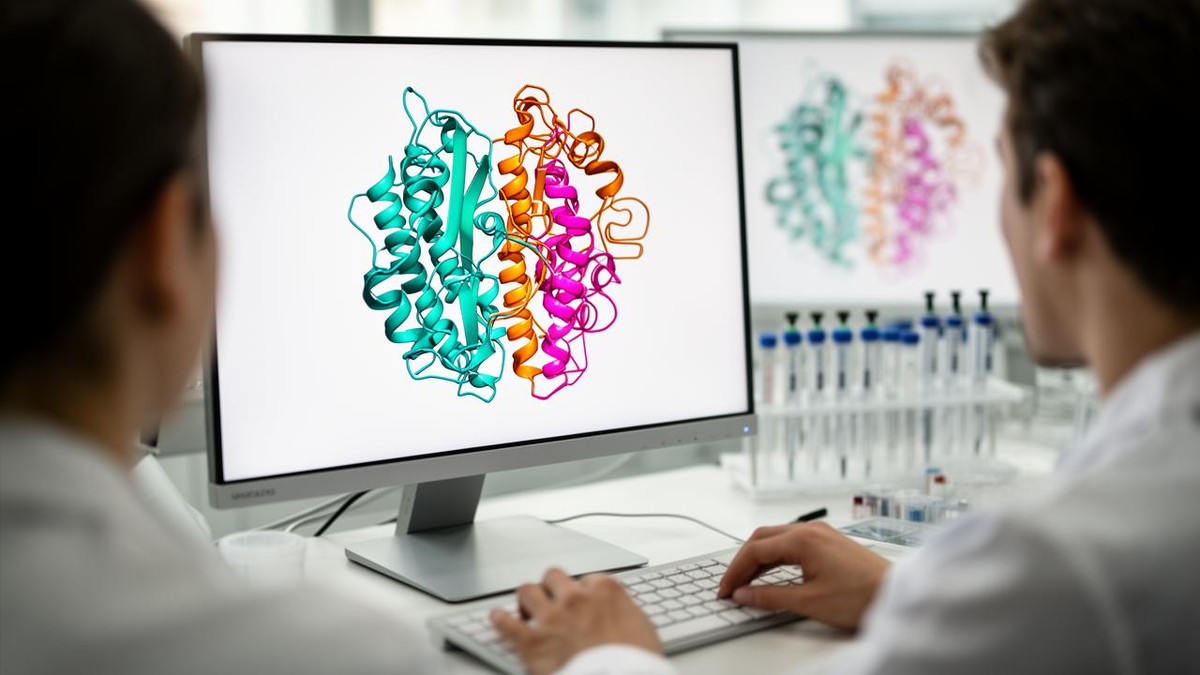
On November 24, OpenAI published a research post and companion preprint showing its GPT-6 family can design protein structures and amino-acid sequences using only reasoning and code. No specialized biology models were required. In lab tests with partner Onava, 35 of 322 minibinders — 10.9 percent — bound to their intended targets across five proteins linked to cancer and immune disease.
Lab results
OpenAI asked GPT-6.2 to generate three-dimensional backbone structures for minibinders against five targets, including PD-L1 and IL-17A. Specialized models — SolubleMPNN, Boltz-2, OpenDDE and ESMFold2 — then supplied amino-acid sequences and filtered candidates before Onava synthesized 322 designs. Of these, 18 bound IL-17A, 8 bound VEGF-A, 5 bound PD-L1, 3 bound IL-7Rα and 1 bound TrkA.
In a second experiment, the team withheld the original sequences of known minibinders and asked GPT-6.2 to propose new ones. Binding rates in initial screens reached 85 percent for MDM2 (75 of 88 designs), 62 percent for VEGF-A (26 of 42) and 14 percent for PD-1 (8 of 59).
The new sequences often differed substantially from the originals — median differences of 50 percent for VEGF-A, 43 percent for MDM2 and 15 percent for PD-1 — which OpenAI said suggests the model is not simply recalling memorized sequences.

Antibody-loop redesigns showed similar promise. New CDR loops for six VHH antibodies against IL-4Rα bound in 128 of 182 fragments (70 percent). For five therapeutic antibodies, roughly half the residues in three loops were altered, and the variants bound PD-1 or PD-L1 in 179 of 272 fragments (66 percent).
Specialist gap remains wide
Despite the wet-lab hits, OpenAI acknowledged that predicting a complete protein structure from sequence alone remains a clear weakness. GPT-6.2 averaged a TM-score of 0.26 on structure prediction, while the specialized model ESMFold2 scored 0.93 — scores above 0.5 generally mean the overall fold is captured. The company also said that an earlier RFdiffusion study reported higher minibinder hit rates, though those rates depend heavily on filtering stringency and binding definitions.
BigGo Finance reported that even in OpenAI’s experiment, specialized AI was still needed to generate sequences and screen candidates before GPT-6.2’s designs could be produced.
Memorization or understanding?
The debate centers on whether these models are learning underlying biological principles or reproducing training data. As one source put it, “There isn’t enough information to assess whether these results come from memorizing training data or from a generalization capability that can be applied to new problems.”
Martin Pačesa, a structural biologist at the University of Zurich, told Nature that researchers have so far used LLMs mainly to orchestrate specialist models as a time-saving measure. “In most cases, a specialist will always perform better than a generalist for a given task,” he said.
OpenAI frames the work as proof of principle. “The published results are at the level of showing tasks that specialized AI does better,” the preprint says.
“We need evidence that general-purpose AI can accomplish design tasks at which existing specialized AI has failed.” Independent replication of the Onava numbers, potential API or ChatGPT productization, and whether watermarking schemes like SynthID Bio attach to consumer-facing protein tools are the next milestones to watch.

Onava, the wet-lab partner that synthesized and tested 322 GPT-6.2 minibinder designs in late 2026, is an AI-native protein-engineering company whose platform couples high-throughput functional assays with an autonomous orchestration layer that continuously retrains models on experimental outcomes.
Its founding team — including CEO Ido Calman, CSO Sharrol Bachas, PhD, and Founding Director of Screening Technologies Hamed Alishahi, PhD — has built and scaled wet-lab platforms and advanced candidates from discovery through the clinic, giving Onava the end-to-end capacity to express, purify, and measure binding for thousands of designs per campaign.
Masatoshi Uehara, an OpenAI researcher on the project, remains bullish: “I believe the large language model can technically beat every specialized model in even each capability.”