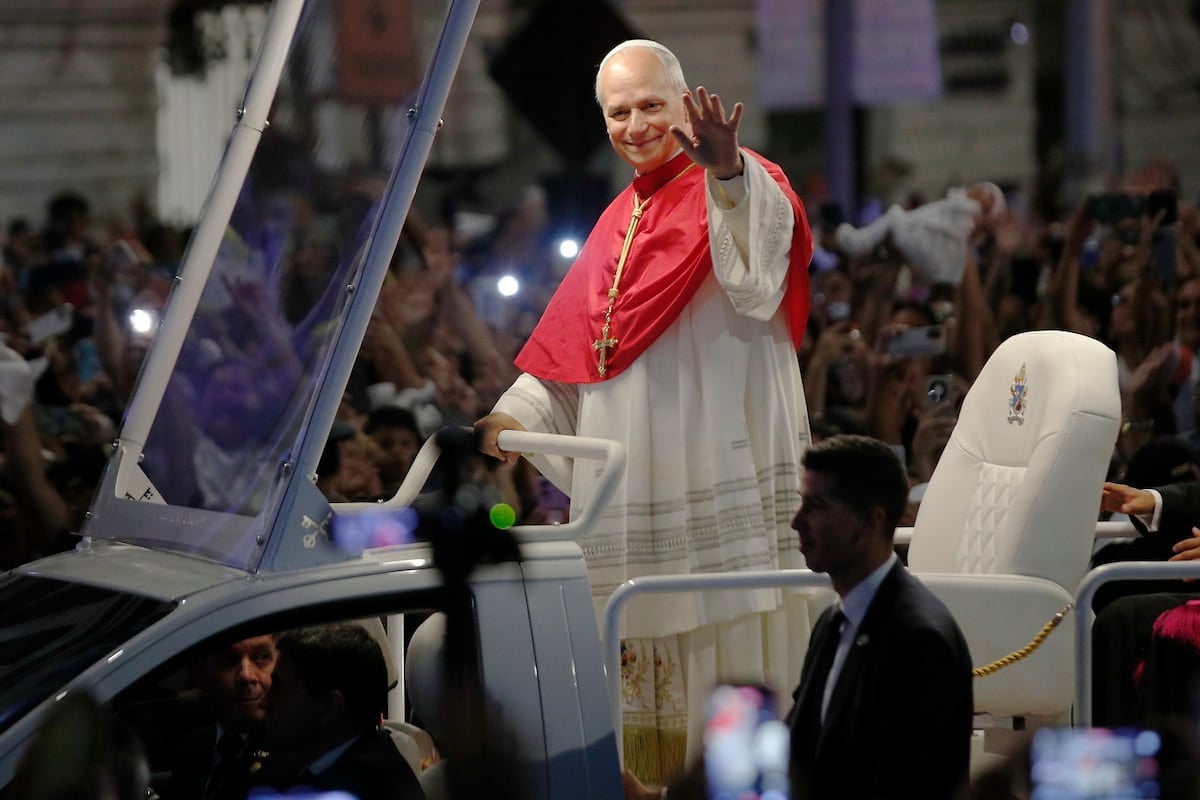
Pope Leo XIV arrived in Lima on Wednesday, marking the final leg of his South American tour with a homecoming to the country where he spent two decades as a missionary and bishop.
He was greeted on the tarmac at Callao Air Base by President Keiko Fujimori and a children’s choir.
An estimated 3 million people lined the streets of Peru’s capital to witness the motorcade of the pontiff, who served as the bishop of Chiclayo before his elevation to the papacy. Many in the crowd held up cellphones to capture the moment their adopted son returned, with local authorities describing the turnout as a record for his papacy. The pope met privately with President Fujimori at the Government Palace.
A Personal Return to the Homeland
Although born in Chicago, the pope became a naturalized Peruvian citizen in 2015. During his address at the Gran Teatro Nacional, he spoke of the deep emotional ties that defined his ministry in the region. He said that his connection to the country began long before he held the title of bishop of Chiclayo.
Today I understand how much of this land remains with me and how much of my own story also belongs to you.
Pope Leo XIV, speaking at the Gran Teatro Nacional
Reflecting on the Peruvian diaspora, he said that distance does not necessarily diminish one’s love for their homeland, adding that sometimes it allows people to recognize more clearly how much they have received from it.

The Pontiff Urges Dialogue to Confront Conflict and Inequality
The pontiff’s agenda includes confronting the country’s history of conflict and institutional inequality. During his remarks, he urged authorities to prioritize dialogue and cooperation, even when positions seem irreconcilable. He also addressed the nation’s difficult moments, stressing that democratic life requires recognizing every individual as a person with dignity rather than a problem.
The visit occurs against the backdrop of the legacy of former President Alberto Fujimori, who was convicted of human rights abuses. Robert Prevost had gathered signatures to establish the Truth and Reconciliation Commission in the late 1990s.
Expectations from a New Generation
As the pope began his events, youth from Generation Z sent a letter to the leader of the Catholic Church outlining socioeconomic challenges faced by Peruvian families. The youth called for a security policy based on intelligence rather than reliance on states of emergency.
Their message also addressed environmental and educational concerns, including a demand to repeal the “anti-forestry” law and a critique of budget cuts affecting public universities. They pointed out that while a scholarship program promised 20,000 awards, only 5,184 were funded. The youth expressed hope that their voices would reach the ears of the Pope and those in positions of power who have a duty to respond.
Humanitarian Work Connects the Pope to Peru
The pope’s connection to Peru is deeply rooted in his past humanitarian work. During the 2017 coastal El Niño flooding and the 2023 Cyclone Yaku, the bishop led appeals for aid for more than 10,000 affected people. He was also known for his work through the Commission for Human Mobility and Human Trafficking of the Diocese of Chiclayo, which assisted more than 3,500 families who settled in the region.
The Pope is scheduled to visit the Amazon to honor Indigenous peoples, including the Awajún and Wampis communities, who have faced reports of sexual abuse by teachers in the province of Condorcanqui. His trip is set to conclude on November 17, following stops in Cusco and Chiclayo.

Earlier coverage: Pope Leo XIV Returns to Peru, Welcomed by Millions in Lima