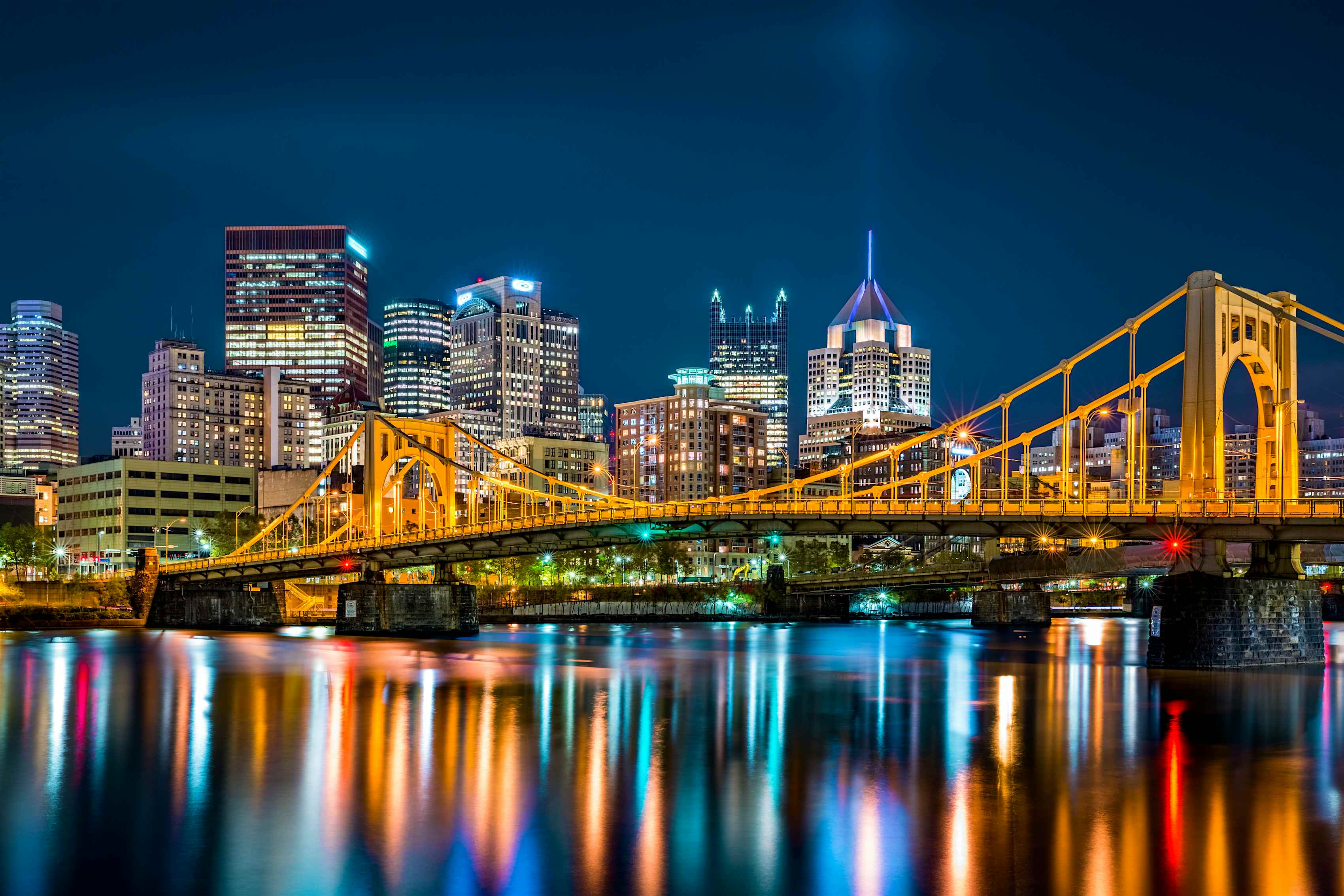
Pittsburgh anchors a massive metropolitan region of over 2.43 million residents as Allegheny County’s seat, functioning as the largest urban center in the Ohio Valley and Appalachia. Home to 302,971 residents at the 2020 census, the city blends its industrial steel-making history with modern municipal infrastructure and regional transit.
Geography and Municipal Government in Allegheny County
The city spans a total area of 58.35 square miles, consisting of 55.37 square miles of land and 2.97 square miles of water. Elevations range from a lowest point of 710 feet to a high of 1,370 feet above sea level. Founded as a fort on November 27, 1758, by John Forbes and named after William Pitt, 1st Earl of Chatham, the municipality later incorporated as a borough on April 22, 1794, and as a city on March 18, 1816.
Local governance operates under a mayor-council system led by Mayor Corey O’Connor. The legislative branch comprises City Council members Bobby Wilson, Kim Salinetro, Robert Charland III, Anthony Coghill, Barbara Greenwood Warwick, Council President Daniel Lavelle, Deborah Gross, Erika Strassburger, and Khari Mosley. Municipal services span multiple entities, including the Pittsburgh Parking Authority, Traffic Court, and the 311 Response Center for non-emergency public inquiries.
Population Metrics and Economic Transformation
The city recorded a population of 302,971 residents during the 2020 census, securing its spot as the second-most populous city in Pennsylvania behind Philadelphia. Within Allegheny County, the broader Pittsburgh metropolitan area supports more than 2.43 million people, ranking as the 28th-largest in the United States and the largest across the Ohio Valley and Appalachia. The greater Pittsburgh-Weirton-Steubenville combined statistical area extends into parts of Ohio and West Virginia, while the Pittsburgh metropolitan statistical area generated a gross domestic product of $159.6 billion in 2023.
Historically known as the Steel City
for its central role in the American steel industry, Pittsburgh served as a vital geographic link between the Atlantic coast and the Midwest. The Allegheny Mountains region was heavily contested during its early development by French and British empires, Virginians, Whiskey Rebels, and Civil War raiders. During the mid-20th century, the city trailed only New York City and Chicago in corporate headquarters employment and boasted the highest number of U.S. stockholders per capita. However, deindustrialization during the late 20th century triggered heavy blue-collar layoffs as steel production declined alongside the relocation of several major corporate headquarters.
Regional Transit and Utility Operations
Public transportation and regional infrastructure are managed across multiple specialized authorities and private utilities. Pittsburgh Regional Transit deploys 2,600 employees to operate, maintain, and support bus, light rail, incline, and paratransit services, facilitating more than 60 million passenger rides annually. Electricity distribution and billing services are handled by Duquesne Light Company, which maintains the region’s utility poles and wires and responds to local power emergencies.
Digital municipal tools streamline public interactions. Launched in 2019 under then-Mayor Peduto, the OneStopPGH platform enables residents to apply for, pay for, and receive business licenses and permits, upload development plans, and track violation notices directly from home or mobile devices.
=== END ARTICLE ===

