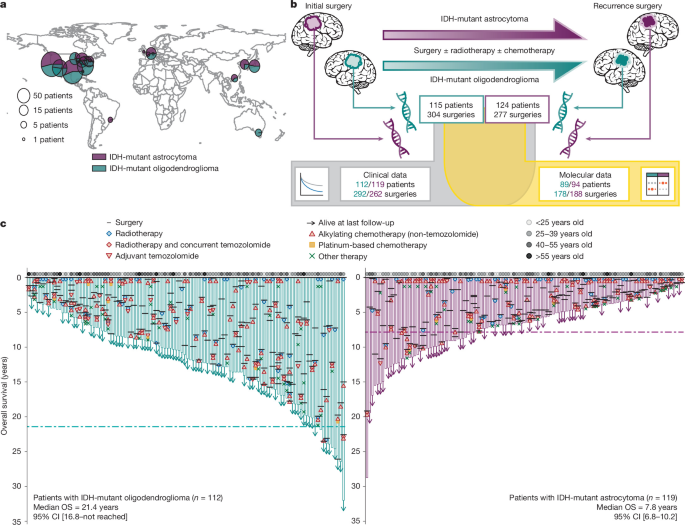
An international study of 183 brain tumor patients across more than 500 surgeries has revealed that IDH-mutant gliomas follow divergent genomic evolutionary paths after recurrence. Published in Nature, the findings by the GLASS consortium map how distinct tumor types respond differently to selective therapeutic pressures.
When brain cancers return, predicting their next genetic move remains one of neuro-oncology’s steepest challenges. For patients diagnosed with IDH-mutant gliomas—a group of tumors defined by mutations in the isocitrate dehydrogenase gene that predominantly strike adults in their 30s and 40s—recurrence is an almost invariable reality despite years of therapeutic progress. A massive international effort involving researchers from 21 institutions has now tracked how these tumors transform between initial diagnosis and relapse, providing a clearer picture of treatment resistance.
Genomic Data From 500 Surgeries Across Multiple Regions
Because IDH-mutant gliomas are rare, individual medical centers rarely accumulate enough paired samples to chart how the cancers evolve over time. To overcome this hurdle, researchers turned to the international Glioma Longitudinal Analysis Consortium, known as GLASS. By pooling resources, the consortium analyzed tumor samples collected before treatment and after recurrence from 183 patients.
The underlying material was gathered through more than 500 surgeries performed across North America, Europe, Asia, Australia, and South America. Sequencing data and clinical materials were contributed by institutions including The Jackson Laboratory, Yale University, Columbia University, the German Cancer Research Center, Samsung Medical Center, and Biobank Japan. Whole-genome sequencing and whole-exome sequencing were performed on DNA and RNA extracts, allowing scientists to compare how individual tumors mutated within the same patients over time.
Divergent Evolutionary Paths in Astrocytomas and Oligodendrogliomas
The analysis revealed a striking split when comparing the two main subtypes of IDH-mutant glioma: oligodendrogliomas and astrocytomas. Although both share the same fundamental IDH mutation, they take sharply different genetic routes when they recur. Oligodendrogliomas acquire new point mutations in growth-promoting genes one alteration at a time. Astrocytomas, by contrast, undergo large-scale chromosomal disruptions, gaining and losing vast stretches of DNA.
Oligodendroglioma and astrocytoma are distinct tumor types, despite sharing the IDH mutation. This study shows that differences that exist when the tumor is first detected can set the stage for what happens after they are treated.
Frederick Varn
This dynamic suggests that a tumor’s starting genome acts as a forecast of its evolutionary options under therapeutic pressure. Furthermore, standard treatments leave their own marks on the cellular architecture. Samples from recurrent tumors displayed characteristic genetic signatures associated with the use of temozolomide, a standard chemotherapy drug, indicating that therapies actively shape the mutations cancers acquire as they fight back.

Genetic Abnormalities Shorten Survival After Recurrence
These evolutionary pathways carry direct clinical consequences. In astrocytomas, large-scale chromosomal abnormalities—such as duplicated chromosome sets and catastrophic breakage-and-reassembly events—linked directly to shorter survival times after recurrence. In oligodendrogliomas, emerging genetic changes tied to uncontrolled cell growth also correlated with a poorer prognosis.
The findings arrive alongside recent therapeutic shifts. In 2024, the U.S. Food and Drug Administration approved vorasidenib, an IDH inhibitor, for certain patients with these tumors. While the new research concentrated on tumors recurring after radiation and chemotherapy rather than targeted IDH inhibition, the generated datasets provide a foundational reference for understanding how current and future treatments alter tumor behavior.
IDH-mutant gliomas are rare, which makes them challenging to study. Through this international collaboration, we were able to gather enough samples to characterize the most common ways each type of IDH-mutant glioma changes when it recurs.
Frederick Varn
Researchers hope the comprehensive genetic maps will ultimately enable clinicians to anticipate resistance patterns and tailor therapies to specific glioma subtypes before recurrence takes hold.


