
Working adults in Southwest Georgia looking to transition into healthcare now have a clearer, more supported route to a nursing career. Starting in January 2027, Albany State University and Phoebe Putney Health System are launching a collaborative pathway designed specifically for students who need to balance their education with existing daytime employment and other responsibilities.
This initiative expands upon Albany State’s existing Associate of Science in Nursing (ASN) evening track, a program that has been in place for over a decade. By integrating financial assistance and professional development, the partnership aims to bridge the gap between classroom instruction and the workforce needs of the region’s healthcare sector. The program is a response to a regional demand for qualified registered nurses.
Students Receive Tuition Aid for Nursing Job Commitment
The core of this partnership is a tangible investment in the student experience. Each participant who enrolls in the ASN evening track under this new collaboration will receive $10,000 in financial support during their studies. In exchange for this assistance, students agree to a two-year employment commitment with Phoebe Putney Health System upon graduation and licensure.
This structure is designed to provide career security for the student while stabilizing the nursing pipeline for the healthcare provider. Beyond the financial aid, the program offers a suite of professional resources, including:
- Mentoring from experienced nursing professionals.
- Clinical training and simulation experiences using state-of-the-art resources.
- Opportunities for students to serve as nurse externs at Phoebe facilities.
- Additional academic tutoring and success coaching provided by Albany State University.
Strengthening the Educational Infrastructure
The partnership extends its reach beyond the students by addressing the faculty shortages that often constrain nursing program growth. Phoebe Putney Health System has committed to funding one full-time faculty member, one part-time faculty member, and two clinical instructors for the university. This infusion of resources allows the program to maintain its quality while expanding capacity.
Robert Scott, president of Albany State University, emphasized the necessity of this alignment. He noted that the institution has long recognized that flexibility is essential for the next generation of healthcare professionals. By aligning the university’s academic mission with the clinical needs of the health system, the program aims to create a model for workforce development in Southwest Georgia.
The National Context of Healthcare Staffing
This local effort arrives at a time when the healthcare industry is grappling with significant labor shifts. According to data from the U.S. Bureau of Labor Statistics, employment of registered nurses is projected to grow by 5% between 2024 and 2034. This growth rate, which outpaces the average for all occupations, highlights the economic stakes for regions like Southwest Georgia, where the competition for skilled clinical staff is intensifying.
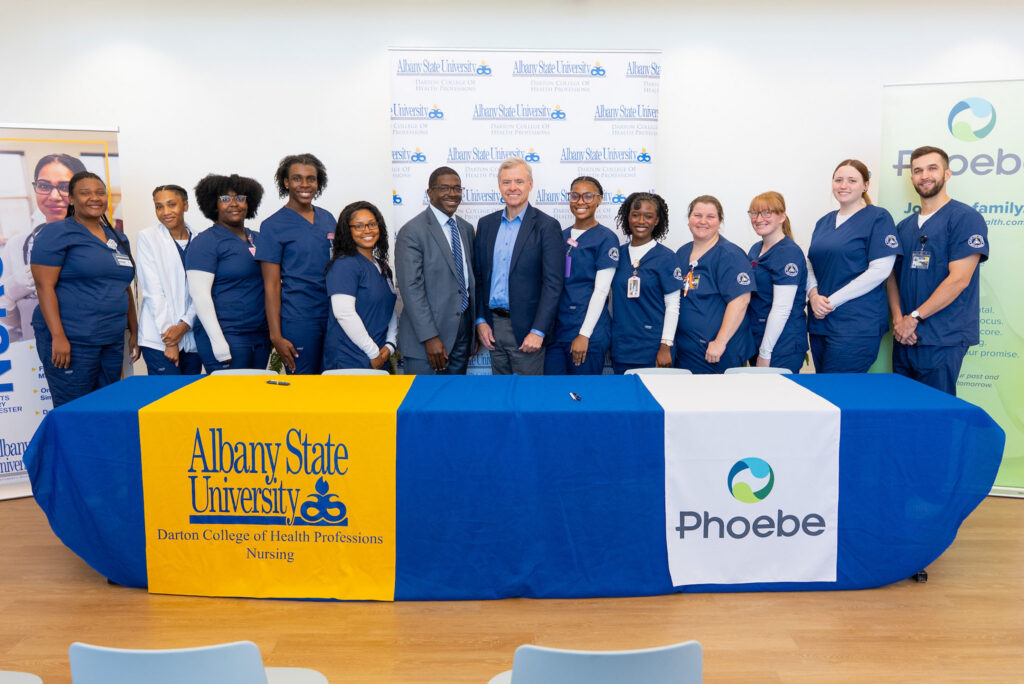
For the students, the “so what” is clear: they gain a financial package and a job in a high-demand field. For the community, it represents a strategic attempt to grow the local workforce from within, rather than relying solely on external recruitment. Scott Steiner, president and CEO of Phoebe Putney Health System, described the partnership as a way to create life-changing opportunities for individuals with a “heart for service.”
Considering the Trade-offs
While the program offers clear benefits, it does require a long-term commitment from the student. By signing a two-year employment agreement, graduates gain job security but limit their mobility in the early stages of their careers. This is a common structure in modern nursing education, but it is one that students must weigh carefully against their long-term professional goals and desire for geographic flexibility.
Albany State University brings a unique history to this endeavor as the first Historically Black College and University (HBCU) in Georgia to establish a nursing program. As the university continues to offer a wide array of nursing degrees—ranging from associate tracks to master’s programs in nursing informatics—this new partnership acts as a specialized layer of support for the working demographic. The success of this collaboration will likely be measured by the number of students who move from the evening classroom to the hospital floor, filling critical gaps in patient care across the region.