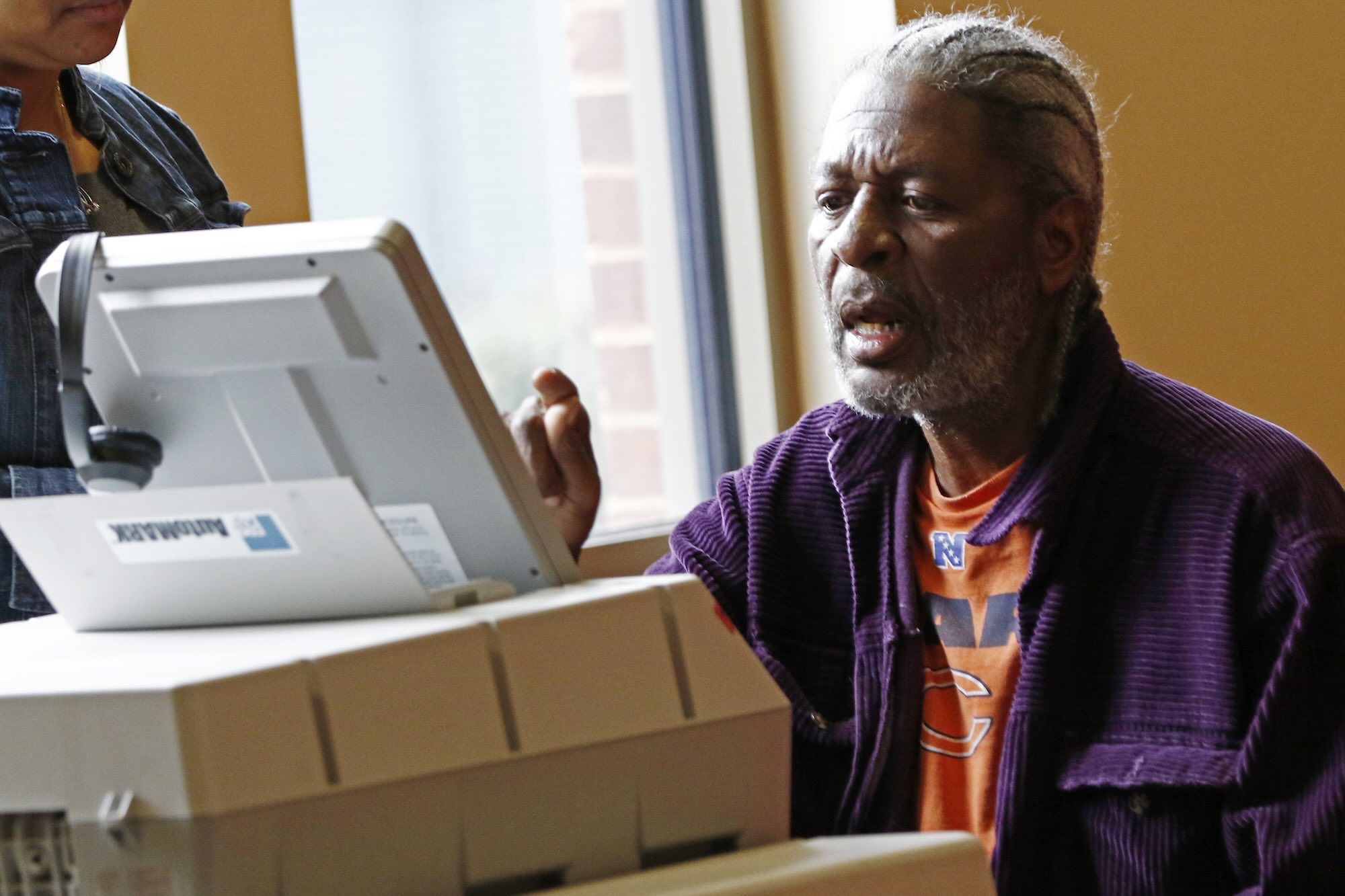
Mississippi voters with disabilities face an uphill battle at polling places across the state, where physical barriers and a lack of oversight frequently compromise equal access on Election Day. With a disability rate of 19.5%—the second highest in the nation and well above the 14% national average—thousands of residents are routinely confronted with infrastructure that falls short of basic legal standards.
Physical Barriers and the Limits of Compliance
Dr. Scott Crawford, a retired neuropsychologist and advocate for people with disabilities in Jackson, encountered a striking example of these persistent hurdles several years ago when he attempted to inspect Chastain Middle School’s gym in Hinds County. A metal bar running directly down the center of the double doors left neither side wide enough for his wheelchair to pass through.
“It’s a non-starter,” Crawford told the Mississippi Free Press on Oct. 26. “I could not get my wheelchair through that double door because neither side was wide enough with that metal bar running down the middle. You need at least a minimum 32” of clearance, but it is preferable to have 34” clear width.”
Ahead of the 2023 primaries, Crawford raised similar alarms about a Hinds County polling place serving 1,585 voters that he described as a metal box. Constructed from a small shipping container, the site lacked adequate interior maneuvering space, featured no guardrails, and included a two-inch lip at the bottom of the ramp alongside an inch-and-a-half gap at the top of the outward-opening door.
Though Crawford notified Hinds County supervisors weeks beforehand, local election commissioners relocated the precinct only hours before the polls opened, following his appearance on local news.
Under the Americans with Disabilities Act, election administrators must ensure specific accessibility measures, including accessible parking spaces, paths at least 36 inches wide with curb cuts, ramps with a slope no steeper than 1:12, and entrances featuring doors at least 32 inches wide. Yet Crawford argues that these minimum standards are fundamentally inadequate.
“I would never go below four feet of width for a path of travel,” Crawford told the Mississippi Free Press. “Because you need two people to be able to pass side-by-side, you know. The technical thing is you need to have a 36” wide path of travel, but that is not sufficient in my view. And so the ADA itself has limitations.”
The Challenge of Church Polling Places and Documentation Gaps
Beyond structural hurdles, administrative oversights compound the problem. Obtaining information from local authorities regarding ADA polling place inspections was frequently a struggle for Disability Rights Mississippi, according to former director Greta Kemp Martin.
Compounding the challenge, churches make up about 18% of all polling places across Mississippi, mirroring the national average of roughly one-fifth. While leading DRMS, Greta Kemp Martin observed that problems with church polling places were common, though she also pointed out that they were “the most likely to go and get the temporary ramps.”
The Mississippi Free Press submitted records requests to counties asking for documentation showing that officials had inspected and ensured their polling places met ADA requirements. None of those counties were able to provide the requested paperwork.
“I was unable to locate any records responsive to the request.”
State officials remain divided on where ultimate responsibility lies. In October 2024, Mississippi Secretary of State Michael Watson stated that county supervisors hold the duty of selecting accessible precincts. On the other side of the issue, Jane Watson Carroll expressed to the Mississippi Free Press that local election officials carry an obligation to maintain ADA compliance, yet in her view,