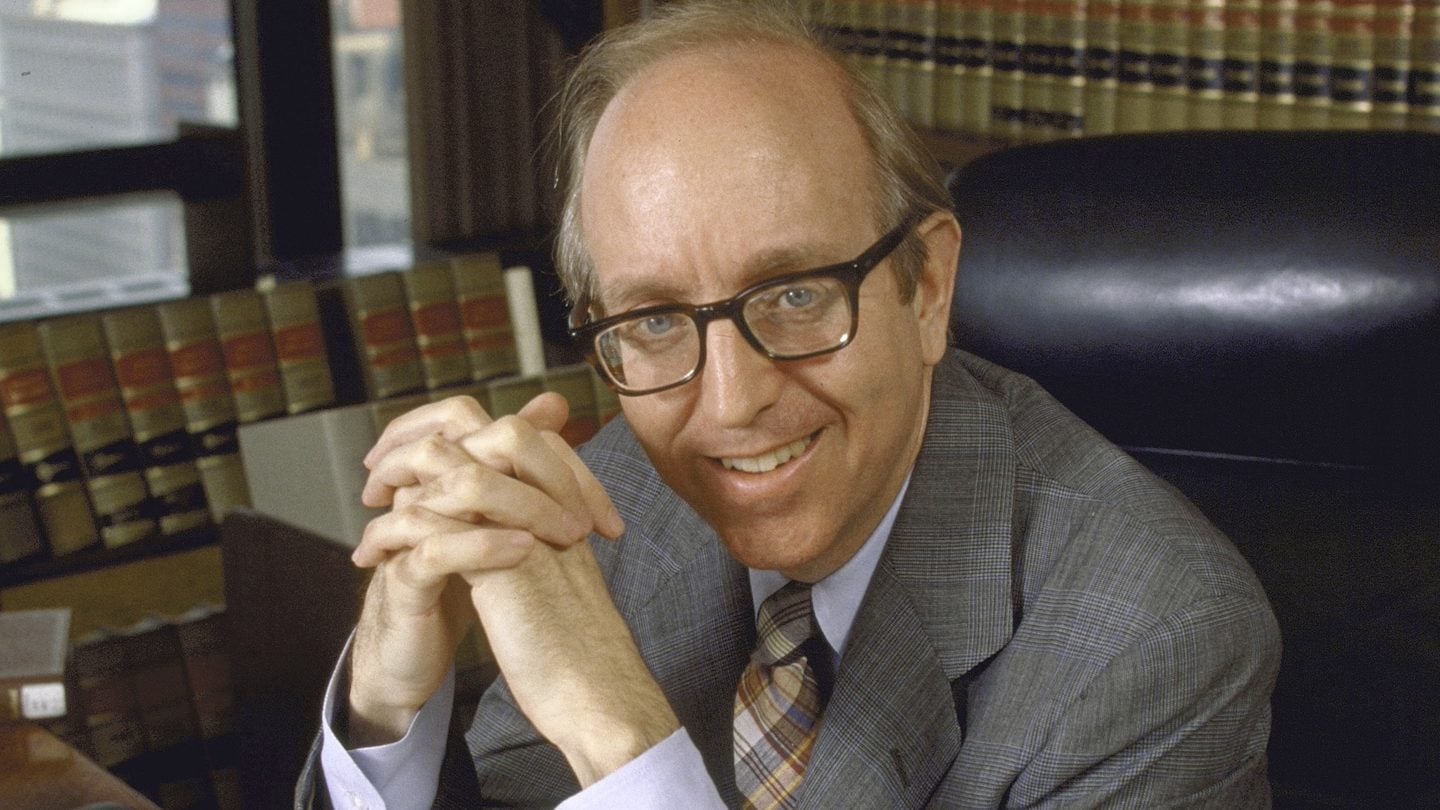
Richard A. Posner, a pioneering legal scholar and former federal appellate judge whose work fundamentally reshaped the relationship between economics and American law, died on November 10 at age 87.
Widely considered one of the most influential legal scholars of the 20th century, Posner left behind a vast body of work, including thousands of judicial opinions and dozens of books. He had largely receded from public view following an Alzheimer’s diagnosis in 2018.
Judge Richard Posner, whose protean intellect, relentless work ethic and startling candor made him a towering figure in the law, dies at 87. @adamliptak https://t.co/oqsbAU0Lf7
Born in New York City in 1939, Posner was the son of a mother with left-wing political leanings. According to a 2000 profile in the Chicago Tribune, his childhood included exposure to radical figures, including acquaintances who adopted the children of Julius and Ethel Rosenberg, the executed Russian spies.
His career began with clerkships for Supreme Court Justice William J. Brennan Jr. In 1965, he became the assistant to Thurgood Marshall, then the U.S. solicitor general and a future Supreme Court justice.
So sad to hear of the death of Richard Posner, a long-time colleague, a good friend, a frequent sparring partner, an enemy of nonsense, a focused consequentialist, a learner and a listener, and a true and constant inspiration.https://t.co/G3kjWPuPtJ
He joined the faculty of the University of Chicago Law School in 1969, where he became a leading figure in the field of law and economics. In 1978, he was named the university’s Lee and Brena Freeman Professor of Law, a title he held until his appointment to the judiciary.
In 1981, President Ronald Reagan appointed Posner to the U.S. Court of Appeals for the Seventh Circuit. He served as the court’s chief judge from 1993 to 2000 and remained on the bench until his retirement in 2017. During his 36-year tenure, he authored approximately 3,300 judicial opinions, often challenging traditional legal thinking with a pragmatic, economic approach.

Before Posner published “Economic Analysis of Law” in 1973, legal scholarship and economic theory were often treated as separate disciplines. Posner’s work served to bridge this gap, arguing that common law doctrines—such as contracts, torts, and property—functioned as if they were designed to maximize economic efficiency. He also served as founding editor of the Journal of Legal Studies.
He authored thousands of court opinions, hundreds of academic articles, and dozens of books, and was a leading scholar of law and economics, a field born and developed at the University of Chicago beginning in the early 20th century.
University of Chicago Law School
His prolific writing included titles such as “The Economics of Justice,” “How Judges Think,” and “A Failure of Capitalism.” His influence reached across generations of legal professionals, and studies have identified him as the most-cited legal scholar of the latter half of the 20th century.
Richard Posner has died. A true giant in the law. I wrote this thread in 2023 in anticipation of today's news. pic.twitter.com/tALs0acxfH
When he encountered arguments he found irrelevant, he was known to cut off counsel with a dismissive “No, no, no!” delivered in a distinct nasal tone.
In later years, he demonstrated a willingness to reconsider his past stances, such as his public admission that Indiana’s voter ID laws imposed real-world burdens on vulnerable voters that outweighed their speculative benefits.
RIP, Richard Posner: a towering figure in American law, he pioneered the field of law and economics @UChicagoLaw, authored 3,300 opinions as a judge on the Seventh Circuit, and wrote widely on varied topics like antitrust and judicial administration. https://t.co/It5ZA5LzZ2
There has never been a legal scholar quite as prolific, influential, and endlessly curious as Dick Posner—he was a giant whose influence on our legal system, the field of law and economics, and on our law school cannot be overstated.
Adam Chilton, Dean of the University of Chicago Law School
His judicial record includes rulings such as his 2014 opinion overturning same-sex marriage bans in Indiana and Wisconsin, and a 2013 decision to block a Wisconsin abortion ban. He is survived by his wife, Charlene, two sons, and four grandchildren.