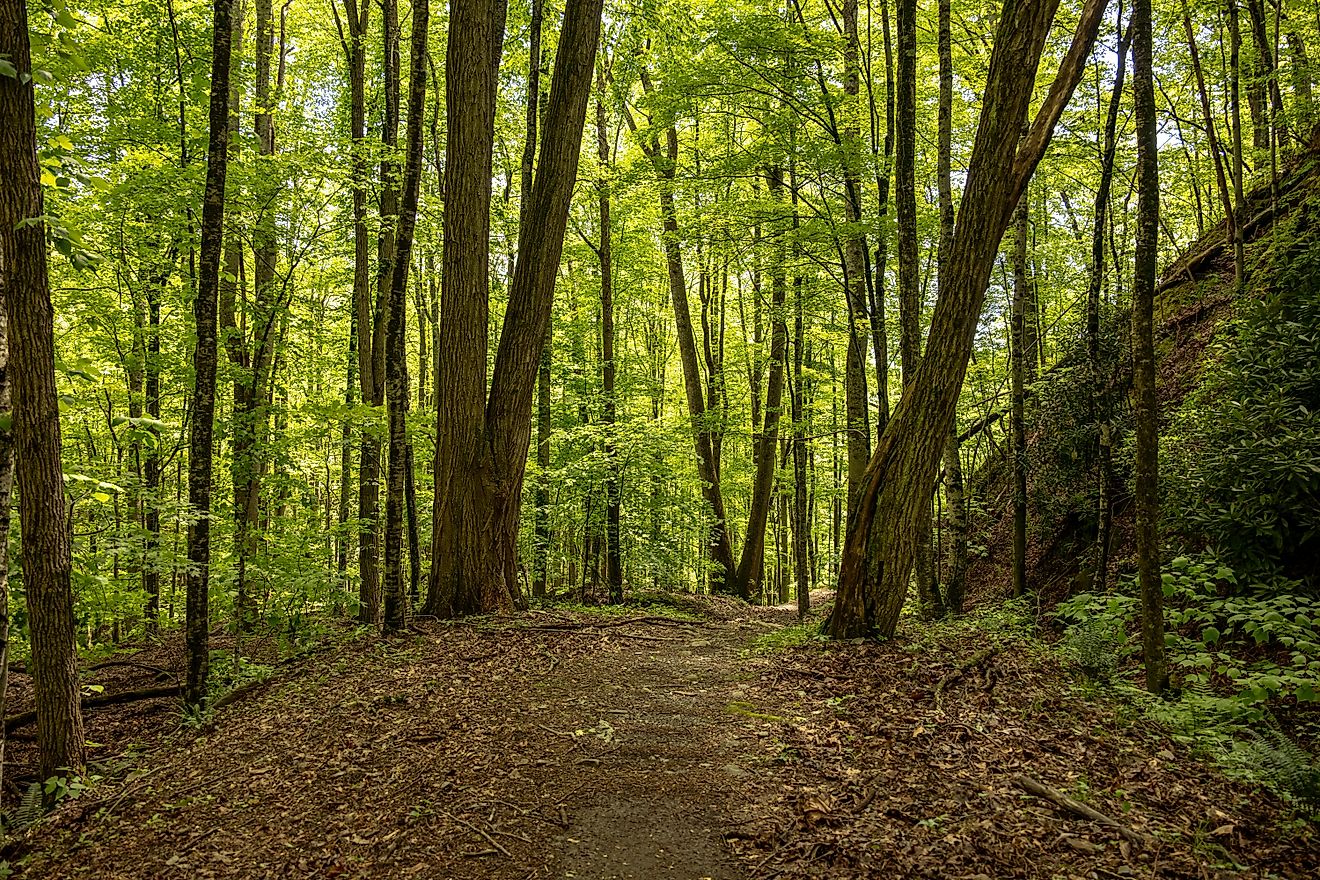
The Fork Ridge Tuliptree claims the title for the tallest tree east of the Mississippi
A single tuliptree growing in a sheltered cove of the Great Smoky Mountains has officially become the tallest known tree east of the Mississippi River. The specimen, known as the Fork Ridge Tuliptree, reached a height of 191.9 feet when measured by a climber dropping a tape down its trunk in 2011. This massive hardwood also stands as the tallest native broadleaf tree ever accurately measured in temperate North America.
The tree’s survival and immense scale are tied directly to its location within the North Carolina side of Great Smoky Mountains National Park. Unlike many surrounding areas that were heavily logged for timber in previous centuries, this specific mountain cove has remained protected for generations. This lack of human interference has allowed the tuliptree—also referred to as the tulip poplar or yellow poplar—to shoot straight toward the canopy in the rich, damp soil of the southern Appalachians.
The physical presence of the Fork Ridge giant is staggering. The tree’s lowest branches do not begin until roughly 85 feet above the forest floor, and its trunk measures more than 5 feet across at chest height. It is a fast-growing species, recognized by its cup-shaped, orange-and-green spring flowers, but the Fork Ridge specimen represents an extreme outlier even for its kind.

A shifting record from the Boogerman Pine to the Fork Ridge giant
For much of the modern era, the record for the tallest accurate tree height in the eastern United States belonged to a white pine located in the park’s Cataloochee Valley. Named the Boogerman Pine after the nearby Boogerman Trail, that tree was measured at 207 feet in August 1995. However, its reign was cut short just weeks later when the top of the tree snapped off during Hurricane Opal, leaving it at approximately 189 feet.
The Fork Ridge Tuliptree finally edged past the damaged pine to claim the top spot. This measurement was made possible by the Eastern Native Tree Society, a group of volunteer tree hunters who utilize more precise methods than older champion-tree records. By working with a National Park Service study team, these volunteers used laser scans of the forest canopy to identify the tallest crowns before hiking into the wilderness to confirm them by hand.
| Tree Name | Species | Recorded Height | Location |
|---|---|---|---|
| Boogerman Pine | Eastern White Pine | 207 feet | Great Smoky Mountains NP |
| Fork Ridge Tuliptree | Tuliptree | 191.9 feet | Great Smoky Mountains NP |
| Pennsylvania Pine | White Pine | 184.2 feet | Pennsylvania |
| Little Foot | White Pine | 174 feet | Adirondacks, New York |
The environmental conditions that foster Appalachian giants
The region provides a specific combination of heavy rainfall, deep and moist soils, and sheltered coves that protect large trees from being toppled by high winds. Because large sections of the park escaped the heavy logging that stripped much of the East’s original forests, these old-growth pockets have had the necessary time to recover and reach unprecedented heights.
While these giants are impressive, they exist in the shadow of the West Coast’s massive conifers. The coast redwoods of Northern California, for instance, can reach heights of 380 feet. However, the tuliptree is a different category of growth; it is a broadleaf tree competing against oaks, maples, and hickories. In its specific ecosystem, the Fork Ridge Tuliptree is a true outlier.
Historical context suggests that the current record holders are actually smaller than their colonial-era ancestors. During the colonial period, the tallest and straightest white pines often exceeded 200 feet and were highly prized as ship masts. Today's tallest trees are found almost exclusively in protected parks and preserves, showing how historical logging permanently changed the eastern terrain.
As tree hunters continue to use advanced canopy scanning technology, the search for the next record holder remains active. Because the most meticulous measuring in the East has only been a widespread practice for a few decades, there is a possibility that an even larger tree remains undiscovered in an unreached Smoky Mountain cove.


