Drilling Starts in Lake County as PG&E Tests a Hilltop Water Battery to Fight Blackouts
If you live anywhere Pacific Gas and Electric strings a wire, you already know the drill. When winds are predicted and moisture levels fall, the power company initiates a Public Safety Power Shutoff—the polite terminology for cutting off electricity to your community to prevent transmission lines from sparking a blaze. On Thursday, October 15, that meant 3,601 customers in Lake County, California, sitting in the dark under a red flag warning, part of what the Press Democrat described as the utility’s biggest planned outage since 2021.
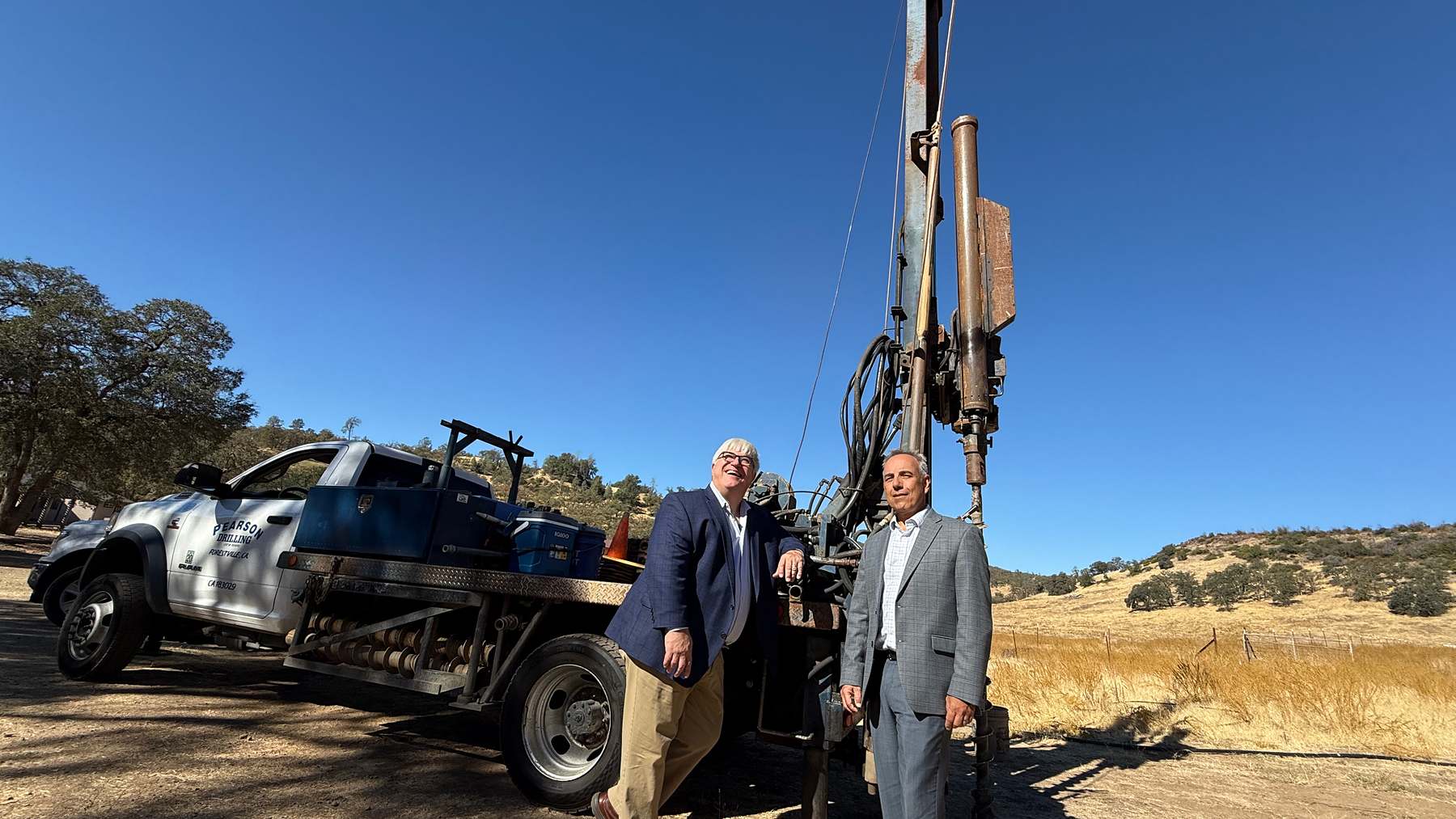
That same Thursday, in the same county, a Forestville contractor operated a drilling rig that extracted core samples from a Hidden Valley Lake hillside to build a water-based energy storage system. This is the kind of battery designed to keep the lights on through exactly that sort of shutoff, with a top tank engineered to double as the fire department’s emergency reserve. The project bears the acronym FLASHES, standing for Firemain Linked Auxiliary Supply/Hydraulic Energy Storage.
The developer behind the effort is Trane Energy Services, the division of Trane Technologies handling energy projects rather than air conditioners. Funding for the initial feasibility study flows directly from PG&E’s Microgrid Incentive Program. That means the very utility cutting the power is footing the bill to find out whether a hill full of water can render those outages obsolete next time around.
How a Damless Water Battery Works on California Slopes
Pumped hydro remains about the oldest trick in the energy storage book. Operators pump water uphill when electricity is cheap and plentiful, then let it run back down through a turbine when demand spikes, letting gravity do the heavy lifting. Traditional setups rely on massive dams and entire valleys. The Lake County version utilizes no dam at all, consisting instead of just two tanks and a hill, as Microgrid Knowledge detailed.

A solar field covering more than 100 acres generates power during daylight hours. That energy runs pumps pushing water from a lower reservoir tank up to roofed tanks at the top of the slope. When evening arrives or an outage strikes, the water drops back down through a turbine to generate electricity. Sealed tanks stop evaporation across this sun-baked summer county, while the supply itself is scheduled to be drawn from a dedicated well that developers informed the Press Democrat could extend past 1,000 feet in depth.
That well represents the entire ballgame for the project. Trane’s Michael Day told Lake County supervisors back in June that the project must prove it pulls water from somewhere other than the local supply relied upon by residents. If the underground geology does not cooperate, the rest of the engineering becomes irrelevant.
Five Million Gallons Reserved Strictly for Wildfire Defense
The fire mitigation angle is what transforms this project from a standard microgrid into a local lifeline, and it is where the name originates. Firemain Linked means the upper tank plumbs directly into the firefighting water system, walling off a portion entirely from the energy generation side. Day explained to the Press Democrat that the upper tank would always maintain 5 million gallons as a never-touch-it emergency fire reserve.
Those 5 million gallons sit above the turbines, pressurized entirely by gravity, ready for fire crews without ever being spun into electricity first. A typical engine tank holds a few hundred gallons, and a rural water district’s entire storage tank often sits well under a million gallons. Having 5 million gallons parked above a subdivision matters immensely in Lake County, a region that has burned repeatedly over the past decade.
Engineering Figures Across Three Proposed Sites
PG&E project manager Madison Hoffacker outlined the design figures for the study across three planned facilities. One facility features 10 megawatts of solar with 40 megawatt-hours of storage, while two feature 20 megawatts of solar with 80 megawatt-hours each. An 80 megawatt-hour plant running flat out at 20 megawatts would last about four hours.
| Facility Target | Solar Capacity | Storage Capacity | Key Infrastructure Details |
|---|---|---|---|
| Hidden Valley Lake | 20 MW (100+ acres) | 80 MWh | 5 million gallon dedicated fire reserve in upper tank |
| Hartley / Lucerne (North Lakeport) | 20 MW each | 80 MWh each | Two upper tanks at 45 million gallons each, one 90 million gallon lower tank, three pipelines to 10 MW generators |
To provide some context, Hidden Valley Lake proper—the body of water that gave the community its moniker—contains roughly 3,500 acre-feet, translating to over a billion gallons. The project utilizes massive engineered tanks rather than natural lakes, but the sheer volume remains substantial.

Feasibility Study Determines Project Viability by Mid-2027
Nothing has been built yet, and the deep well everything depends on remains undrilled. The rig at Hidden Valley Lake was performing geotechnical core boring to examine the composition of the hill. PG&E’s September 17 announcement detailed that the grant pays specifically for core boring, early test wells, and environmental and financial studies.
Day was blunt in telling the Press Democrat that work on October 15 marked a feasibility study rather than actual construction. Trane expects to determine whether the projects pencil out by May or June of 2027. The Press Democrat put the overall proposal at roughly $300 million, a developer estimate rather than a signed construction contract. Lake County has yet to decide whether it wants to own the plants outright or hand them off to an investor, a question the study is meant to resolve.
The backing comes from a $200 million statewide pot approved by the California Public Utilities Commission, featuring $79.2 million allocated to PG&E and a cap of $14 million per project. PG&E noted that developers in the program expect to find about $6 from other sources for every dollar the utility contributes. Whether a 1,000-foot well can keep tens of millions of gallons topped up without draining the local aquifer remains the central question the drilling rig was brought in to answer.