Lincoln’s Final Sedan Hits Rock Bottom
CarBuzz reported that the final Lincoln Continental can now be purchased for roughly $19,000 to $23,000 on the used market. When new, top-tier configurations of this large luxury sedan carried a price tag approaching $70,000.
That steep drop puts the 400-horsepower twin-turbo V6 flagship at the same price point as a used Toyota Highlander from the same model year. Depreciation has been brutal on Detroit’s final traditional passenger car, but that market indifference has created an unusual opening for buyers looking for American luxury.
From High-End Aspirations to Rapid Decline
Lincoln gave its final Continental incarnation equal parts luxury and power starting in the 2017 model year, following the blueprints of the old guard without relying on heavy sporty pretensions. At 201.4 inches long, it sat between a Mercedes-Benz E-Class and a standard-wheelbase S-Class.
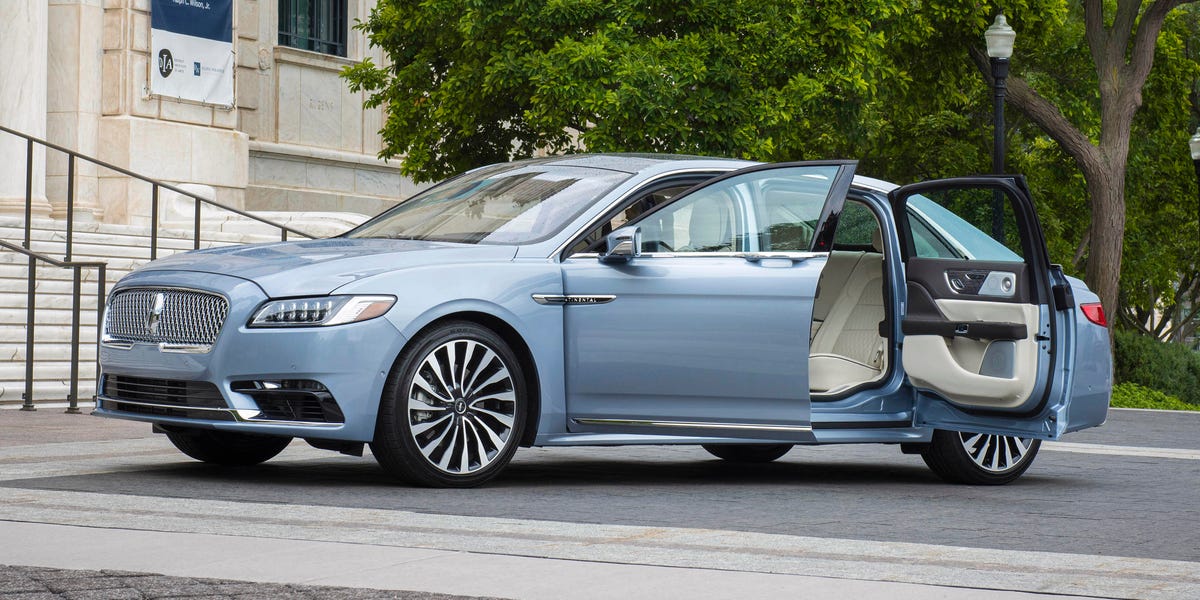
CarBuzz noted that the vehicle’s first full year of sales returned 12,012 units in 2017. That figure bested Cadillac’s CT6 by 2,000 units and tripled Lexus’s LS sales during the same window.
Yet consumer preference had already shifted decisively toward crossovers and SUVs. Even as sales of the Lincoln Navigator climbed, sedan sales dwindled across the brand, prompting the decision to kill the Continental after the 2020 model year.
The Coach Door Collector Paradox
To further differentiate the car against European competitors, Lincoln built just 230 Coach Door Edition models from 2019 to 2020, carrying a price around $115,000 before options. Cabot Coach Builders in Haverhill, Massachusetts, modified fully assembled Black Label Continentals to incorporate rear-hinged doors reminiscent of the 1960s.
While standard high-mileage Continentals now trade for under $10,000, those limited-run Coach Door Editions have proven immune to standard depreciation.
Choosing the Right Engine Variant
Buyers shopping the 2017 to 2020 window face multiple powertrain choices. A 3.7-liter naturally aspirated V6 came standard on Premiere and Select trims, while a 2.7-liter twin-turbo V6 powered other variants. The top-of-the-line 3.0-liter twin-turbo V6 produced 400 horsepower and 400 lb-ft of torque through an all-wheel-drive system.
That same 3.0-liter engine lives on in modern applications like the Ford Explorer ST and Lincoln Aviator, making mechanical parts support straightforward. For buyers wanting a smaller footprint with similar muscle, the concurrent Lincoln MKZ also offered the 3.0-liter engine with 400 horsepower in AWD trim before its own discontinuation in 2020.