“Take a beat. Everybody just needs to chill out for a second,” said Chris Krebs, who ran the Cybersecurity and Infrastructure Security Agency during the first Trump administration, during an appearance on CBS.
Federal Officials Reject Malicious Intent
Director of National Intelligence Jay Clayton dismissed suspicions that malicious activity caused the cascade of system failures. “This is not cyberattack, and this is not a coordinated effort by a nation state,” Clayton told CNBC.
Authorities had looked very closely at the incidents. Secretary of State Marco Rubio echoed those assessments during remarks in Manila, saying that the government has zero evidence indicating the incidents are related.
MULLIN ON OUTAGES: I talked to one guy in the tech industry, he asked not to mention his name, it's not Elon. I asked, what could be causing these outages? He said I believe it's SI, because these programs aren't designed to work as fast as SI is. So when they put in a program… pic.twitter.com/aFwWcVfcm3
Homeland Security Secretary Markwayne Mullin told Fox News that authorities were pushing new technology on top of really old computer systems.
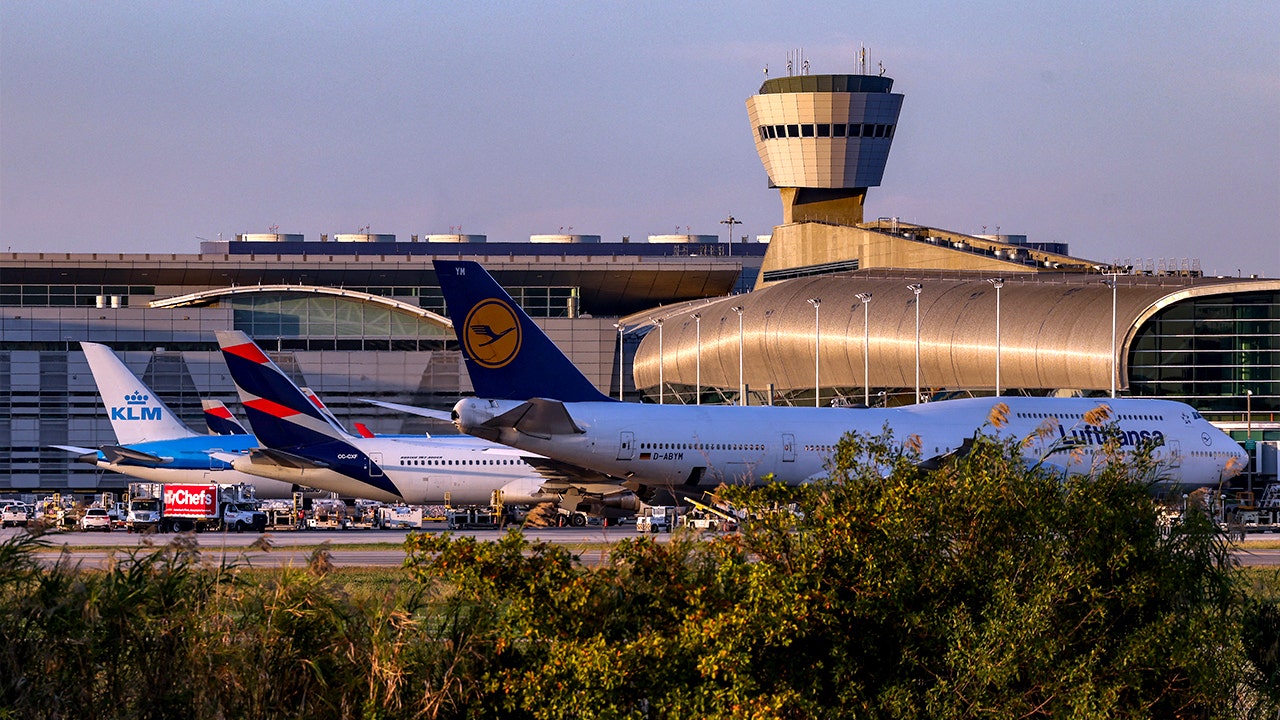
From Friday through Sunday, travelers across the United States faced over 18,000 flight cancellations.
🟡🚨I asked @ONCD's Sean Cairncross about the FAA router outage, United glitch, banking software issue all happening at once and if it could be a cyber attack here at @semafor Silicon Valley and the World conference: “No, this is not any sort of coordinated, nefarious cyber…
Chad Brightbill, traveling through the Patrick Leahy Burlington International Airport in Vermont, told local outlet WPTZ, “I saw a couple of people in tears.”
Another passenger at Albuquerque International Sunport, Maritza Brummer, told KOAT, “I have to get home to my family, so now I’m a little concerned.”
Weird but we still can’t rule out the possibility that everything breaking at once has been a string of coincidences that has nothing to do with AI pic.twitter.com/raUSsDT1bO
A Timeline of Cascading Outages
The disruptions began when Microsoft Outlook went down in the middle of a workday.
The outage cut off email and virtual meetings for millions of users across at least 74 countries. Microsoft later attributed the failure to an undetected bug that had been lurking since July.

The following day, the Federal Aviation Administration ordered a rare nationwide ground stop.
Router updates at sites in Arkansas and Texas overwhelmed aging air traffic control systems.
We are deeply sorry for the disruption this incident has caused our customers and partners. We know the trust they place in our services and take that responsibility extremely seriously. We are seeing broad recovery and stability across our services. This was a technical issue…
Operations at major financial institutions and technology platforms experienced subsequent failures.
- JPMorgan Chase reported transaction slowdowns and account access issues due to a software bug on Monday, according to The Independent.
- United Airlines experienced a brief internal system failure that delayed departures, as reported by the NZ Herald.
- Apple confirmed that services including iCloud, Apple Pay, and Apple Music faced disruptions following an internal update, noted by New York Magazine.
- The National Security Agency experienced a temporary degradation of its classified internal communications network during scheduled routine maintenance, as detailed by CNBC.
Customers of major banks, including Chase, Bank of America and Wells Fargo, started losing online access to their accounts.
JPMorganChase has experienced a temporary issue related to a software bug in on-premise hardware systems – there is no evidence this is cyber-related. It is taking longer than usual to service some customers. Where we were party to a transaction involving other banks, those…
Users experienced issues with Apple services.
Security Experts Point to Accelerated Patching
Officials attributed the events to routine maintenance, bugs, and infrastructure upgrades. Cybersecurity researchers pointed to the rush to patch vulnerabilities before malicious actors can exploit them.
Security researcher Scott Helme discovered malicious code planted via Optimizely on websites belonging to 178 organizations. Hackers stole about $7,000 in cryptocurrency before being ejected, according to the BBC.
“Where most people see conspiracy, I almost always encounter incompetence” –@byjacobward https://t.co/g2ygt126sm
Helme said to the BBC that artificial intelligence is accelerating the pace at which both attackers and defenders operate.
“I would be very surprised if all of these cyber-attacks and the attackers behind them were not using AI to accelerate themselves,” Helme said.
A lot of folks don't realize how much of our computer infrastructure is an improvised system prone to cascading failures. You didn't need offensive AI cyberattacks to have big outages like Microsoft/FAA. Of course, now we DO have to deal with offensive AI (but also defensive AIs)
Paul Wagner, professor at the University of Arizona’s College of Information Science, said that anybody can fall victim to a data breach.
Sheila Pancholi, risk assurance lead at consultancy firm RSM UK, said that the Oracle Java vulnerability shows how dependent businesses have become on a small number of critical technologies.
“.. If this is all a coincidence,” he added, “it’s like the greatest coincidence in the history of the world.”@nytimes https://t.co/SHeIUG6D6m pic.twitter.com/GY4JpXEI2W
Pancholi said that businesses must identify where their critical technology dependencies reside, react swiftly when flaws surface, and verify that their remedial measures have successfully resolved the issue.
Xander Van Raemdonck, security engineer at Aikido Security, said that the challenge lies in knowing whether an organization is exposed.

Interconnected software dependencies leave organizations vulnerable when underlying services falter.
Stuart Madnick, an IT security professor at MIT, told CNN that society runs on background dependencies that remain obscure until failures occur.
“We’re dependent on so many things we’ve never even heard of behind the scenes that keep society running,” Madnick said.
Lawmakers have pressed the administration for further clarity.
Republican Senator Rick Scott posted on X that federal agencies need to be fully transparent about the causes behind the service disruptions.
House Minority Leader Hakeem Jeffries called for congressional briefings to inform the public on necessary infrastructure steps, according to CNBC.
Earlier coverage: Microsoft Services Stabilizing After Global Outage Hits 70 Countries


