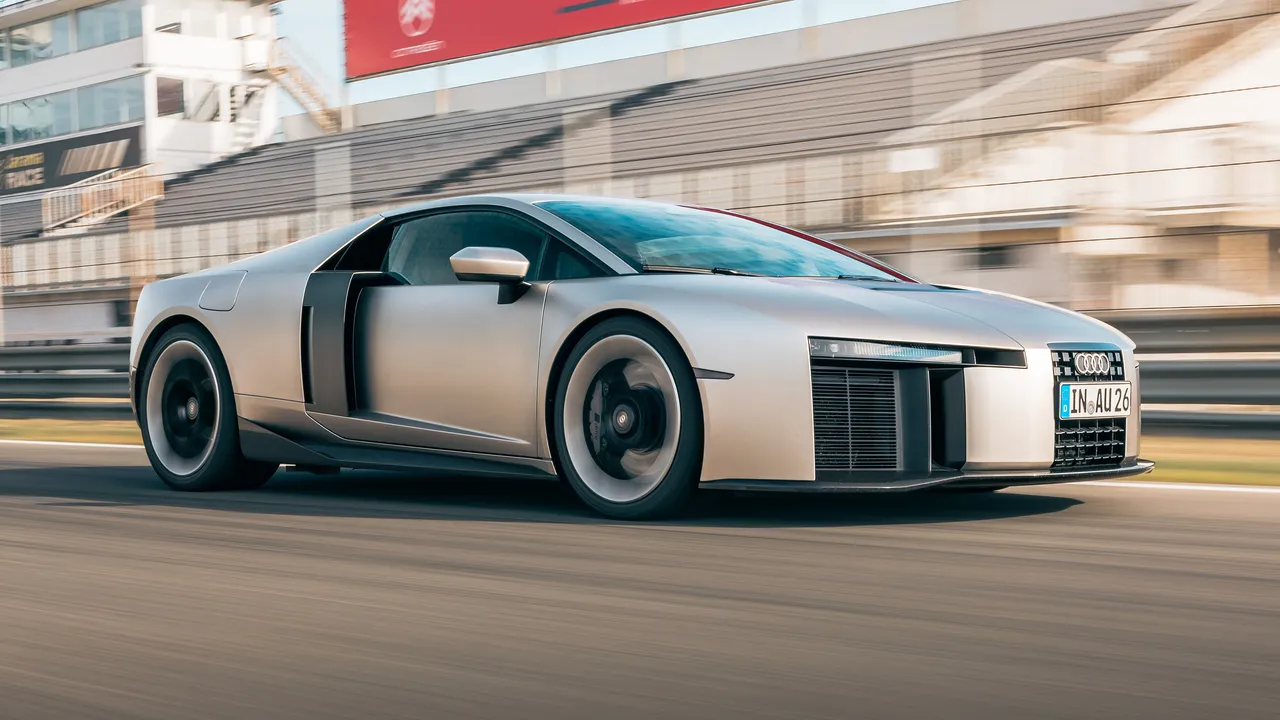
Audi has unveiled the Nuvolari, an ultra-limited supercar powered by a hybrid setup, built in a run of 499 units priced at £526,990 each.
The vehicle serves as a preview of Audi’s new design direction, following the path pioneered by the Concept C.
The story behind the project dates back to March 2025, when a handful of senior engineers and designers hijacked a meeting with Audi CEO Gernot Döllner with a bare idea for a supercar.
The Nuvolari is based on the Lamborghini Temerario. While it shares the same powertrain architecture, the Audi produces 1,001bhp, compared to the 920hp found in its Lamborghini sibling. The setup consists of a 4.0-litre twin-turbocharged V8 engine—which can rev to 10,000rpm—mated to a trio of electric motors. The vehicle is capable of driving on electric power alone for approximately 12 miles.
Performance figures are significant, with the car capable of reaching 0-62mph in 2.6 seconds. It has a top speed of 270mph. Despite the complex powertrain, the car weighs approximately 1,900kg, with 1,750kg cited as the dry weight. Braking is handled by 420mm Brembo CCMR discs clamped by 10-piston calipers.
The exterior design is functional, featuring 20-inch wheels at the front and 21-inch rims at the back. An active rear wing is capable of producing up to 400kg of downforce. There is no plastic to be seen on the exterior; notably, the grilles are machined from aluminium.
The suspension system is passive, developed in collaboration with KW. It features four-way adjustable dampers, though adjustment requires jacking the car up and working from underneath, a process reserved for technicians. The central computer manages traction and power distribution, contributing to a more natural driving feel.
Audi sought to address the V8’s sound. Underberg tells us the aim:

is to take out the noise, but keep the sound. The tunes
While the car is not designed as a track-only machine, reviewers found it surprisingly capable on the circuit. It is described as being friendlier and more balanced than the Temerario, which can feel edgier and more disjointed.
However, some reviewers noted the engine noise can still sound industrial when pushed to high revs, and that for pure track performance, a Porsche 911 GT3 RS may be preferred. Inside, the cabin is stripped of non-essentials like cup holders and door bins.