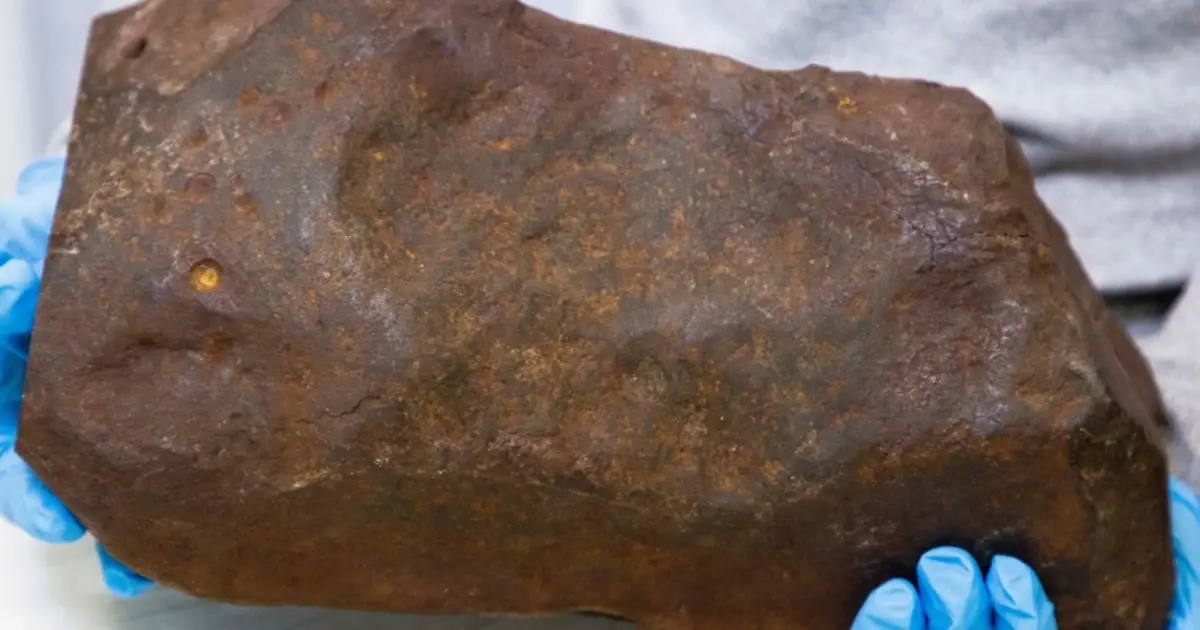
In 2015, a gold prospector in Victoria, Australia, discovered a very heavy, reddish rock while scanning Maryborough Regional Park with a metal detector.
David Hole took the heavy stone home, convinced it contained a gold nugget. The area sits squarely within the state’s Goldfields region, where a massive nineteenth-century gold rush left generations of prospectors searching the local clay and gravel.
For years, however, the object resisted every attempt to crack it open. Hole tried an angle grinder, a rock saw, a heavy drill, and an acid bath, but not even a sledgehammer could make a crack.
Melbourne Museum Identified the Space Rock
Hole eventually brought the stubborn stone to the Melbourne Museum for expert identification. Museum geologists quickly realized that the dense specimen was no gold nugget, but a rare meteorite.
“It had this sculpted, dimpled look to it,” Melbourne Museum geologist Dermot Henry told The Sydney Morning Herald in 2019, describing how atmospheric melting shapes incoming space rocks during descent.
Henry had examined thousands of rocks across thirty-seven years at the institution, yet only two offerings had ever turned out to be real meteorites. Bill Birch, now curator emeritus at the museum, said that an ordinary Earth rock of that size and type should not be nearly so heavy.
Researchers Analyzed the Maryborough Meteorite
Researchers published a scientific paper in the Proceedings of the Royal Society of Victoria detailing the 4.6 billion-year-old specimen, which they named Maryborough after the nearby town. The stone weighs a whopping 17 kilograms, or 37.5 pounds.
In some meteorites, there is ‘stardust’ even older than our Solar System.
Dermot Henry, geologist
After cutting a small slice with a diamond saw, investigators found a high percentage of iron within its composition, classifying the find as an H5 ordinary chondrite. The cut surface revealed tiny crystallized droplets of silicate minerals called chondrules distributed throughout the matrix.
Victoria Recorded Seventeen Rare Meteorites
Scientists estimate via carbon dating that the meteorite has rested on Earth for less than one thousand years. Henry said that this is only the 17th meteorite found in Victoria, making it significantly scarcer than the thousands of gold nuggets recovered in the region.
The specimen stands as the second-largest chondritic mass recorded in the state, trailing a 55-kilogram specimen identified in 2003. Researchers suggest the object most likely originated in the asteroid belt between Mars and Jupiter before an asteroid collision nudged it toward an eventual impact on Earth.
Ancient Material Inside the Meteorite
Geologist Dermot Henry said that some meteorites contain stardust predating our Solar System. Museums Victoria pointed out that meteorites offer the cheapest form of space exploration for researchers.
Investigators used a diamond saw to remove a small slice, discovering that a high percentage of iron makes up its composition and classifying the heavy specimen as an H5 ordinary chondrite. Once opened, the interior reveals tiny crystallized droplets of silicate minerals known as chondrules distributed throughout the mass.
Dating the Specimen and Tracing Its Origins
Researchers applied carbon-14 dating to estimate that the meteorite possesses a terrestrial age of less than one thousand years.
Henry explained that the rock most likely originates in the asteroid belt situated between Mars and Jupiter. He added that an asteroid collision first nudged the object out of that region before it ultimately smashed into Earth.
Terrestrial Timeline and Discovery Context
Carbon dating points to a terrestrial age of under one thousand years for the dense visitor. Records show multiple meteor sightings between 1889 and 1951 that could potentially align with its arrival on the planet.
Victoria’s Goldfields region, where the Maryborough meteorite was found in 2015, was reshaped by the 1850s and 1860s gold rush that dramatically increased the state’s population and wealth, leaving generations of prospectors searching local clay and gravel with metal detectors.
Experts observe that meteorites supply the cheapest form of space exploration available to science. Investigators said that unearthing the iron-rich object under such unlikely circumstances was quite astronomical.