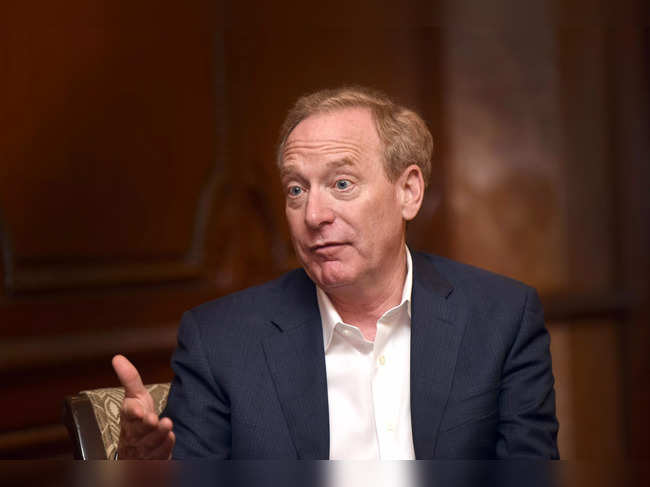
Microsoft President Brad Smith has called for urgent regulation of artificial intelligence, warning that the technology currently lacks oversight compared to household goods.
A Call for Urgent Oversight
Right now, AI is less regulated than your washing machine, it is less regulated than a carton of milk,
Smith said. He emphasized that the industry cannot afford to remain on the sidelines, stating, I think the time to act is now. Let’s not wait until it’s beyond our ability to solve.
Smith’s assessment reflects a broader societal anxiety, as recent data indicates that six in ten people in the UK believe artificial intelligence will destroy more jobs than it creates. While Smith remains optimistic that future employment is possible, he acknowledged that a period of significant upheaval is coming. He advocated for government intervention to help people manage this transition, suggesting that authorities must ensure the workforce has the right skills to adapt. He also proposed taxing companies that use AI or robots to replace human labor, and suggested that certain professions—specifically teachers, doctors, judges, and care workers—could require protection from being performed by AI.
Trump Dismisses Concerns over Artificial Intelligence Risks
The regulatory debate is complicated by significant political friction. President Donald Trump has lashed out against concerns regarding rogue artificial intelligence, claiming that efforts to limit the technology are part of a SICK conspiracy.
In a series of social media posts, Trump declared, AI taking over the World, destroying Humanity, and all other things bad, is a HOAX.
He further maintained that his presence in the Oval Office should assuage any fears, stating, The only control or ‘guardrails’ that AI needs is a STRONG AND SMART (High IQ!) PRESIDENT, and the U.S.A.
Trump’s approach involves opposing constraints that he claims could cause China to eclipse America in the technological race. According to social media posts and videos, Trump and Nvidia CEO Jensen Huang agreed that there is excessive alarmism surrounding the technology. The president has long resisted greater government oversight, having revoked a Biden administration executive order on AI during his return to the White House before providing a new order 16 months later. Vice President JD Vance has also expressed skepticism toward the motivations of tech companies, noting that it feels like a Trojan horse
when frontier AI firms come to the government to beg for regulation.
International Cooperation
Despite the domestic political divide, Smith emphasized that America must win the race against China. However, he maintained that the United States must balance this with the need for international cooperation and collaboration
to introduce necessary safeguards. I think that this is the time when this government and the country
can position itself to lead, Smith stated.
Throughout the discussion, Smith was careful to avoid direct criticism of the president, even while noting the urgency of the situation. He acknowledged that President Trump is right to say we don’t want to slow innovation,
yet reiterated that the lack of current regulation remains a critical vulnerability. As the industry faces scrutiny—including reports of OpenAI delaying the release of models due to security concerns and calls from figures like Elon Musk to slow development—the path forward remains uncertain.