
November’s full moon lit up twilight skies on November 24 as a Beaver Moon and the first of four consecutive supermoons.
- The November 24 supermoon reached peak illumination at 9:53 a.m. EST, sitting about 224,170 miles from Earth.
- The lunar event is the first of four consecutive perigee full moons running through February 2027.
- December’s upcoming Cold Moon will bring the closest, largest, and brightest full moon of 2026.
The Mechanics of the Beaver Supermoon
A supermoon occurs when a full moon coincides with perigee, the closest point in the moon’s 27-day elliptical orbit around Earth. A supermoon appears roughly 7 percent bigger and up to 14 percent larger and 30 percent brighter than an ordinary full moon. Sunlight travels through thick atmosphere near the horizon, where Rayleigh scattering removes short blue wavelengths.
The Moon takes approximately 27.5 days to return to perigee and about 29.5 days to finish a full phase cycle. Kevin Lewis, vice chair and professor of Earth and planetary sciences at Johns Hopkins University, said overlapping time frames allow full moons to align with close orbital approaches several months in a row.
Noah Petro said that the full moon appears roughly 17 percent larger and 30 percent brighter than the smallest full moon of the year. Carys Herbert, an astronomer at the Royal Observatory Greenwich, explained that stricter guidelines define supermoons as occurring when the moon sits within roughly 223,694 miles of Earth.
Photographers Capture Global Views of the Lunar Display
Skywatchers around the globe captured the lunar disk as it climbed into autumn skies.
Moonset today from space station – no edits to these photos from 400mm lens pic.twitter.com/OrlShgArwP
Allen Berman tracked the moon over downtown Los Angeles in Southern California. “Finding the right spot for tonight’s full moon over downtown Los Angeles was a bit tricky,” Berman told Space.
“We wound up on a neighbor’s front lawn in the Baldwin Hills section of town. The owner was a bit surprised to see photographers there. But he was cool. The conditions were perfect with thin clouds over the distant mountains that made for a magical image.” Salih Zeki Fazlioglu captured a colorful photograph of the Beaver Moon illuminating a thin veil of clouds above Istanbul, Turkiye, as reflected sunlight competed with the city’s artificial glow.
Other photographers framed the Beaver Moon against architectural landmarks, including the Parthenon in Athens, the Wat Phra That Doi Suthep Buddhist temple in Chiang Mai Province, and the Old Post Office Pavillion in Washington, D.C. Pongmanat Tasiri photographed the moon rising over the roof of the Wat Phra That Doi Suthep.
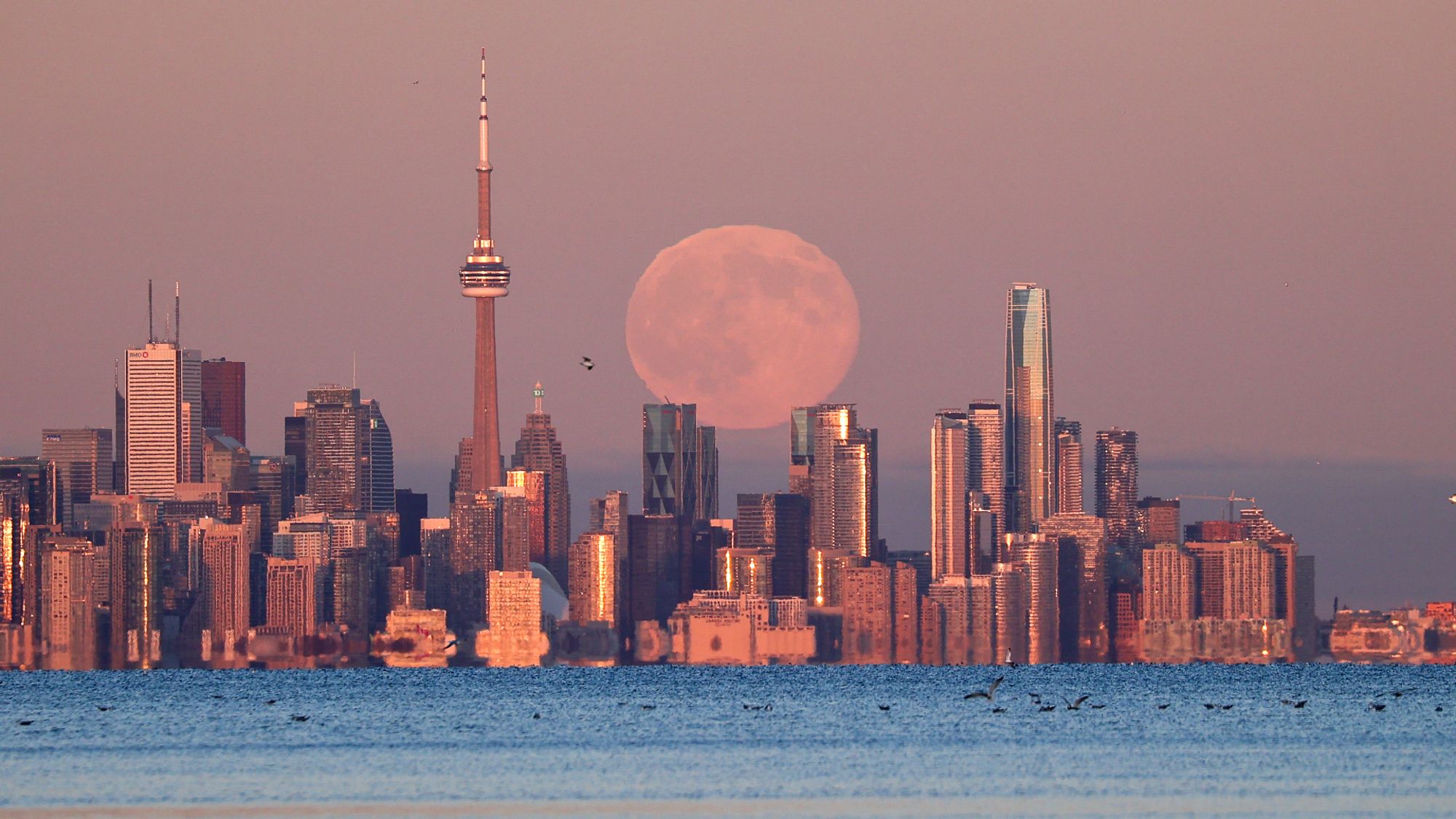
Mert Alper Dervis photographed the full moon rising above the Toronto skyline with a flock of birds in the foreground. Gary Hershorn captured the yellow moon rising over the Chrysler Building in New York alongside the Empire State Building.
Folklore and Coastal Tides Across New England
The traditional name Beaver Moon originates from the period when beavers shore up their lodges for winter and trappers set traps before waterways freeze over. The November full moon is also called the Frost Moon, Freezing Moon, Snow Moon, Trading Moon, Deer Rutting Moon, or Whitefish Moon.
Jonathan Erdman said that halos around the full moon, produced when moonlight bends through ice crystals in clouds, are traditionally said to signal snow or rain within a day or two, whereas a bright and sharp-edged moon points toward a cold and dry stretch ahead.
The alignment of the sun, Earth, and moon produced astronomical high tides known as king tides. These tides reached about 12 feet in Boston Harbor, pressing close to the 12.5-foot flood stage and raising concerns among meteorologists regarding coastal flooding ahead of incoming holiday storm systems. Brian Lada writes for AccuWeather that the alignment produces full moons causing a greater difference between high and low tides than usual.
Forecasting Tides and Cultural Monikers
Ada Wood said the historical name stems from late autumn traditions when beavers work to fell trees and early trappers secured pelts for trade, with alternative regional designations including the Whitefish Moon.
November's full moon will be the first of four back-to-back supermoons. Here's when the beaver moon rises. https://t.co/TPjusj5eGW
The gravitational pull of these alignments influences ocean tides. Kevin Lewis said that full moons contribute to larger high tides.
Tracking the Upcoming Sequence and Distances
Ada Wood said we get three to four supermoons a year back to back.
Carys Herbert told BBC Newsround that taking a stricter definition for holiday coincidences means the most recent Christmas Eve full moon perigee was in 1787, though a more generous definition includes 2007 and 1912.
Viewing Upcoming Supermoons in the Four-Part Sequence
The November event opens a quartet of perigee full moons. December’s Cold Moon will reach peak illumination on December 23, offering the closest approach of the year at about 221,667 miles from Earth, making it the closest full moon since January 2018.
Subsequent supermoons will follow on January 22, 2027, with the Wolf Moon, and February 20, 2027, with the Snow Moon. Jamie Carter said that the second supermoon in the series falls on Christmas Eve as the closest full moon to Earth since 2018.
November's full moon will be the first of four back-to-back supermoons. Here's when the beaver moon rises. https://t.co/dky30GzN5J
More on Beaver Moon
November's full moon will be the first of four back-to-back supermoons. Here's when the beaver moon rises. https://t.co/6dsKlEd0OD