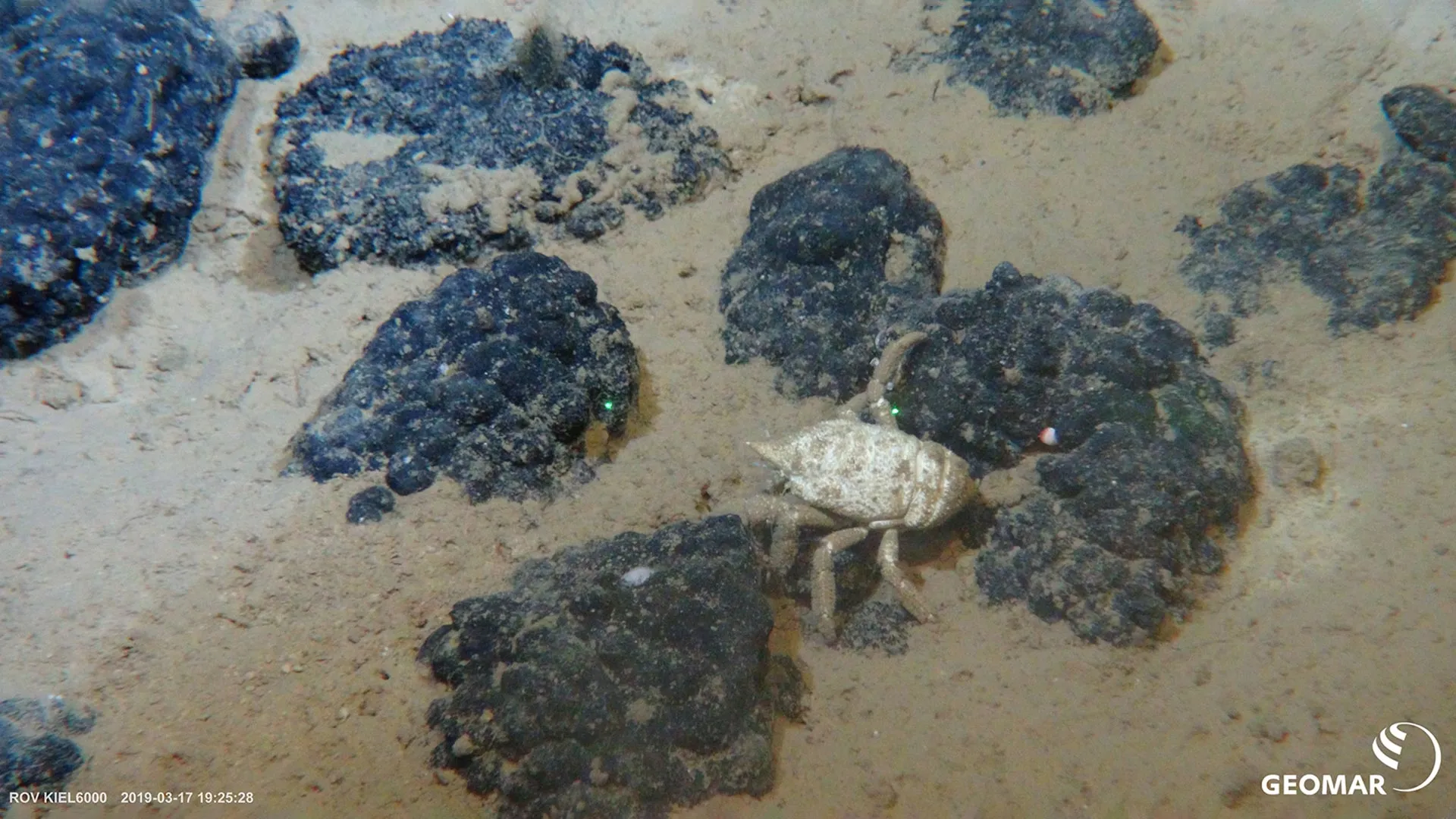
Miles beneath the surface of the central Pacific Ocean, metal-rich rock formations strewn across the abyssal plain are harboring thousands of tiny, living creatures inside their hidden pores and cracks.
A new study published in Scientific Reports reveals that potato-sized polymetallic nodules function as miniature three-dimensional shelters for organisms smaller than a millimeter, sparking urgent warnings from marine scientists regarding the potential consequences of commercial deep-sea mining.
The research details how these strange rock formations, which take millions of years to grow as dissolved metals slowly accumulate around ancient debris, create hard surfaces and internal habitats in an environment otherwise dominated by soft mud.

“We already knew that polymetallic nodules provide attachment surfaces for deep-sea organisms, but very little was known about the animals living inside them,” marine genomicist Coral Diaz-Recio Lorenzo told ScienceAlert. While scientists have long known that creatures attach to the outside of these nodules, the recent analysis of 244 individual rocks collected from the Clarion-Clipperton Zone found bustling ecosystems thriving entirely within their internal crevices.
During the investigation, researchers discovered that each nodule sheltered an average of 17 animals, with one exceptionally crowded specimen containing 245 individual lifeforms. The inhabitants ranged from single-celled species to roundworms and small crustaceans.
“In our study we show that the sizes of cracks inside the nodules are large enough to provide home to animals that are smaller than a millimeter in size,” said Tanja Stratmann, a deep-sea ecologist and one of the study’s three lead authors from MARUM—Center for Marine Environmental Sciences at the University of Bremen, according to Science Daily.
Polymetallic nodules provide a distinct habitat for abyssal meiofauna Diaz-Recio Lorenzo et al.https://t.co/S0a9yagvF0 pic.twitter.com/qsYTF3POfz
— Post by @EntAntony on X
Although the muddy sediment surrounding the rocks contained a higher volume of life overall, the communities living inside the nodules were distinctly different from those found in the soft seafloor. Certain organisms, such as the single-celled armored amoeba species Thurammina sp. 1, appeared uniquely adapted to life within the rock crevices and were not encountered in the surrounding sediment.
“The crevices in the polymetallic nodules function as small shelters and provide home to animals that we do not encounter in the soft sediment of the seafloor,” said Coral Diaz-Recio Lorenzo, a co-lead author and marine genomicist from the Royal Netherlands Institute for Sea Research, according to Yahoo.
The specimens analyzed in the study were collected in 2019 during an expedition to the Clarion-Clipperton Zone at depths of 4,000 to 6,000 meters—roughly 2.5 to 3.7 miles—aboard the German research vessel RV Sonne, as part of the JPI Oceans Mining Impact II project, according to ScienceAlert. Researchers used box corers and diving robots to retrieve the samples, which were subsequently frozen and dissected in laboratories.
The findings affect commercial interest in harvesting the ocean's mineral resources. Because polymetallic nodules require geological timescales to form, new ones do not regrow within a human lifetime. Scientists emphasize that commercial mining operations could permanently eradicate these specialized micro-habitats before researchers fully understand their role in global marine ecosystems.
“Our findings point out that commercial mining may result in an irreversible loss of undescribed and unique biodiversity associated to nodules,” said Sabine Gollner, senior author of the study from the Royal Netherlands Institute for Sea Research, according to Ocean News & Technology. “This needs to be considered in environmental management of deep-sea mining.”