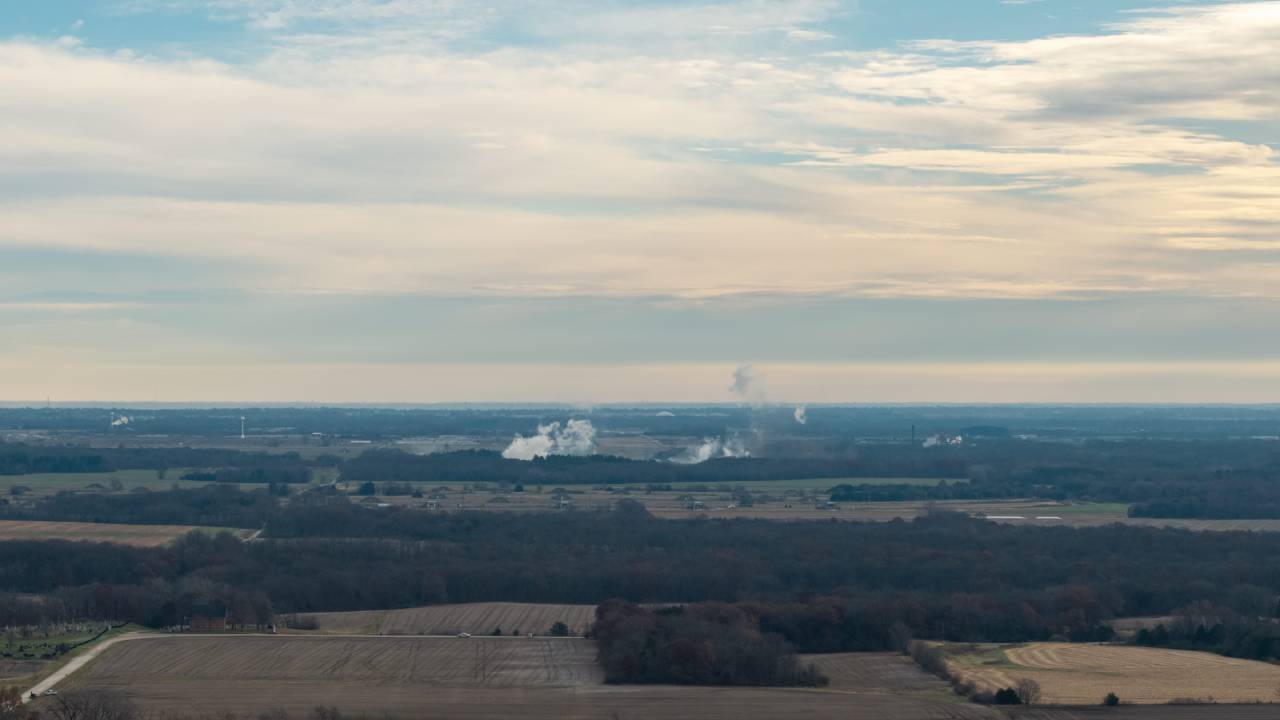
The U.S. Army detonated the nation’s entire stockpile of lead azide at the Iowa Army Ammunition Plant in Middletown, Iowa, carrying out a controlled blast at approximately 9:00 a.m. CST.
Officials declared the operation a huge success after weeks of public anxiety, legal battles, and evacuations surrounding the dangerously degrading explosive material.
Army Destroys Lead Azide with Containment
The controlled explosion destroyed roughly 5 tons of lead azide stored across 68 degrading plastic barrels. To prevent toxic dust from escaping, the military encased the bunkers in two-story-high earthen barriers, deployed ballistic gels, and poured thousands of gallons of aqueous foam and water over the site.
Maj. Gen. Eric Shirley, commander of the Army Sustainment Command, said that the operation reduced risk as close to zero as humanly possible.
I believe, absolutely, that we reduced, as close to zero as it’s absolutely humanly possible, the risk to the health and safety of the people of Middletown and the extended communities throughout Iowa.
Maj. Gen. Eric Shirley, commander of the Army Sustainment Command
Acting Secretary of the Army Adam Telle echoed that sentiment on social media, writing that the mitigation efforts exceeded all expectations and eliminated the threat of an unplanned, spontaneous detonation.
The compound is sensitive to shock, heat, impact, and friction, and it can explode when dry. Staff discovered during a routine inspection in March that the lead azide had partially crystallized, creating the risk of spontaneous detonation.
Robert Cekada, director of the Bureau of Alcohol, Tobacco, Firearms and Explosives, said that the stockpile had been transported to Iowa in 2009 from military installations nationwide. Following expert consultations, the Army concluded that a controlled detonation offered superior safety compared to alternatives like thermal treatment or neutralizing the contents of the drums.
Although initially slated for the prior Friday, the controlled explosion was rescheduled three times to accommodate safer wind conditions and additional precautions. The Army ultimately proceeded on Wednesday because winds blew southwestward, directing emissions away from populated locations such as Burlington, a Mississippi River municipality with a population just under 25,000.
The military did not livestream the Iowa detonation, but filmed Wednesday morning’s controlled detonation and made the footage and photos available as soon as possible, providing updates on its social media accounts while keeping media outlets and others more than 4 miles away from the blast site.
At 9:00am CT, @USArmy Sustainment Command executed the controlled mitigated detonation at the Iowa Army Ammunition Plant in Middletown, Iowa. ALL EPA real-time air monitors are reporting ZERO detection of airborne lead throughout the region. EPA monitors never stopped collecting…
Colonel Aaron Teller, a munitions specialist who oversaw the operation, said in a videotaped public service message posted online afterward that the demolition and the array of containment measures to muffle the blast and emissions had worked.
EPA Monitors Detect No Airborne Lead
In the hours following the detonation, environmental monitors deployed by the Environmental Protection Agency recorded no detectable traces of lead in the air across impacted areas in Iowa and Missouri. EPA Administrator Lee Zeldin reported that all EPA air monitors continued to report a zero detect of airborne lead.
UPDATE: Our EPA team has now been scaled up to 209 personnel on the ground in Middletown, Iowa, and we will be over 300 by tomorrow. We have now collected 1,216 samples ahead of tomorrow’s controlled lead azide detonation at the Iowa Army Ammunitions Plant: 650 soil samples 297… https://t.co/SoksHujBrA pic.twitter.com/3iAjG8DX55
More than six hours after the blast occurred at the Iowa Army Ammunition Plant, the Federal Emergency Management Agency disseminated a mobile phone alert in the late afternoon to inform all residents that earlier shelter-in-place directives were lifted and normal routines could resume safely.
Despite the reassuring initial readings, independent experts cautioned that ground-level contamination testing would take considerably longer. Jun Wu, an environmental health professor at the University of California at Irvine, said that while airborne monitors are accurate where they sit, they cannot alone tell us how much lead settled on the surrounding soil and water sources.

Environmental Protection Agency personnel were dispatched to Middletown, Iowa, to conduct air, water, and soil testing throughout the area prior to, during, and after the Army’s controlled detonation. The Iowa Department of Health and Human Services said that it believes the risk of breathing in harmful amounts of lead from this event is low.
Governor-Elect Criticizes Chaotic Emergency Response
Iowa and neighboring states deserve a full accounting of why the situation was allowed to get to the point of crisis.
Sarah Green, executive director of the Iowa Environmental Council
Governor Kim Reynolds shared updates from the operation site, confirming that state experts viewed the detonation as successful. However, Governor-elect Rob Sand criticized the handling of the emergency.
Initial feedback from our state experts and federal partners is that the detonation at the Iowa Army Ammunition Plant was successful. We remain in close contact with authorities on the ground, while state agencies continue to monitor incoming data from the State Emergency… pic.twitter.com/l6k5xT43vq
“The lead-up to the detonation should never have been so chaotic and unclear,” Sand wrote in a statement, adding that Iowans across the state were understandably alarmed.
“Iowans across the state are understandably alarmed and scared,” Iowa Gov.-elect Rob Sand said.
EPA has been on the ground in Iowa BEFORE the controlled detonation, we will be here DURING the detonation, and we will be here for as long as necessary AFTER detonation to ensure communities are safe. With over 1,200 air, land, and water samples already conducted, and 300…
FEMA Orders Middletown Evacuation Until Friday
Out of an abundance of caution, FEMA supported the recommended relocation for all residents of Middletown, Iowa, and immediate surrounding impacted areas commencing on Tuesday, November 24, 2026. An emergency notification sent to cellphones Tuesday morning advised those within that zone that they might be evacuated, while the Centers for Disease Control and Prevention urged residents to either stay indoors or evacuate if they were in the evacuation zone.
Residents were advised to remain relocated until Friday at the earliest, with the Army stating in an advisory posted Tuesday that evacuated individuals would be notified by phone once the all-clear was given and at that point could return home at their convenience.
The controlled, mitigated detonation of the lead azide stored at the Iowa Army Ammunition Plant has taken place. Initial analysis shared with us by federal partners and Iowa Homeland Security and Emergency Management indicates that the mitigation measures appear to have been…
Farmer David Vandenberg, who lives around 20 miles from the site, said the Army Corps of Engineers took samples from his yard and pond on Tuesday. He mentioned hearing a rumble about nine o’clock on Wednesday morning but did not see or smell anything, describing it as nothing and noting he was happy to see the blast was relatively contained.
Other nearby residents expressed lingering anxieties about environmental risks. Lucy Giehl, who lives nearby in West Burlington, said that she does not think lead danger goes away any time soon and felt someone might have thought about all of it a little sooner before it came to that point.
The Army’s controlled, mitigated detonation exceeded all expectations and was a HUGE success. The threat of an uncontrolled spontaneous detonation has been eliminated. I am so proud of our SOLDIERS for their courage, training, mitigation, and precision! They put it on the line…
Representing Earthjustice and its clients, attorney Thien Chau maintained that local residents had consistently warranted greater transparency and stronger safeguards against the hazardous lead plume. Meanwhile, President Donald Trump posted on social media that the Army did a great job during the operation.
Earlier coverage: U.S. Army Detonates Degraded Lead Azide in Controlled Iowa Blast
There is obviously more testing to do that will provide certainty over time, but for now, federal officials have reported that lead dispersal should be limited, Iowans are safe, and damage to property is limited. I’m grateful to the experts on the ground who did all they could to…
More on U.S. Army
It is clear: the delay we secured for the IAAAP detonation in Middletown was incredibly important. But it should not have taken public outcry for the federal government to put in place every mitigation measure possible to protect the health and safety of Iowans. The failure of…
U. S. Army personnel are on site in Middletown, Iowa, and have worked around the clock to mitigate the impacts of the planned controlled detonation later this morning. This includes a water wall filled with more than 100,000 gallons of water, earth berms, sand filled blocks,… pic.twitter.com/eQa3erwlXj