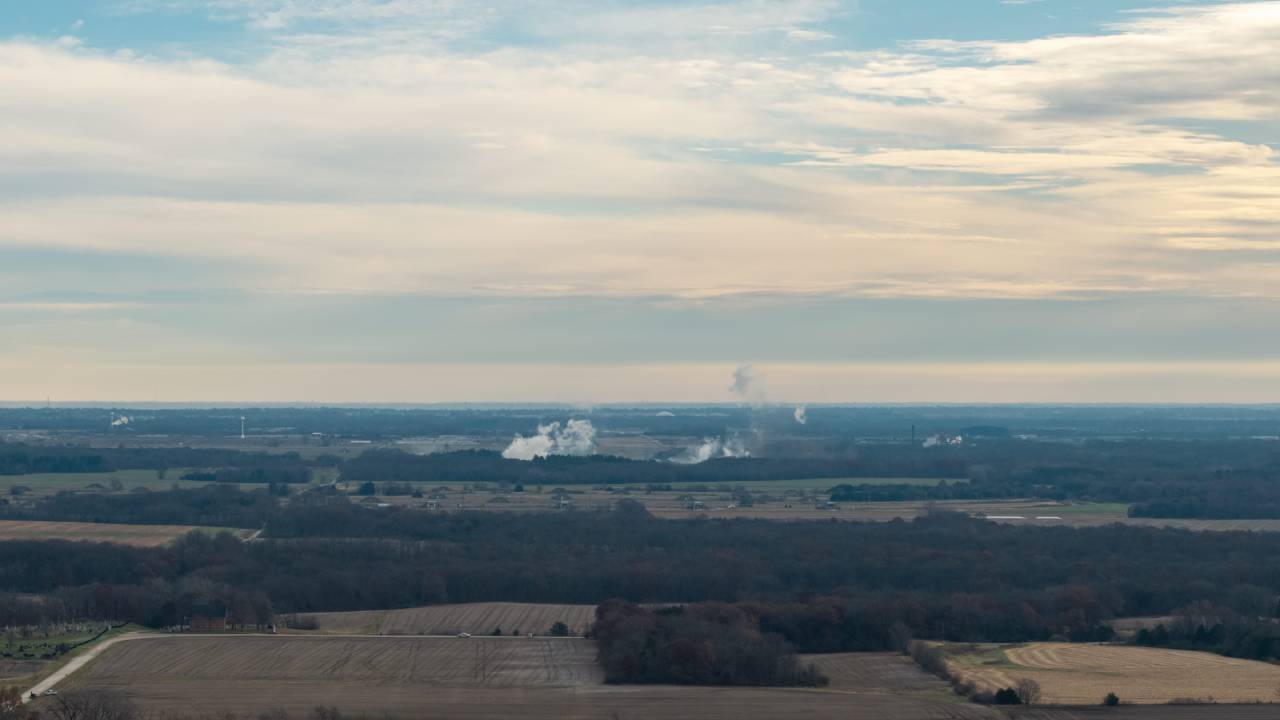
On Wednesday, November 25, 2026, at 9:00 a.m. CST, the U.S. Army detonated roughly 5 tons of degraded lead azide at the Iowa Army Ammunition Plant in Middletown, Iowa.
Army Detonates Stockpile in Iowa
According to Robert Cekada, director of the Bureau of Alcohol, Tobacco, Firearms and Explosives, the entire national stockpile of lead azide was transported to the Iowa site from military bases nationwide back in 2009.
Officials warned that the degrading bomb-making chemicals could explode at any time. ““Inaction is no longer an option,”” said Maj. Gen. Eric Shirley, the Army’s leader of the operation.
Munitions rely on this compound as an initiating explosive, and historically it has served in detonators to trigger other explosive materials like TNT. Experts concluded that methods such as thermal treatment lowered safety margins compared to a controlled detonation.
The controlled explosion had been scheduled for the preceding Friday, but its timing changed to accommodate better wind conditions. Last week, environmental organizations initiated lawsuits seeking to block the controlled explosion. On Monday, the appeals court overturned a decision to halt the blast, ruling that the risk from an unplanned explosion was greater.
Military Constructs Barriers for Blast
To manage the hazards, the military constructed earthen barriers two stories high around a pair of bunkers holding the materials, pouring foam and water onto the site. Workers applied more than 3,600 gallons of aqueous foam and thousands of gallons of water to help absorb any lead particles from the blast.
The two controlled blasts destroyed all 68 barrels containing more than 9,700 pounds of degraded lead azide, measured by net explosive weight.
Following two loud booms at 9 a.m., a pair of white plumes rolled high in the air before dissipating. Army Colonel Aaron Teller said the visible smoke stemmed from the foam sprayed on the site.
At 9:00am CT, @USArmy Sustainment Command executed the controlled mitigated detonation at the Iowa Army Ammunition Plant in Middletown, Iowa. ALL EPA real-time air monitors are reporting ZERO detection of airborne lead throughout the region. EPA monitors never stopped collecting…
The Army kept media outlets more than 4 miles away from the blast site. The military did not livestream the Iowa detonation, but filmed Wednesday morning’s controlled detonation and made footage available.
Monitors Show No Lead After Blast
Acting Secretary of the Army Adam Telle said the mitigation plan was successful and went as planned. “President Donald Trump said shortly after the blast” that reports showed mitigation efforts “far exceeded expectations.”
EPA has been on the ground in Iowa BEFORE the controlled detonation, we will be here DURING the detonation, and we will be here for as long as necessary AFTER detonation to ensure communities are safe. With over 1,200 air, land, and water samples already conducted, and 300…
Environmental Protection Agency monitors showed no detectable traces of lead in the hours following the detonation. EPA administrator Lee Zeldin said on social media that all EPA air monitors continued to report a zero detect of airborne lead.
“I believe, absolutely, that we reduced, as close to zero as it’s absolutely humanly possible, the risk to the health and safety of the people of Middletown and the extended communities throughout Iowa,” Shirley said.

Advocates Question Handling of Crisis
Despite the reassuring initial readings, environmental advocates questioned the operation. Sarah Green, executive director of the Iowa Environmental Council, said that “Iowa and neighboring states deserve a full accounting of why the situation was allowed to get to the point of crisis.”
Governor-elect Rob Sand expressed gratitude that property damage was minimal but criticized the communication surrounding the event, saying that “the lead-up to the detonation should never have been so chaotic and unclear.”
Initial feedback from our state experts and federal partners is that the detonation at the Iowa Army Ammunition Plant was successful. We remain in close contact with authorities on the ground, while state agencies continue to monitor incoming data from the State Emergency… pic.twitter.com/l6k5xT43vq
The Federal Emergency Management Agency issued a mobile phone bulletin late Wednesday afternoon advising residents that “it was safe to resume normal activities” as shelter-in-place orders were lifted.
Residents and Attorney Voice Ongoing Lead Contamination Concerns
Thien Chau, an attorney for Earthjustice, said that legal groups and their clients consistently maintained that residents of Iowa deserved stronger protections regarding the hazardous lead plume.
UPDATE: Our EPA team has now been scaled up to 209 personnel on the ground in Middletown, Iowa, and we will be over 300 by tomorrow. We have now collected 1,216 samples ahead of tomorrow’s controlled lead azide detonation at the Iowa Army Ammunitions Plant: 650 soil samples 297… https://t.co/SoksHujBrA pic.twitter.com/3iAjG8DX55
Local resident Lucy Giehl in West Burlington expressed lingering worries, saying she believes the threat posed by lead will persist. Rhonda Woodson, a former employee at the ammunition facility residing nearby in Burlington, shared relief and skepticism, saying that particles are inevitable when explosives are detonated.
Farmer David Vandenberg, situated roughly 20 miles away, reported hearing a dull rumble at 9 a.m. on Wednesday without seeing anything unusual. He said the Army Corps of Engineers visited his property on Tuesday to collect samples from his pond and yard. Wally Taylor with the Sierra Club Iowa Chapter said that watchdog groups must remain engaged until remediation concludes.
The Army’s controlled, mitigated detonation exceeded all expectations and was a HUGE success. The threat of an uncontrolled spontaneous detonation has been eliminated. I am so proud of our SOLDIERS for their courage, training, mitigation, and precision! They put it on the line…
FEMA Supports Relocation for Residents
Out of caution, FEMA supported recommended relocation for all residents of Middletown, Iowa, and immediate surrounding impacted areas commencing on Tuesday, November 24, 2026. The Army advised residents to remain relocated until Friday at the earliest.
Iowa Secretary of Agriculture Mike Naig expressed gratitude for the Army’s implementation of additional mitigation measures to protect residents, livestock, food, and feed supplies in Middletown and the surrounding area.
The controlled, mitigated detonation of the lead azide stored at the Iowa Army Ammunition Plant has taken place. Initial analysis shared with us by federal partners and Iowa Homeland Security and Emergency Management indicates that the mitigation measures appear to have been…
The Iowa Department of Health and Human Services said it believed the risk of breathing in harmful amounts of lead from the event was low, while noting it would continue reviewing environmental monitoring information and soil sampling results as they become available.
What soil sampling results will show remains unstated.
There is obviously more testing to do that will provide certainty over time, but for now, federal officials have reported that lead dispersal should be limited, Iowans are safe, and damage to property is limited. I’m grateful to the experts on the ground who did all they could to…
More on Iowa Army Ammunition Plant
It is clear: the delay we secured for the IAAAP detonation in Middletown was incredibly important. But it should not have taken public outcry for the federal government to put in place every mitigation measure possible to protect the health and safety of Iowans. The failure of…
U. S. Army personnel are on site in Middletown, Iowa, and have worked around the clock to mitigate the impacts of the planned controlled detonation later this morning. This includes a water wall filled with more than 100,000 gallons of water, earth berms, sand filled blocks,… pic.twitter.com/eQa3erwlXj