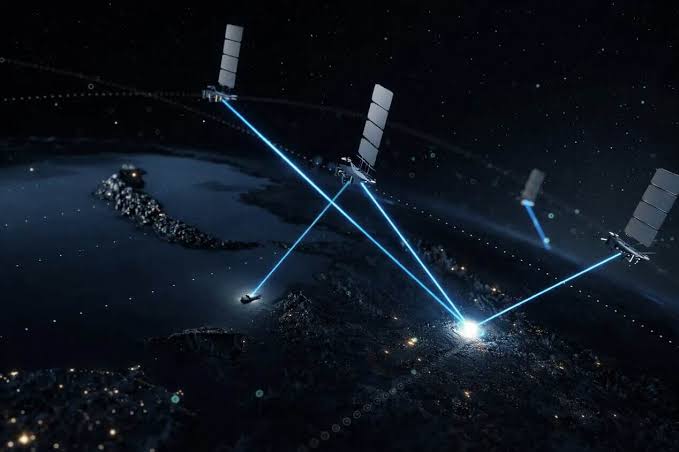
Russia is deploying its developing Rassvet satellite network for military communications over Ukraine, according to the Ukrainian military intelligence agency GUR.
Russia Deploys Rassvet Satellites
Moscow designed the system as a domestic alternative to SpaceX’s Starlink network. Ukrainian officials warned that the technology could allow Russian reconnaissance and attack drones to exchange data in real time.
The network improves the accuracy of Russian attack drones while making them harder to neutralize through electronic warfare. The system allows operators to alter the flight path of attack drones while airborne, reducing their reliance on pre-programmed flight trajectories and helping them adapt to new targets or bypass air defense systems, according to the Ukrainian military intelligence agency GUR.
Markus Reisner, an Austrian military expert, said that the satellites already provide at least two stable communication windows daily over Ukraine. Mykola Zientsev, a security expert, said that these communication sessions last longer than an hour each and provide enough capability to generate operational consequences on the battlefield.
Andrii Yusov told Reuters in a written statement that “Russia is using the Rassvet satellite system on the territory of Ukraine for military purposes,”
This technology could enable reconnaissance drones to transmit data in real time, and operators could change the flight path of attack drones in the air, making them less dependent on previously programmed flight routes, Andrii Yusov told Reuters in a written statement.

Constellation Faces Coverage Gaps
The constellation remains limited in scope. Moscow launched 32 Rassvet satellites this year in two separate batches during March and July.
That quantity fails to provide continuous coverage. Connection is periodic, occurring only when satellites pass over specific target areas. Military analysts estimate the network provides two daily communication windows lasting longer than an hour each.
The system faces technical setbacks. Two of the launched units burned up, while independent portal “The Insider” and satellite tracking catalogs like CelesTrak said there were technical difficulties. Elon Musk’s SpaceX operates a constellation exceeding 10,000 satellites, rendering commercial US systems superior to the dozens of Russian low Earth orbit units.
The Ukrainian military launched an attack in August against the Progress rocket center in the Samara region of Russia, where the carrier rockets for Rassvet launches are produced. Other units successfully climbed to intermediate positioning altitudes, though technical setbacks included the deorbiting of specific satellites due to potential propulsion issues.

Bureau 1440 Plans Expansion
Bureau 1440 develops the project, aiming to expand the constellation to more than 900 satellites by 2035. Moscow plans to expand the constellation to 408 satellites by 2031 and eventually 924 satellites by 2035, intending to cover 94 percent of Russian state territory with speeds up to 150 Mbit/s. Russia plans to launch nearly 20 additional satellites this year and hundreds more next year to accelerate the constellation.
Ukrainian President Volodymyr Zelenskyy imposed sanctions on 10 companies linked to the Rassvet development.
Ukraine relies on Starlink and its military variant Starshield, after Kyiv persuaded SpaceX earlier in the year to disable unauthorized Starlink terminals acquired by Russian forces on the black market. Juliana Süß, a space security expert at the Stiftung Wissenschaft und Politik, said that Starlink remains a critical and essential system for maintaining communications where terrestrial infrastructure has been destroyed.