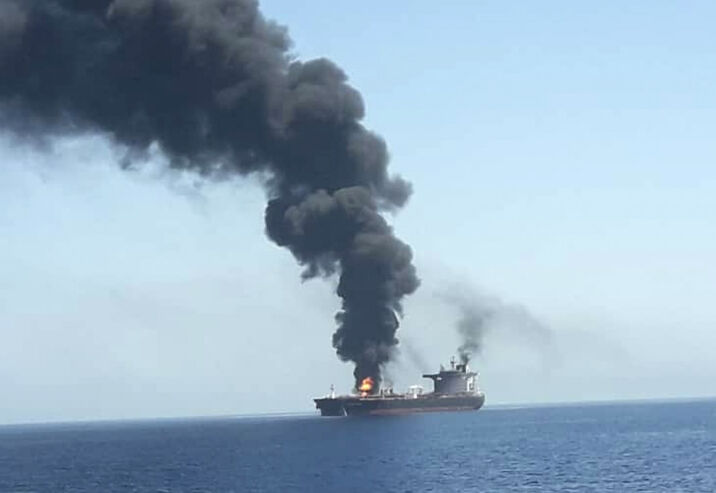
An oil tanker carrying over two million barrels of crude oil exploded in the Strait of Hormuz on October 17, 2026, after colliding with a sea mine. The incident occurred as maritime security deteriorated amid an ongoing regional conflict, drawing warnings from international authorities over blocked shipping lanes and threats to global energy supplies.
The Strait of Hormuz remained a critical flashpoint on Saturday as shipping traffic confronted severe maritime hazards. According to the Islamic Revolutionary Guard Corps (IRGC), an explosion ripped through a supertanker after it struck a sea mine in shared waters. The vessel was transporting a massive cargo exceeding two million barrels of crude oil.
🚨🇮🇷🇺🇸 IRGC claims a supertanker carrying 2 million barrels of crude hit a mine and exploded in Hormuz… and says the ship was running dark with US military supportThe Guard's navy told IRGC-tied Tasnim that the vessel took an "unauthorised" route with its tracking and radar… pic.twitter.com/FaXdvrnXSr
Iranian authorities alleged that the tanker was attempting to navigate illegally along an unauthorized route
through the strategic waterway without official authorization from Tehran. The IRGC navy further stated that the ship had disabled all positioning and radar systems in an attempt to travel through the passage under the cover of support from the United States military.
Maritime Attacks and Casualties Reported Across the Strait
The explosion followed a series of security incidents affecting commercial vessels in the region. Indian Minister of Shipping Sarbananda Sonowal reported that another crude oil tanker carrying a 15-member Indian crew was struck by a projectile on Friday in the same waterway. The minister confirmed that all 24 Indian sailors across the recently targeted ships are safe.
Oil flow through Strait of Hormuz hits 12M barrels a day — defying increasing attacks from Iranhttps://t.co/JnD2AIVklq
Sarbananda Sonowal stated that they are completely fine, and no injuries or loss of life have been recorded
.
The United States Central Command (CENTCOM) addressed prior incidents by confirming that a Singapore-flagged container ship was hit by a projectile launched by the IRGC rather than striking a sea mine, pushing back against alternative accounts of the incident.

International Maritime Organization Warnings Over Unresolved Navigation Hazards
International maritime officials underscored the severe risks facing commercial fleets as the waterway remains effectively closed. Arsenio Dominguez, Secretary-General of the International Maritime Organization, stated that navigation through the Strait of Hormuz remains unsafe, noting that Iran had not provided necessary information to reopen the passage and guarantee safe transit.
The IMO chief pointed out that more than 100 vessels have faced attacks in the strait since the beginning of the conflict. He confirmed that sea mines have not yet been cleared from the channel, with removal operations expected to resume only after hostilities end.
Three FALSE Iranian claims in the past 24 hours: 🚫 CLAIM: The IRGC has continued to falsely claim control of the Strait of Hormuz.✅ FACT: The United States and regional partners control the strait as commercial vessels continue to transit despite unwarranted IRGC… pic.twitter.com/rgpeZ95dvU
Trump Rules Out Nuclear Weapons Against Iran
Tensions in the region remain elevated following a series of naval restrictions and counter-measures. Tehran established a restricted zone near the waterway in September, while IRGC naval forces warned that any vessel disabling steering systems during transit would be treated as hostile and face severe action.
On the political front, United States President Donald Trump stated that he sees no need to use nuclear weapons against Iran and dismissed the deployment of large-scale ground troops, while keeping the door open for potential conventional military strikes against Iranian targets amid stalled diplomatic negotiations.