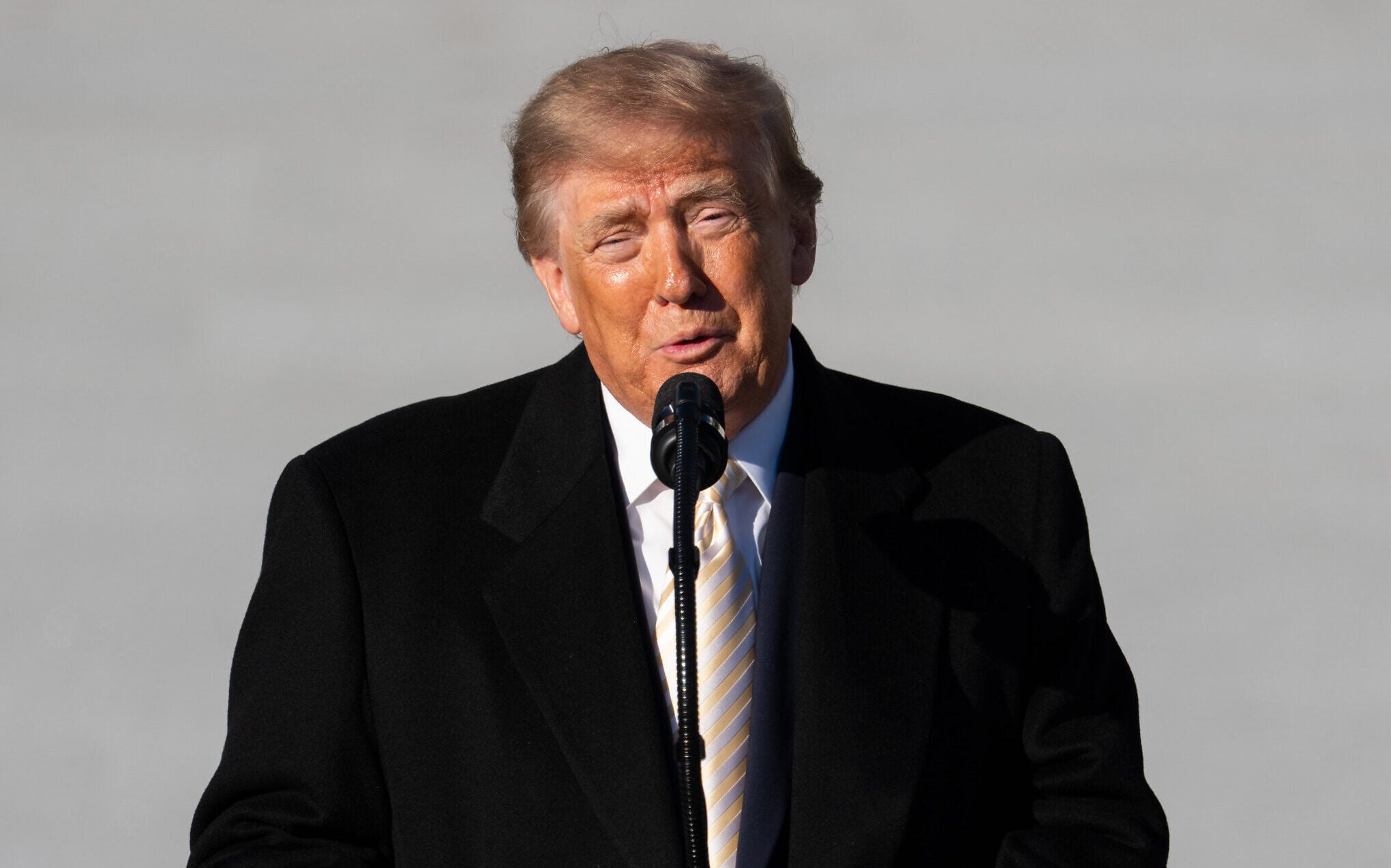
President Donald Trump said Tuesday the U.S, according to AP News. war effort against Iran is funded only through January, creating a narrow window for any new military action before a Democratic-controlled Congress could cut off money.
In an interview with the New York Post, Trump acknowledged that Democrats taking control of Congress in January could constrain his military options, and argued that ending the campaign prematurely would turn what he called a “total win” into “a loss.” He said he had not decided whether to resume strikes.
Trump also said Israel’s goal of toppling the Islamic Republic was “probably doable” but was not his objective. “I just don't want them to have a nuclear weapon. I was never for or against regime change, that was never a criteria for me,” he told the Post.
President Trump told The Post that his war effort with Iran is “funded” through January — as he swiped at congressional Democrats threatening to bring a halt to his conflict, which the commander in chief said would turn a “total win” into “a loss.” “I just don’t want them to…
— Post by @sfrantzman on X
Trump faces political pressure over war
The war, launched on February 28 by the U.S. and Israel, has become a political vulnerability for Trump. Discontent over the conflict was a major reason for Republicans’ midterm defeat on November 3, a point Trump himself has conceded.
A YouGov/Economist survey of 1,685 Americans conducted November 9–11 found 63 percent believe the U.S. should prioritize ending the war as quickly as possible, while 21 percent said the country should keep fighting until all objectives are achieved.
Trump told the Post that congressional Democrats would “take a total win and make it a loss” if they halt the war. “Their navy's gone, their air force is gone, their anti-aircraft, everything's gone. Their leaders are gone,” he claimed.

Naval blockade and economic pressure
The U.S. reimposed a naval blockade on Iranian ports in July and announced Task Force Iron Gate this month to restrict weapons and sanctioned materials across Iran’s land borders and the Caspian Sea.
Trump called it “the greatest naval blockade in history” and said more oil was moving through the Strait of Hormuz than before the war began. “Not one Iranian ship has gotten through the blockade since we established it,” he said, citing a “little moratorium” as the only exception.
The Trump administration's current approach on Iran "is the most sustainable of the options the president has to choose from and holds the best hope for getting a diplomatic deal more favorable to the United States," Michael Singh told @AP. https://t.co/Q91oUiNxIy
— Post by @WashInstitute on X
Iran’s First Vice President Mohammad Reza Aref said Wednesday the blockade was not a concern, telling the semi-official Tasnim news agency that cargo clearance through non-southern borders had increased and strategic reserves remained strong. “The increase in the unloading and clearance of goods through non-southern borders sends the message that we are not concerned about the enemy's naval blockade,” Aref said.
Iran plans lawsuit over school airstrike
Iran announced this week it would sue the U.S. for a February 28 airstrike on a school. Trump dismissed the move, saying he wants compensation for the 75,000 protesters he claims Iran killed in the seven months before the war began, referencing Tehran’s crackdown on mass anti-regime protests.

Trump alleges Iran developing chemical weapons
Trump said last week there was an “indication” Iran was looking to develop chemical or biological weapons, without offering evidence. Iran’s Foreign Ministry rejected the accusation. Kasra Aarabi, director of IRGC research at United Against Nuclear Iran, said the Islamic Republic had spent more than four decades building an extensive infrastructure for chemical and biological weapons research, arguing the threat had received far less public attention than Tehran’s nuclear ambitions.
Huckabee outlines Trump conditions and Gaza hurdle
U.S. Ambassador to Israel Mike Huckabee said Tuesday that President Trump prefers a diplomatic solution to the deadlock with Iran but has set uncompromising conditions: the Iranian regime must not possess nuclear weapons, retain enriched uranium, or control the Strait of Hormuz, Israel Hayom reported.
🇺🇸🇮🇷🇨🇳 China forced Trump to pause the Iran war. Iran spent that pause rearming. Pravin Sawhney, former Indian Army officer and defense analyst, says the Beijing trilateral summit changed everything. The Nov 19th U. S.-China-Russia meeting ruled out nuclear weapons in West Asia… pic.twitter.com/LduOHc4oUR
— Post by @MarioNawfal on X
Huckabee also pointed to his home state to illustrate security assistance, saying every round of ammunition the IDF uses in Israel is manufactured just outside Little Rock, according to ynetglobal.
Saudi strikes Hodeidah; Iran threatens Bab el-Mandeb
Secretary of State Marco Rubio has called some of the Iranian demands “outrageous and ridiculous,” pouring cold water on prospects for a near-term breakthrough, USA Today reported.
Diplomatic sources describe Trump option preference
According to diplomatic sources, Trump favors the fourth option among those prepared by intelligence and policy teams, supported by Secretary of State Marco Rubio, Treasury Secretary Scott Bessent and Commerce Secretary Howard Lutnick, Israel Hayom reported. The sources said Trump has ordered closer surveillance of Iran’s nuclear and missile facilities, as well as sites suspected of involvement in chemical or biological weapons development, according to the same outlet.

Intelligence provided by Israel to the U.S. concerning Iran’s potential development of chemical weapons has not conclusively persuaded the administration, Israel Hayom reported. Some in Trump’s circle have warned against repeating the precedent set by former President George W. Bush regarding unconventional weapons claims, the same sources said.
Congressional war powers vote
The Senate last week rejected a war powers resolution on Iran by a 48–51 vote, leaving the decision on renewed strikes with the White House. Trump discussed Iran with Russian President Vladimir Putin and Chinese President Xi Jinping at the APEC summit in China, saying the leaders agreed Iran should never have a nuclear weapon.
Task Force Iron Gate was established by U.S. Central Command on 7 November 2026 to coordinate with other government agencies in blocking Iran’s overland and Caspian Sea routes for advanced weapons, dual-use technologies, sanctioned materials and illicit revenue. The unit comprises roughly 20 civilian and military personnel based in Tampa, Florida, and was created to complement the existing naval blockade by targeting land-border and inland shipping networks.
Whether the January deadline brings a deal, renewed strikes, or another extension remains uncertain. Kuwait’s Al-Jarida newspaper reported the U.S. gave Iran four days to respond to a new proposal covering the Strait of Hormuz, Iran’s nuclear program, and sanctions, citing a single unnamed Iranian Foreign Ministry source — a claim that remains unconfirmed by U.S. officials.