One year after a fire killed 168 people at Wang Fuk Court in Hong Kong, survivors face lingering grief and legal battles.
- The November 26, 2025 fire killed 168 people and displaced thousands in the Tai Po district.
- An independent investigation report blamed substandard materials, inadequate oversight, and building maintenance deception.
- Police and anti-corruption authorities charged Will Power, Prestige and seven people with offenses such as manslaughter and conspiracy to defraud.
Inferno Spreads Rapidly Across Tai Po Estate
The disaster began on a sunny Wednesday afternoon at the residential estate in Tai Po, a northern suburban district of Hong Kong. Flames quickly ripped through seven blocks covered in bamboo scaffolding and mesh netting. “Mrs Lau could only watch helplessly” as the fire tore through Wang Fuk Court at 10 meters per second across its 31-storey blocks.
Foam boards melted and produced burning droplets that aided secondary ignition. A staff member of the property manager, ISS, turned off the power supply to fire alarms across all eight buildings. No alarms rang when the blaze broke out. Blocked escape routes trapped residents, and most deaths resulted from smoke inhalation.
Inquiry Blames Multiple Government Departments
The inquiry faulted the Housing Bureau’s independent checking unit, the Buildings Department, the Fire Services Department, and the Labor Department. These bodies failed to properly investigate foam boards, check scaffolding net fire-retardancy certificates, or handle worker complaints effectively. Residents had expressed concerns about fire hazards before the blaze on Nov. 26, 2025, but warnings went unheeded.
Police Charge Firms and Seven People with Manslaughter and Fraud
Police and anti-corruption authorities charged Will Power, Prestige and seven people with offenses such as manslaughter and conspiracy to defraud. Police and prosecutors brought charges against Prestige Construction and Engineering (PC&E) and Will Power Architects. Defendants face charges of manslaughter, conspiracy to defraud, and attempting to pervert the course of public justice.

Investigators found that PC&E submitted the most expensive bid at HK$336m ($42.8m; £32.4m) for the renovation contract, worth more than HK$300 million ($38 million). The companies and select defendants conspired to defraud apartment owners by concealing Prestige’s previous litigation records.
Following the release of the inquiry report, Hong Kong leader John Lee apologized for the tragedy and accepted the findings. The housing minister resigned. Officials announced reforms, including legislation to criminalize bid-rigging in building maintenance works.
Religious Services Mark Anniversary of Disaster
Memorial events marked the one-year anniversary across religious sites in the city. Reverend Dominic Chan led a service at the Catholic Cathedral of the Immaculate Conception. He told attendees that every single individual lost was a unique life rather than a mere statistic. The Hong Kong and Macau Affairs Office of the Chinese government issued warnings against people attempting to stir up trouble under the guise of commemorating the disaster.
Inspector Fails to Scrutinize Repair Documents
According to an inquiry led by a judge, the designated inspector tasked with overseeing the repair work automatically approved all official documents presented to him without proper scrutiny. The investigating committee found the maintenance project bore the hallmarks of bid-rigging and anticompetitive conduct.
Police and anti-corruption authorities charged Will Power, Prestige, and seven individuals with offenses such as manslaughter and conspiracy to defraud. The committee pointed to shortcomings within public bodies, specifically highlighting faults in the operations of the Labour Department, the Buildings Department, the Fire Services Department, and the Housing Bureau’s independent checking unit.
Government Officials Bow During Press Conference
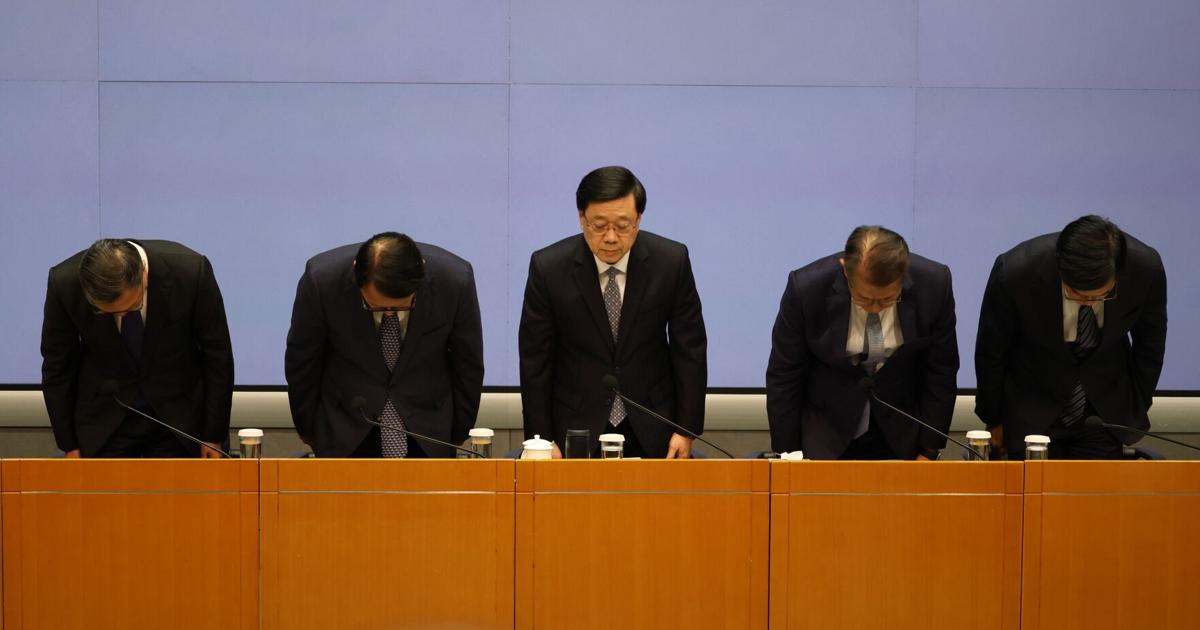
Hong Kong leader John Lee led senior officials in bowing during a press conference on the inquiry report, and his housing minister resigned to bear political accountability. Human Rights Watch said that the administration in Hong Kong reacted by adopting Beijing-style methods to silence the voices of those affected while offering vague promises of accountability.
The city’s number two official, Eric Chan, said that the government will offer help to lawful events while warning against acts of disorder. Authorities warned against people with ulterior motives who stir up trouble under different guises to undermine overall social stability, while residents laid flowers in a small authorized space near the charred buildings.
Widower Sends Voice Messages to Late Wife
For the residents who survived, the past year has been defined by profound loss and difficult adjustments. Yip Ka-kui, a 68-year-old resident whose wife was among the 168 victims, continues to send WhatsApp voice messages to his late partner’s phone. “I can’t believe she’s no longer here,” Yip said during an interview in Hong Kong.
Betty Ho spent 18 years paying off her mortgage before the fire destroyed her home. She lives in temporary housing overlooking the charred remains of the complex. Displaced residents faced hard choices regarding the administration’s resettlement plan, including selling their homeownership rights to the government.
Investigations revealed that Wang Fuk Court, a Home Ownership Scheme court comprising eight residential buildings offering 1,987 units, saw the fire tear through its 31-storey blocks at 10 meters per second. The disaster’s rapid spread was facilitated by bamboo scaffolding and mesh netting, alongside foam boards that melted and produced burning droplets aiding secondary ignition.
Released last Thursday, an investigation report into the Wang Fuk Court blaze detailed almost 200 pages of complaints and enquiries made as early as 2022. In full: https://t.co/IzE8vbRdE7
The government rolled out new-beginning support grants, including HK$300,000 for owners of each flat at Wang Fuk Court and HK$200,000 to families of each deceased victim. Officials maintained a “one social worker per household” mechanism to connect survivors with ongoing medical and welfare services.