
Early in-person voting began Tuesday in Wisconsin’s chaotic Democratic primary for governor, featuring five candidates and an electorate divided over insurgent democratic socialist Francesca Hong. The primary follows a dramatic July shakeup involving campaign exits and endorsements, ahead of the August 11 election.
Swing state Wisconsin entered a crucial electoral phase on Tuesday, July 28, 2026, as in-person early voting opened alongside a high-stakes televised debate among the Democratic gubernatorial hopefuls. Democrats are aiming to retain the governor’s office and flip both legislative chambers for the first time since 2010. Yet a turbulent month of candidate exits, re-entries, and high-profile endorsements has left the primary deeply fractured, with nearly half of registered voters remaining undecided according to recent polling from the Marquette University Law School.
Early Voting and the Ballot-Spoiling Legal Battle
A Fractured Field and the Rise of Francesca Hong
The primary features five remaining candidates: State Rep. Francesca Hong, Milwaukee County Executive David Crowley, former Lt. Gov. Mandela Barnes, former Department of Administration Secretary Joel Brennan, and State Sen. Kelda Roys. Hong, who describes herself as a democratic socialist, has garnered strong support among the liberal wing of the party and led her opponents in the third consecutive Marquette University Law School poll released prior to Rodriguez’s exit.

Voter reactions to Hong’s frontrunner status highlight deep divisions within the electorate. Ian Anderson, a 46-year-old state Department of Natural Resources worker who voted in Madison on Tuesday morning, said he cast his ballot for Hong because she’s exactly the burst of energy we need,
according to pbs.org. Conversely, some moderate and establishment-aligned Democrats expressed deep reservations. Steve Wiesner, a Democratic voter in Milwaukee, said that if Hong wins the August 11 primary, he would vote Republican for the first time in his life, stating, I would never support her or any DSA candidate at this point.
Debate Night Clashes and Electability Arguments
On Tuesday night, the five Democratic candidates gathered for their only televised debate ahead of the primary, hosted by WISN 12 News. Instead, contenders centered their arguments on electability against Republican U.S. Rep. Tom Tiffany in November.
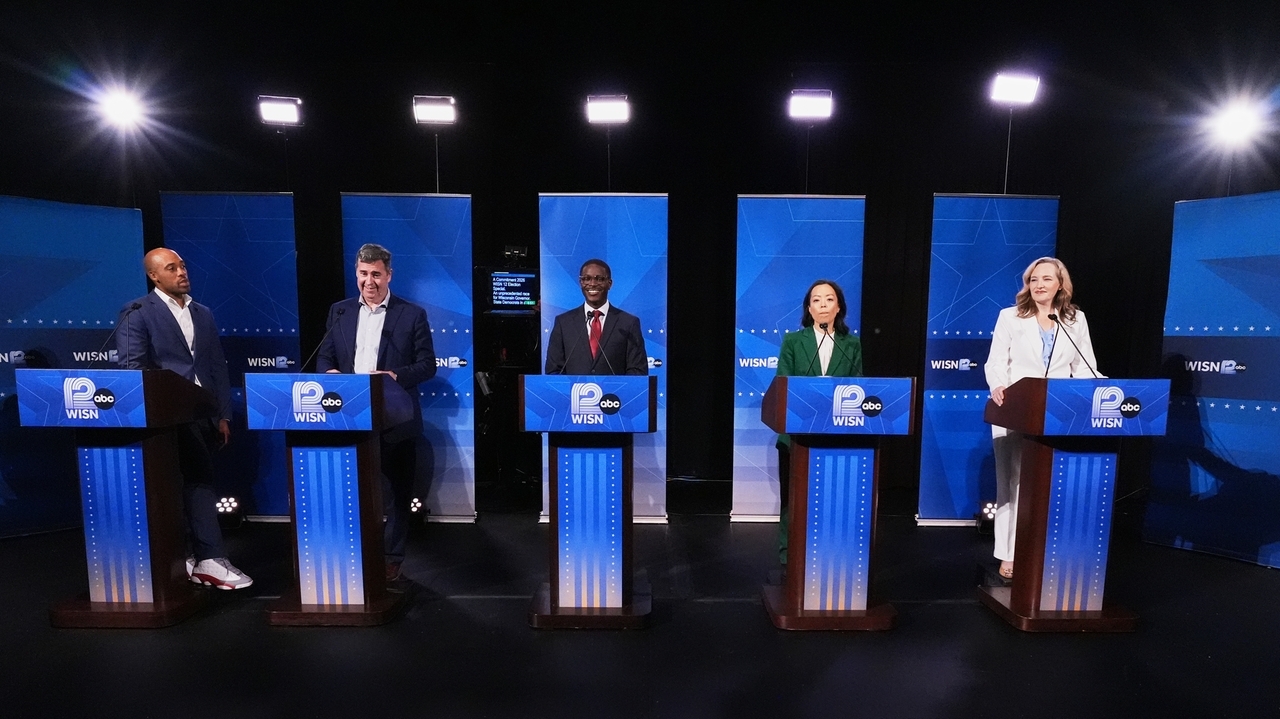
Tiffany is running with the backing of President Donald Trump in a state Trump won in 2016 and 2024, and faces only nominal primary opposition. Crowley, who secured the endorsement of Gov. Tony Evers after re-entering the race on July 17 following Rodriguez’s campaign finance scandal, emphasized his executive experience. With my experience in the legislature, building coalitions across the state, but also being the only executive representing the largest county in Wisconsin,
Crowley said when asked if he did enough to prove his viability, as cited by WISN 12 News.
Barnes, who narrowly lost a 2022 U.S. Senate race, also stressed his positioning against Tiffany. The polls also show me as the only democrat in this field who is ahead of Tom Tiffany,
Barnes said, according to wisn.com. Meanwhile, political analysts note that Hong’s path to the nomination does not require a majority of the total vote. Anthony Chergosky, an associate professor of political science at the University of Wisconsin-La Crosse, noted that Hong could win with 35 to 40% of the vote given the fractured nature of the remaining field.


