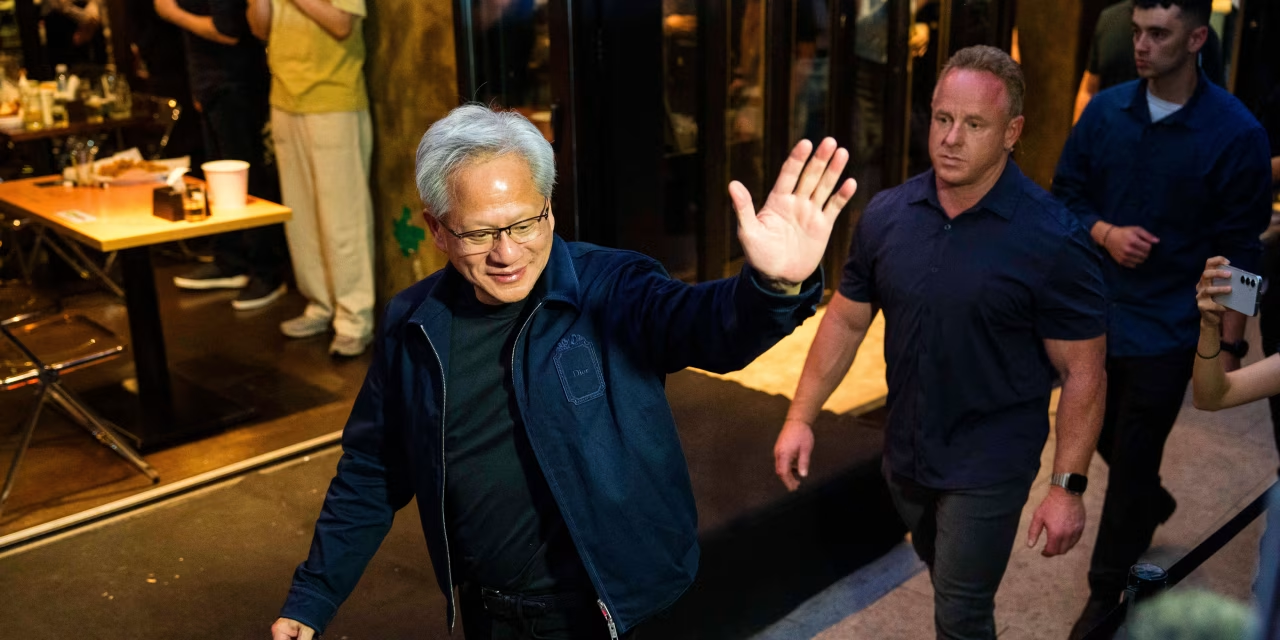
Nvidia’s aggressive financing of the artificial intelligence boom is facing a sharp reversal following the resignation of Jensen Huang, as the company reassesses billions of dollars in commitments.
Huang, the longtime chief executive, stepped down on November 12, 2026, amid a leadership shake-up that left Chief Financial Officer Colette Kress in charge as interim CEO. The transition has cast doubt on the scale of $164.5 billion in total financial commitments that Nvidia had disclosed to support its AI customers.
Market reaction was immediate; Nvidia shares fell 2.01% from November 12 to November 13, closing at $162.85. The stock had already been under pressure, declining 12.75% over one week and 26.41% over one month, down from $221.30 on October 14.
Disagreements Over Financial Risk
Internal friction between Huang and Kress centered on the company’s use of “credit guarantees,” which allowed cloud providers and AI labs to secure bank loans for expensive data center projects. In these arrangements, Nvidia provided assurances to lenders to cover costs if developers defaulted.
According to reports, Huang favored an expansive strategy to keep these firms purchasing Nvidia’s hardware, while Kress, who has served as CFO for 13 years, pushed for stricter oversight of the risks.
Nvidia’s interim CEO is expected to rein in deals after a stretch in which the company aggressively financed computing deals and startup investments https://t.co/0u69UMEvl2 via @WSJ
A notable point of contention was a proposed deal with OpenAI. Huang reportedly initially suggested a $250 billion credit plan to support an Ohio data center, a figure Kress and her finance team successfully negotiated down to $105 billion. This project alone accounts for the largest portion of Nvidia’s obligations, involving 20-year leases for compute hosting.
During an August meeting to discuss these exposures, Huang reportedly dismissed Kress’s caution, referring to her as “a deer in the headlights,” according to accounts shared by those familiar with the matter. Following that confrontation, the company reportedly paused some financing arrangements and implemented additional reviews by senior executives and board members.
Elon Musk says a petition to reinstate Jensen Huang as $NVDA CEO is underway and that he plans to sign it. That comes as Nvidia employees are already pushing for Jensen’s return. pic.twitter.com/nOur0HR0sD
The Strategy of Circular Financing
Analysts suggest this approach helped maintain the perception of high demand even as some hyperscalers began pivoting toward custom, in-house silicon. In just two months in 2026, Nvidia’s dealmaking and credit guarantees reached $140 billion. The company invested more than $7 billion in neocloud stocks.
By funding data center expansion, Nvidia effectively created an outlet for its surplus inventory.
NEW: We continue to learn more and more about how Nvidia's plans to finance the AI boom were running into issues—even before Jensen was ousted. Nvidia’s Days as an Open Checkbook for the AI Economy Are Numbered. w/ @RWhelanWSJ & @KateClarkTweets for @WSJ more tips? Signal… pic.twitter.com/FyOTTSj7Xx
NYU Professor Emeritus Gary Marcus warned on CNBC’s “Fast Money“that the sudden change in leadership could introduce uncertainty into the network of arrangements fueling the AI boom.” Any kind of move like that and the whole thing might collapse,” Marcus said, noting that if Nvidia scales back commitments—such as potentially reducing a $10 billion anticipated investment in Anthropic—it could create significant complications for the ecosystem.
Nvidia's Scale Mirrors the Dot-Com Era Bubble
The scale of Nvidia’s involvement has drawn comparisons to the dot-com era.

A Morgan Stanley report from Oct. 8 mapped the AI ecosystem, noting that capital flows between companies like OpenAI, Nvidia, Microsoft, Oracle, Advanced Micro Devices, and CoreWeave created a web that “resembled a plate of spaghetti.” Veteran investor George Noble warned that Nvidia now accounts for roughly 8% of the S&P 500, double the weighting Cisco Systems held at the peak of the 2000 dot-com bubble.
While Kress retains her finance responsibilities during the transition, analysts remain divided on the long-term impact. Yardeni Research president Ed Yardeni suggested in a note that the investment boom could continue under Kress’s leadership.
However, with memory availability and manufacturing constraints persisting, tech writers have said that affordable gaming GPUs are unlikely to make a comeback in 2027, as data-center hardware remains more profitable for manufacturers. As the industry watches, the central question remains whether data center developers can secure sufficient funding without the credit backstops that have characterized the past year of growth.
“There is very little that can be done to prevent a global recession should the AI boom collapse,” Frederic Neumann, chief Asia economist at HSBC in Hong Kong, said.
Earlier coverage: Nvidia Shares Slide as CEO Controversy and Inflation Hit Markets