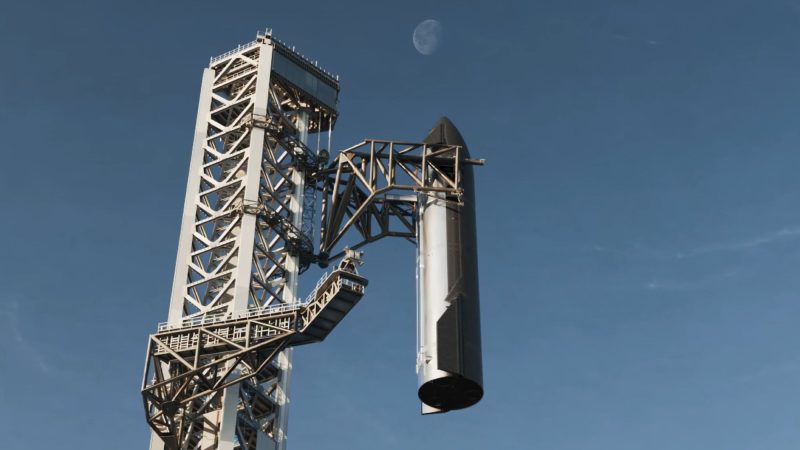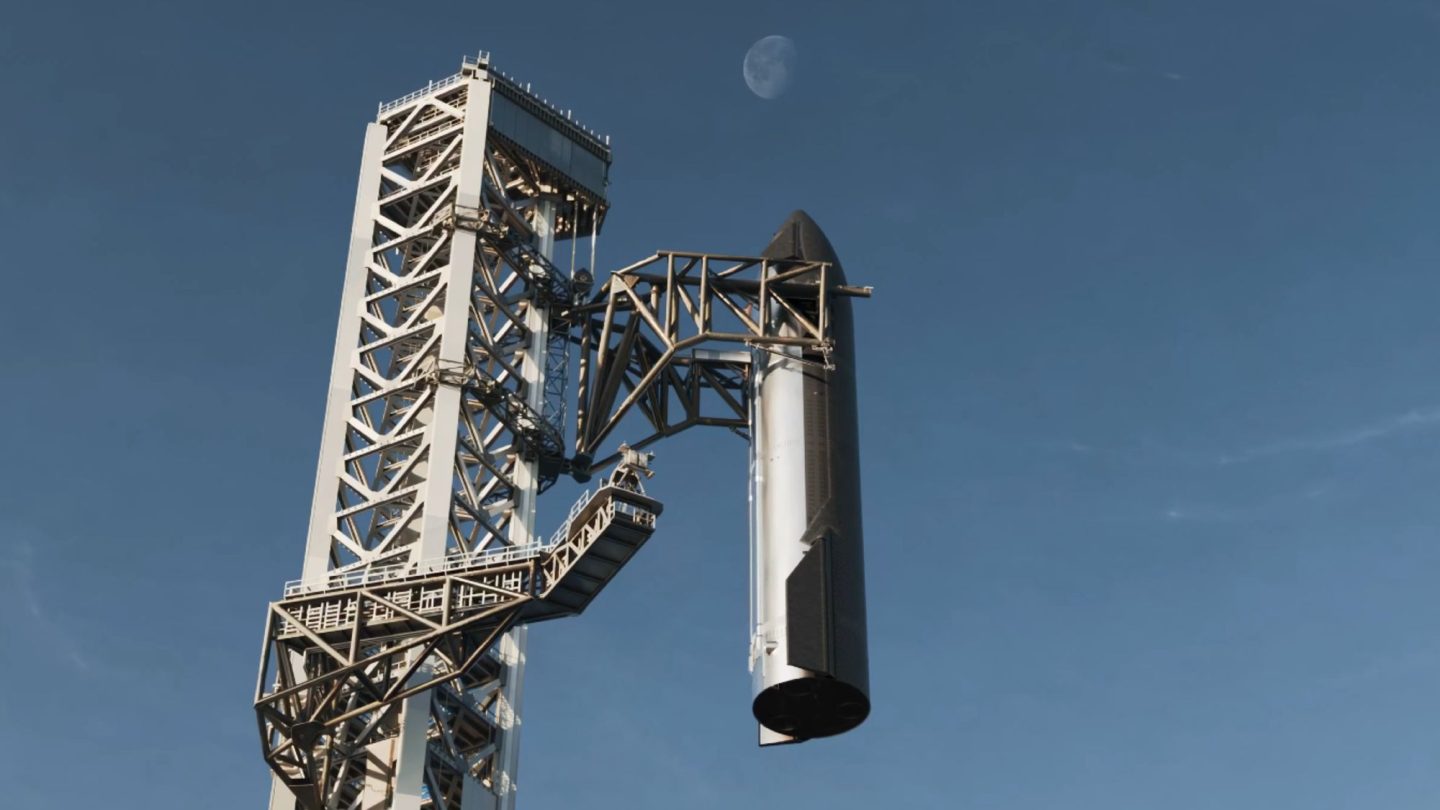
SpaceX targets a 75-minute window starting at 5:45 p.m. EST on Friday for the 15th flight test of Starship from Starbase in South Texas, with plans to attempt an unprecedented double catch of both the Super Heavy booster and the upper-stage spacecraft using the launch tower’s robotic arms.
The mission marks only the second time the 400-foot-tall megarocket has reached orbit, following the success of Flight 14 in September. If successful, the flight will establish the first fully recovered orbital rocket in history, a milestone aimed at eliminating the need to discard multimillion-dollar hardware after a single trip.
Starship Separates from Super Heavy After Pad 2 Liftoff
Liftoff will originate from Starbase’s newer tower at Pad 2. A little over two minutes after clearing the pad, the Starship upper stage will separate from the Super Heavy booster. While the lower booster has previously returned to the launch site for a midair catch by the mechanical arms nicknamed chopsticks, SpaceX has never attempted to recover an upper stage using the same method.
Following separation, the upper stage will enter an orbital coast lasting roughly 22 hours, circling Earth approximately 14 times at an altitude of about 170 miles. During that transit, the vehicle is scheduled to deploy 26 next-generation Starlink V3 satellites. Flight controllers will continuously monitor the spacecraft’s health, maintaining precleared options to deorbit early over the Pacific or ocean splashdown locations if any system anomaly arises.
Starship flight maneuvers pic.twitter.com/QVEpWqfm5X
On the scheduled flight plan, the Super Heavy booster is expected to return to Starbase approximately six minutes and thirty-five seconds after launch to be caught by the launch tower’s mechanical arms.
For the upper stage, the return is planned roughly 22 hours later, with the catch attempt expected around 4:17 p.m. EST on November 14 if the vehicle lifts off at the beginning of the window. Flight controllers will only permit the ship to return if statuses meet internally developed and Federal Aviation Administration-approved conditions for a return to launch site and catch.
Morgan Stanley’s Adam Jonas in new @SpaceX note on flight 15: “We do not believe the stock market fully appreciates the significance. A successful catch of both the booster and the ship is likely to be a material positive for the stock, and an even bigger positive for the… pic.twitter.com/ekRJJrMdeQ
SpaceX said that flight controllers will only permit Starship to return to Starbase if the vehicle’s status meets its internally developed and FAA-approved conditions for a return to launch site and catch.
If the mission proceeds as planned, the ship will execute a deorbit burn over the Pacific Ocean, reentry the atmosphere, and maneuver using its control flaps to align with Starbase for Saturday afternoon’s tower catch attempt.
As the vehicle approaches the launch site, residents of Cameron County and nearby areas may hear one or more sonic booms. Alternatively, a late-reentry option exists to direct Starship into the ocean if any systems or the tower encounter an issue after reentry that precludes a safe catch at Starbase.
“Starship is obviously meant to be a reusable launch vehicle and is meant to survive atmospheric reentry,” said Jeremy Pedro, SpaceX's director of Starship propulsion systems.

Visibility and Ground Viewing Across South Texas
Skywatchers near South Texas and across wide geographic bands may have clear opportunities to spot the spacecraft. Because the upper stage measures roughly 171 feet tall, astronomers note it will serve as a prominent target.
“When it passes overhead, it will look like a bright, fast-moving star crossing the sky — similar to the International Space Station, but potentially even brighter depending on its orientation,” explained meteorologist Joe Rao.
Mechazilla has caught the Super Heavy booster! pic.twitter.com/6R5YatSVJX
“As it launches towards the southeast, and it will be daylight, then the prospects for viewing from the U.S. are going to be in Texas and the states along the Gulf of Mexico,” Robert Massey, deputy executive director at the Royal Astronomical Society, told Space.com.
“It certainly will be visible in twilight hours. It should be very bright, considerably brighter than the Starlink satellites due to its size,” said professor James Osborn of Durham University. “Where and when is a bit more tricky.”
James Osborn, professor at Durham University
Observers can follow tracking details on websites such as Heavens-Above, Star Dash, Orbital Radar, and Find Starlink.
Starship is preparing for catch Flight 15 is targeting to launch as early as Friday, November 13, pending regulatory approval → https://t.co/K5XRci6bnw pic.twitter.com/WS2xGLjVsx
SpaceX Pursues Reusable Systems to Lower Payload Costs
The test flight affects commercial space sector finances as SpaceX pursues a fully reusable launch system designed to lower payload costs. According to third-quarter 2026 results, SpaceX’s total revenue reached $14.6 billion, with launch revenue accounting for approximately $1.8 billion of that total.
Industry analysts emphasize that Starship’s primary commercial utility lies in deploying internal assets like the Starlink constellation rather than external commercial launches alone. Morgan Stanley analyst Adam Jonas describes a successful double catch as potentially the biggest positive catalyst since the company’s initial public offering.
Ship 42 moves to the Starbase pad ahead of launch pic.twitter.com/pMUFTHneJQ
Beyond communications, successful heavy-lift capability is projected to accelerate infrastructure deployment for high-performance computing and national security missions.
Earlier coverage: SpaceX Targets First Double Midair Catch Attempt for Starship Flight 15
Weather for Starship Flight 15 on Friday looks good: Sunny, light winds, temperatures in the upper 70s, relatively low humidity. I don't know the constraints on return weather Saturday, but only differences are a few more clouds and slightly stronger winds, gusting 15 to 20 mph.