Descendants of the Jewish publishing family who once owned Vincent van Gogh’s Châtaigniers en Fleurs (Blossoming Chestnut Trees) want Sotheby’s to withdraw the work from a Manhattan auction.
Heirs Challenge the $180 Million Van Gogh Auction
The 1890 painting carries an estimated value of $180 million. This makes it the highest-valued lot in the fall marquee art auctions.
Painted in Auvers-sur-Oise during the final period of Van Gogh’s life, the canvas sits at the center of the Blaquier-Arrieta collection. Sotheby’s backed the high-stakes lot with a financial guarantee ahead of its planned sale on Wednesday night.
Family Claims 1936 Sale Resulted From Nazi Persecution
Heirs living in the United States argue that the painting was sold under financial duress in Amsterdam in 1936 due to Nazi persecution. Gunnar Schnabel, a Berlin-based lawyer for the family, led the research.
“would have wanted to carry out the sale even without Nazi rule,” the heirs' Berlin lawyer Gunnar Schnabel said.
Gottfried Bermann Fischer inherited the artwork alongside the Berlin publishing house S. Fischer Verlag from his father-in-law. The family deposited the painting with art dealer Walter Feilchenfeldt in either 1932 or 1933.
Fischer fled Berlin for Vienna three months before the 1936 transaction. The move subjected the family to the punitive Reich flight tax levied against Jewish emigrants.

Fischer later recovered ownership of his publishing house after the Second World War. He did not pursue restitution for the sold paintings because neutral jurisdictions like the Netherlands offered no legal basis for art compensation at the time.
The artwork itself was created in May 1890 in Auvers-sur-Oise, near Paris, following the artist’s two-year stay in southern France. It stands out as the only chestnut tree study from that period featuring human figures, depicting three women chatting under colorful parasols and a man in blue work clothes wearing a yellow straw hat.
In a letter written to his brother Theo on Sunday, May 25, the artist specifically referenced creating a study of pink chestnut trees alongside a white chestnut tree canvas now housed in the Kröller-Müller Museum in Otterlo.
Following the artist’s death, the painting passed to his brother Theo, then to his widow Johanna van Gogh-Bonger, and subsequently to their son Vincent Willem. Decades later, the canvas became part of the Blaquier-Arrieta collection.
Carlos Pedro Blaquier and Nelly Arrieta de Blaquier of Buenos Aires assembled the collection starting in the 1960s. Philip Hook, a former Sotheby’s executive and author, described the collection in the auction house’s announcement as legendary, whispered about, and kept from public view.
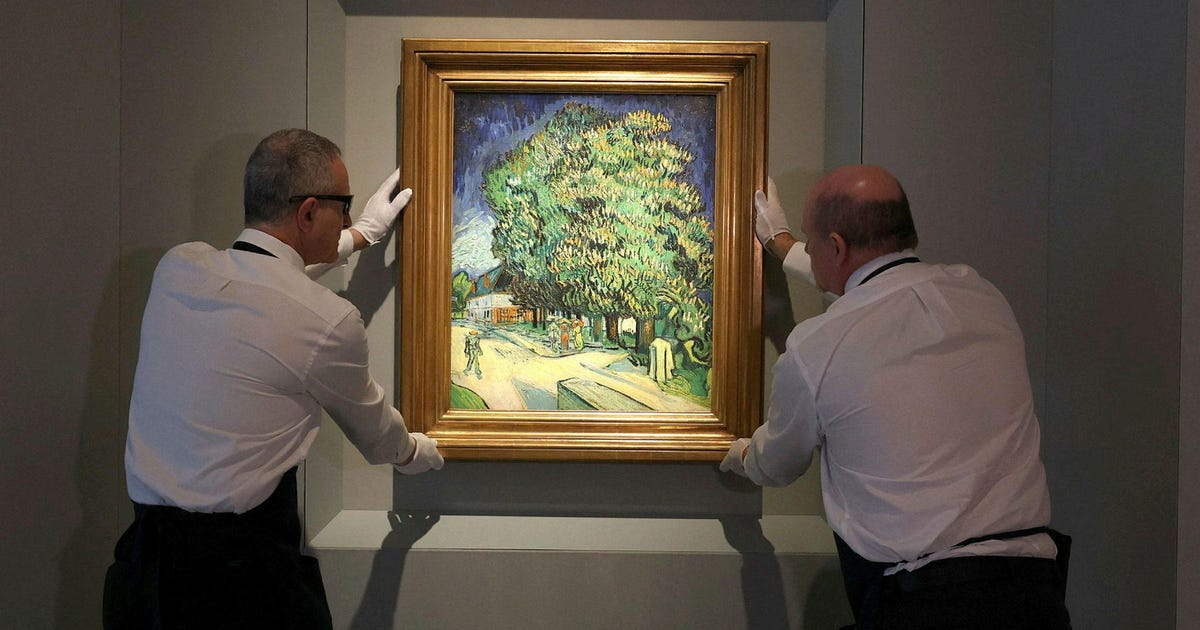
Sotheby’s titled its evening sale Legendary: The Blaquier-Arrieta Collection.
“We are of course aware of the reports concerning Carlos Pedro Blaquier,” said a Sotheby's spokesperson told the outlet.
Sotheby’s Responds to Restitution Demands
Schnabel challenged Sotheby’s restitution department head Marco Toracca in a November 12 email. He demanded that the auction house prove the transaction occurred at fair market value and independent of Nazi pressure.
Otherwise, no auction may take place.
Gunnar Schnabel, lawyer for the heirs, via The New York Times
In the same correspondence, Schnabel said that his client is prepared to work toward a fair and just solution in the spirit of the 1998 Washington Principles, which serve as international guidelines for addressing Nazi-confiscated art.
Sotheby’s responded by acknowledging the family’s concerns while defending the consignment’s current status.
While our research to date has not established that the painting was sold under duress, we recognize the importance of engaging thoughtfully and constructively with the family and are committed to working toward a mutually satisfactory resolution.
Sotheby’s, via The Times of Israel