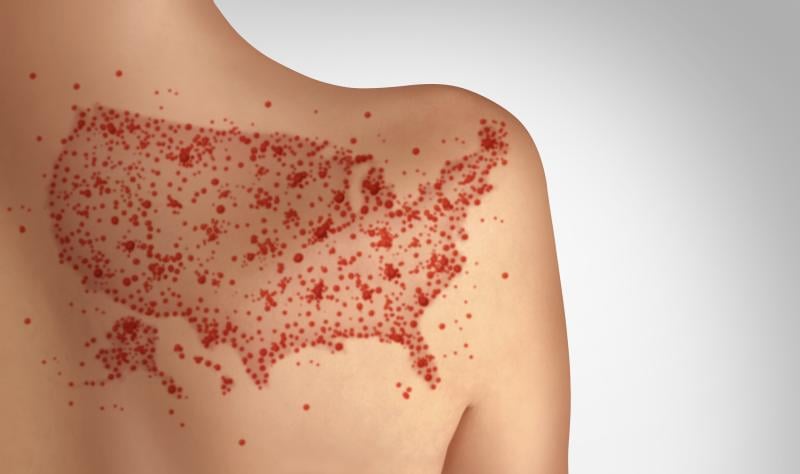
The United States has lost its measles elimination status, marking a significant policy setback 26 years after the country achieved elimination in 2000.
The Pan American Health Organization revoked the designation after determining that continuous domestic spread had persisted uninterrupted for more than 12 months. The decision arrived alongside confirmation of two additional measles-associated deaths in Pennsylvania and Wisconsin, bringing the nationwide toll to 10 for the year.
Surging Case Counts Across 45 States
Nationwide infections have surpassed 5,400 cases across 45 states, representing the highest transmission level recorded in the country in more than 30 years. The Centers for Disease Control and Prevention reported 5,412 confirmed infections, more than double the 2,289 cases registered nationwide in 2025.
Robert F. Kennedy Jr. in a 2021 book wrote that Americans had been "misled … into believing that measles is a deadly disease." He said measles outbreaks had been "fabricated" to push people towards vaccines. https://t.co/lBXK42mpjj pic.twitter.com/lo7ZA0nv8F
“When January 2025 picked up, I felt like this might be the point of no return,” Maimuna Majumder, a distinguished scholar in the Computational Health Informatics Program at Boston Children's Hospital, previously told Live Science.
The Pan American Health Organization, which serves as the regional office of the World Health Organization for the Americas, reached its determination regarding the revocation during a meeting of its Measles and Rubella Elimination Regional Monitoring and Re-Verification Commission in Washington, D.C. The commission’s international team of experts in epidemiology, public health, and virology evaluated data showing that the nation experienced uninterrupted transmission of the virus for more than 12 months.
Tom Frieden, who runs the global health organization Resolve to Save Lives, said that the country’s status represents a loss of achievement and indicates the nation is less healthy than it was when elimination was first achieved 26 years ago.

Nearly all of this year’s cases have occurred in individuals who either never received the measles, mumps, and rubella vaccine or whose vaccination status remains unknown. Public health agencies attribute the downward trend in protection to falling kindergarten vaccination rates, which have declined from 95 percent during the 2019-2020 school year to 92.4 percent.
Pediatric infectious disease specialist Adam Ratner described such fatalities as entirely preventable, while other specialists emphasized that measles remains the most contagious disease in the world, capable of spreading through the air and living on surfaces for two hours after an infected person departs a room.
Outbreaks Impose Heavy Financial Burdens on Public Health Agencies
Beyond the clinical toll, the prolonged outbreaks have imposed heavy financial burdens on state and local agencies. A newly developed tool from Johns Hopkins University researchers estimates an economic cost of nearly $83 million for the current outbreaks.
That projected total accounts for $56 million in public health response expenditures, nearly $25 million in lost workplace productivity, and over $1.8 million in direct medical expenses. Researchers emphasize that containment efforts require local health departments to divert staff and resources from other essential public health priorities.

For example, a previous New York outbreak model estimated labor-driven costs including fixed expenditures alongside thousands of dollars for each individual case managed through contact tracing and public health investigation.
“We're starting to see a whole bunch of people who decided not to get vaccinated as kids or have never gotten exposed to measles because they benefited from herd immunity, who now make it into adulthood and risk potentially getting quite seriously ill and requiring very significant medical expenses, or dying at the hospital,” Bryan Patenaude, a health economist at the International Vaccine Access Center at the Johns Hopkins Bloomberg School of Public Health, told CNBC.
Vaccine Coverage Gaps Among Adults
While much of the public discussion centers on children, adults account for 41 percent of cases this year.
“What you’re seeing now are people in their 20s, 30s and 40s who grew up at a time when this virus wasn’t circulating,” said Offit. Paul Offit, director of the Vaccine Education Center at Children’s Hospital of Philadelphia, during a panel hosted by the Association of Health Care Journalists.
Additional insights were provided by Gavin Harris, an infectious diseases physician with Emory Healthcare and associate medical director of the Serious Communicable Diseases Unit, who said that adults become infected at rates comparable to or higher than children. Nuwan Gunawardhana expressed sadness regarding the national reversal, while Peter Hotez observed that the loss of elimination serves as a vital sign of cracks in the public health foundation.

Readers seeking guidance on personal vaccination records, antibody status, or potential booster doses are advised to consult qualified healthcare professionals or check state immunization registries.
Earlier coverage: US Faces Loss of Measles Elimination Status Amid Case Surge