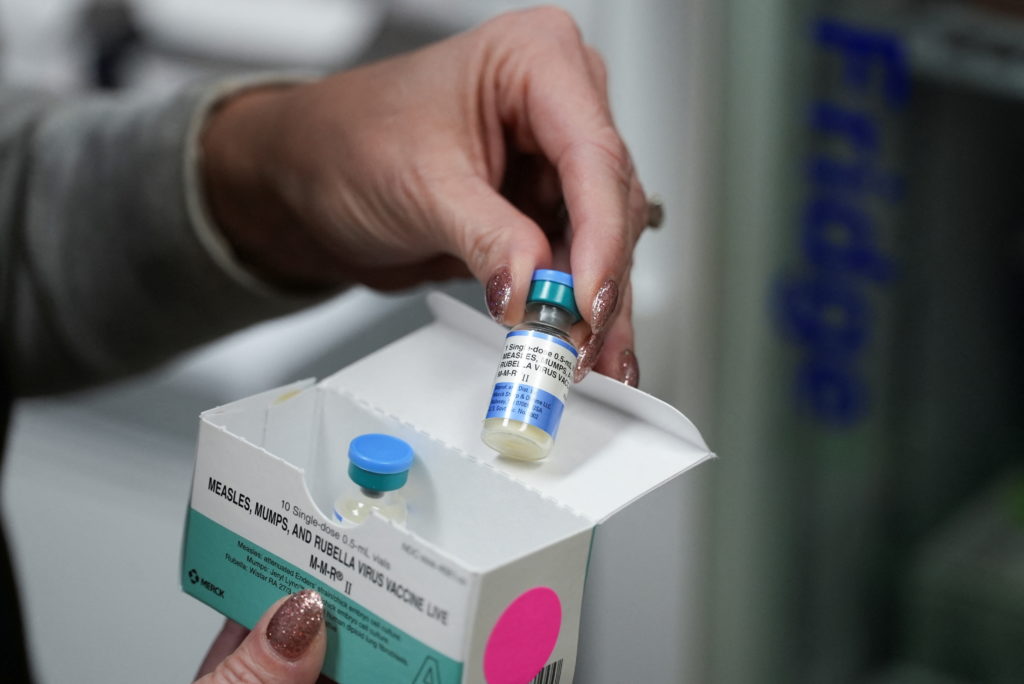
Adults across the United States are questioning whether they need a measles booster shot after the U.S. lost its measles-elimination status.
Measles cases in the United States have reached a 35-year high, with more than 5,000 recorded infections and eight related deaths this year. Nationally, reported cases have climbed past 5,400. Federal health guidance says routine boosters are unnecessary for most people who received proper childhood vaccinations.
The Pan American Health Organization reviews the country’s elimination status, which had been held since 2000. Approximately 41% of reported cases have occurred among adults aged 20 and older.
“We often forget about adults getting measles … 38% to 40% of cases this year of measles have been in adults,” Dr. Gavin Harris said. Adults experience infections at rates comparable to or higher than children. In 2025, just over half of all measles hospitalizations involved adults.
Health officials note that recommendations can change during active outbreaks. Joshua Sharfstein at the Johns Hopkins Bloomberg School of Public Health said that in places experiencing active measles outbreaks, health officials sometimes recommend that everyone have two shots. Sharfstein said that too many people took measles for granted or failed to think about it.
📣As of Nov 17, 2026, the U. S. no longer holds measles elimination status. Measles cases are at a 30-year high, with outbreaks, hospitalizations, and deaths occurring across the country. Learn more https://t.co/yuIPqGkXrd 1/7#MMRVaccine #VaccinesSaveLives #WeArePublicHealth pic.twitter.com/1SzIU37KFN
Checking Immunity Standards for Adults Born Before 1957
Americans born before 1957 are considered to have presumptive evidence of immunity. Childhood exposure to measles was nearly universal before vaccines became widely available.
Dr. Richard Martinello at the Yale School of Medicine said that “most people are protected without getting a booster shot” due to prior childhood infection or vaccination. Martinello said that for people who have received only one shot, particularly in areas where measles is circulating, consulting a physician about whether another shot is needed is a good idea.
Healthcare workers born before 1957 who lack proof of immunity fall into an exception. Clinicians advise that they evaluate whether a booster is appropriate to avoid contracting or spreading the virus to vulnerable patients. Additional groups that may benefit from extra doses include international travelers and students at post-high school institutions who lack proof of immunity.
Reviewing The 1963 to 1967 Vaccine Window
Adults vaccinated between 1963 and 1967 face different considerations. Some children received an inactivated vaccine using a killed version of the virus, which proved less protective than modern live-attenuated formulations.
The United States' measles elimination status is officially gone as doctors warn now is the time to get vaccinated or receive a booster. https://t.co/we3vn5E4mH pic.twitter.com/3kn8mwejNO
Physicians recommend that anyone who received the killed virus vaccine or remains unsure about their history should obtain at least one dose of the live measles, mumps, and rubella vaccine. A single MMR dose provides about 93% effectiveness against measles. Two doses increase protection to about 97%. Until 1989, only a single dose was standard practice.
Locating Lost Vaccination Records
Adults who cannot confirm their vaccination history can contact parents, former primary care doctors, high school or college health services, or previous employers that required immunizations, according to the Centers for Disease Control and Prevention. State health departments may also maintain registries that include adult records.

Wisconsin residents can search the Wisconsin Immunization Registry at dhfswir.org.
When documentation remains unavailable, Dr. Jocko Zifferblatt, an emergency medicine physician at ThedaCare Medical Center in Oshkosh, said that a blood test can help determine if a patient has an immune response. Some public health officials caution against routine titer testing due to lab fees, copays, and potential logistical hurdles.
“If we were truly concerned that you were going to get the measles, then we would actually do you a better service by just giving you a vaccine,” Dr. Margot Savoy said.
Yale School of Medicine, founded in 1810 as the Medical Institution of Yale College, is the sixth-oldest medical school in the United States. It formally opened in New Haven in 1813 and established a enduring tradition of original research by requiring students to write a thesis based on scientific investigation since 1839.
Dr. Gavin Harris, an infectious diseases physician with Emory Healthcare in Georgia and associate medical director of the Serious Communicable Diseases Unit, said that two doses are about 97% effective and one dose is about 93% effective for reducing infection.
Earlier coverage: Most Adults in the United States Do Not Need a Measles Booster Shot
The United States has lost its measles elimination status, the Pan American Health Organization formally announced on Tuesday. PAHO, a part of the World Health Organization, made the decision after reviewing evidence and determining that the measles virus has been continuously… pic.twitter.com/f1s6VHkRzz
More on United States
Measles is officially back in the United States. Today, the Pan American Health Organization (PAHO) announced that the United States has lost its measles elimination status because of an outbreak that has caused more than 5,700 infections and 10 deaths this year.…