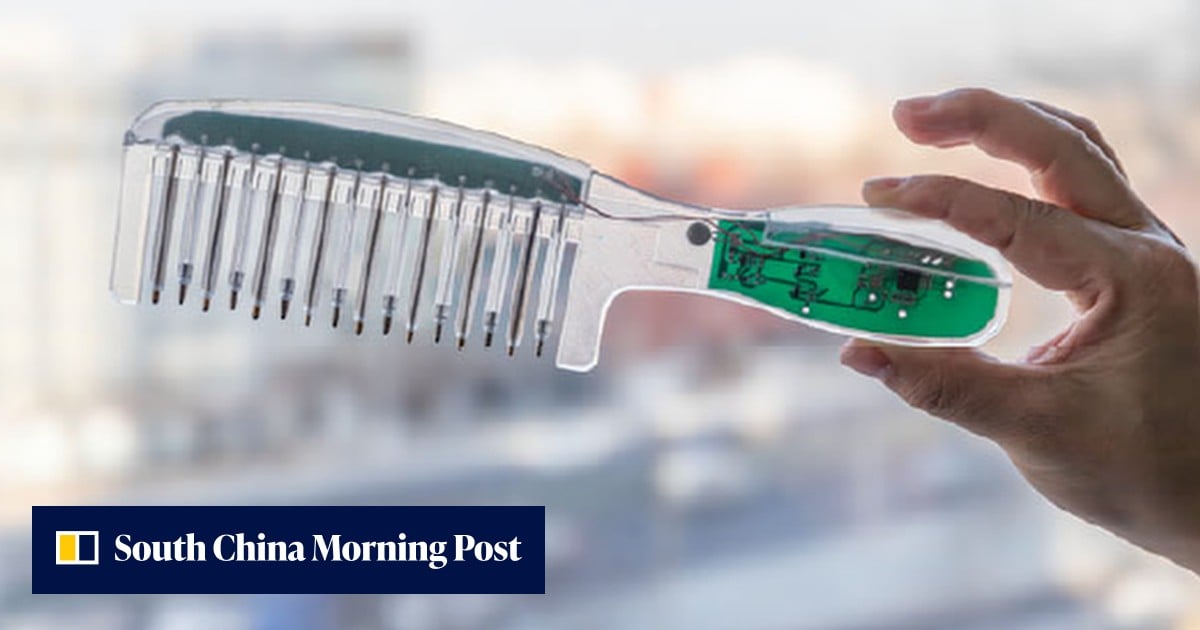
Chinese scientists at Beihang University have developed an experimental electric comb that restored nearly complete hair coverage in mice with pattern baldness within 28 days, outperforming minoxidil by a wide margin, a study published this month in Nature Communications found.
The device, named “Detangle” after the 2010 Disney film Tangled, combines microelectrical stimulation with deep delivery of two gene-based molecules. Mice treated with the comb achieved hair regrowth over almost 100% of the shaved test area. Mice treated with minoxidil reached roughly 70% coverage. Those given finasteride reached about 50%.
The comb resembles an ordinary grooming tool but contains specially designed teeth embedded with electrodes. Some teeth also house compartments loaded with therapeutic molecules. As the comb is drawn across the skin, it delivers tiny electrical pulses while its differently sized teeth gently lift the skin surface.
This action creates a stronger electric field that penetrates deeper into the tissue, helping the molecules enter hair follicle cells where they can stimulate growth.
“[T]hese results demonstrate that electrostimulation via the Detangle system promotes hair growth and follicle regeneration in a safe and effective manner,” the research team wrote in their paper.
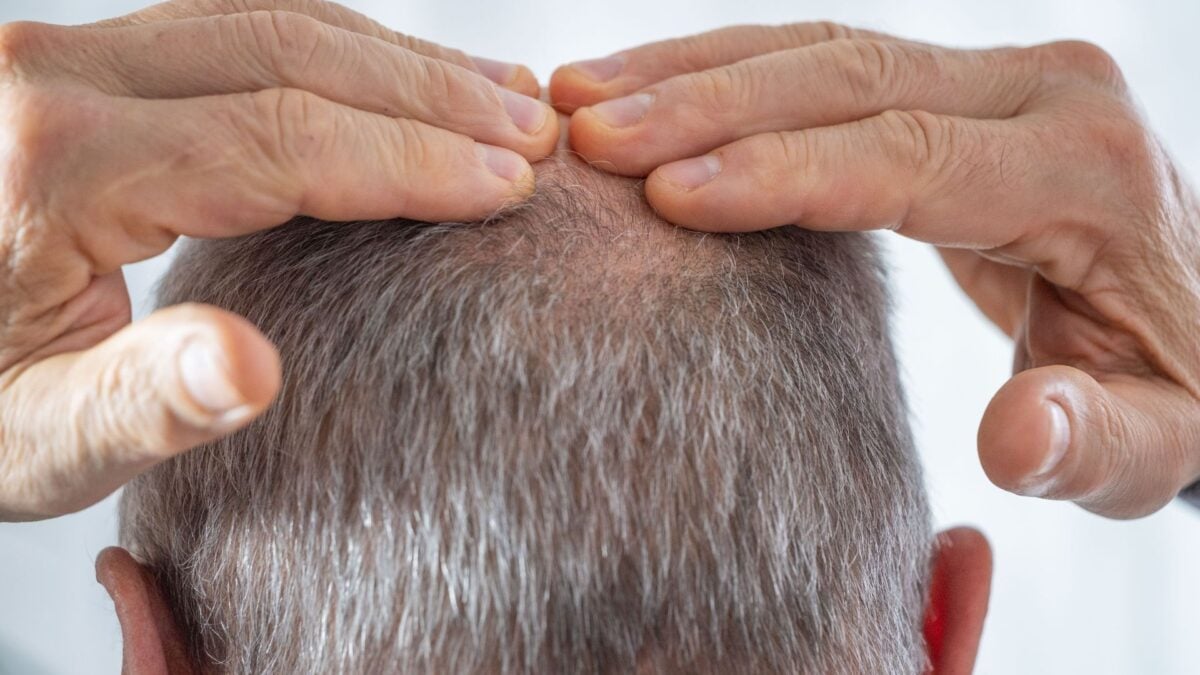
The researchers loaded the comb with two distinct molecules to address different mechanisms of androgenetic alopecia, the most common form of pattern baldness affecting an estimated 1.5 billion people worldwide. The condition is driven by hair follicles that are overly sensitive to dihydrotestosterone (DHT), a hormone that causes follicles to shrink and produce progressively thinner hair.
The first molecule, a VEGFA plasmid, carries instructions for producing a protein that promotes angiogenesis — the growth of new blood vessels — around hair follicles to improve their blood supply. The second, SRD5A2 siRNA, works to suppress the production of DHT. The team tested the device on mice with experimentally induced pattern hair loss, shaving their backs and dosing them with testosterone for 28 days before beginning treatment.
Mice were combed with the Detangle device once every three days over the 28-day study period. A group receiving electrical stimulation alone showed more regrowth than untreated mice. The greatest coverage — close to 98% — came when stimulation was combined with both molecules. Tissue analysis confirmed healthier follicle activity, improved local blood circulation, and safe molecular delivery without signs of skin damage, the researchers said.
“Safe and efficient delivery remains the key to the treatment outcome of AGA,” the study authors said, referring to androgenetic alopecia. They argue that delivering therapeutic molecules deep into the skin is essential, because topical treatments such as minoxidil often do not penetrate far enough to reach the follicles.
A comb with electrified teeth regrew nearly all lost hair on balding skin in a month. The device, called Detangle, was built by engineers at Beihang University in Beijing and described in Nature Communications. Its teeth carry tiny electrodes set at different heights, plus… pic.twitter.com/Fp6qpw23Ax
The study represents an early proof of concept in an animal model. The researchers have not confirmed whether or when the device might enter human trials. Much more research, including trials with human volunteers, is needed to find out whether the Detangle comb can achieve the same results in people, prove its long-term safety, and determine whether any hair regrowth lasts.
If successful in humans, the technology could offer a non-invasive alternative to messy topical gels, oral medications with systemic side effects, and surgical transplants. The team also suggested the deep-delivery platform might have applications for other dermatological conditions beyond hair loss.
SCMP | Gizmodo | Medical Xpress | The Brighter Side of News | Engineering and Technology Magazine