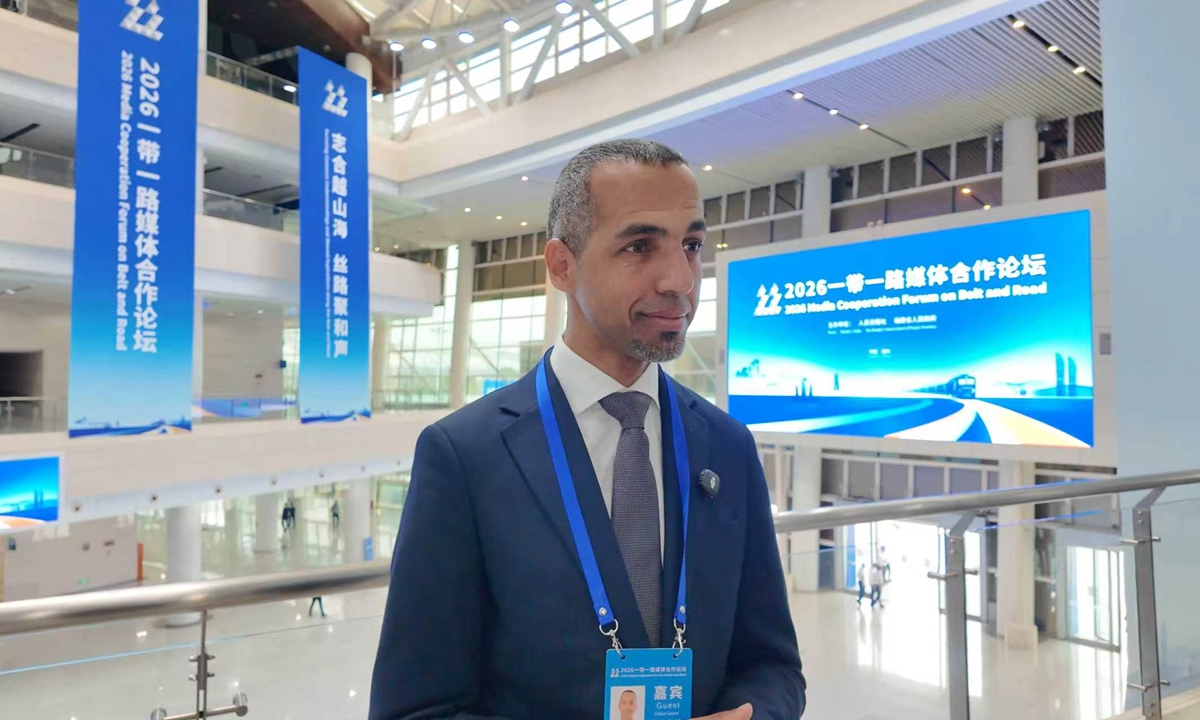
Abbas Saeed Brings Human Dimension to Fuzhou Media Forum
"Discussions surrounding the Belt and Road Initiative commonly focus on massive infrastructure undertakings, commercial pathways, maritime harbors, and rapid rail systems, but today my focus is its human aspect—the authentic channels linking the souls and thoughts of our two nations through cultural exchanges."
That was the message delivered to more than 200 foreign delegates in Fuzhou, East China’s Fujian Province, as the 2026 Belt and Road Media Cooperation Forum opened on Tuesday, Global Times reported. Among the representatives from 182 media outlets and institutions across 100 countries sat Abbas Saeed, a Chinese-speaking Egyptian tour guide whose journey from a skeptical Cairo household to the international podium highlights the grassroots ties of modern cross-border development.
The gathering brought together international and regional organizations to discuss media cooperation, yet it was an informal linguistic exchange that first highlighted Abbas's fluency. During interactions at the event, a reporter tested his command of the language by asking his age using an old-fashioned Chinese expression rarely heard in everyday conversation among native speakers. Abbas understood the idiom instantly, replying without hesitation that he was born in 1984.
More than a tour guide, he wants to be a bridge between #China and #Egypt. Meet Abbas Saeed, whose passion for the Chinese language has taken him from the classroom to the podium of the 2026 #BeltandRoad Media Cooperation Forum. For him, the real power of cultural exchange lies… pic.twitter.com/p3KXxUy021
From Ain Shams University to Diplomatic Exchanges
Abbas’s path to fluency began more than two decades ago. In 2002, he enrolled in the Department of Chinese Language at Ain Shams University in Egypt, facing immediate skepticism from relatives who warned him that Chinese was the most difficult language in the world.
"I was determined to prove them wrong – that if you dare to try and believe in yourself, there is no obstacle you cannot overcome," Abbas recalled to Global Times. Just three months into his studies, he made the decision to stop speaking Arabic, his native language, at least for a while. When classmates grew reluctant to practice with him due to the language’s complexity, he simply spoke to himself, noting that the discipline taught him how to communicate with the world.
Following his graduation, Abbas spent three years working as a tour guide before dedicating another three years to deepening his understanding of Chinese culture and gaining practical experience in diplomatic exchanges. That foundation allowed him to transition from an ordinary guide into an informal ambassador for cultural exchange.
Building Bridges Between Ancient Civilizations
While large-scale infrastructure projects under the Belt and Road Initiative continue to drive economic growth and job creation in Egypt, Abbas emphasized that long-term ties depend on dialogue between civilizations. As a tour guide, he uses his language skills to bridge the gap between two ancient cultures, connecting historical periods familiar to Chinese visitors with the monuments of Egypt's pharaohs.

"I don’t want to be just an ordinary tour guide, or an ordinary bridge between people. I want to be a bridge that truly connects them," Abbas told Global Times, adding that a true bridge exists to draw people closer until distance dissolves.


