Following surgery to treat an abnormal tangle of blood vessels in his brain, a 28-year-old man living in the northeastern United States has developed a rare visual condition that causes him to see features of his gray tabby cat, Luna, superimposed on human faces, and human features on his cat.
Brain Surgery and the Onset of Face Distortions
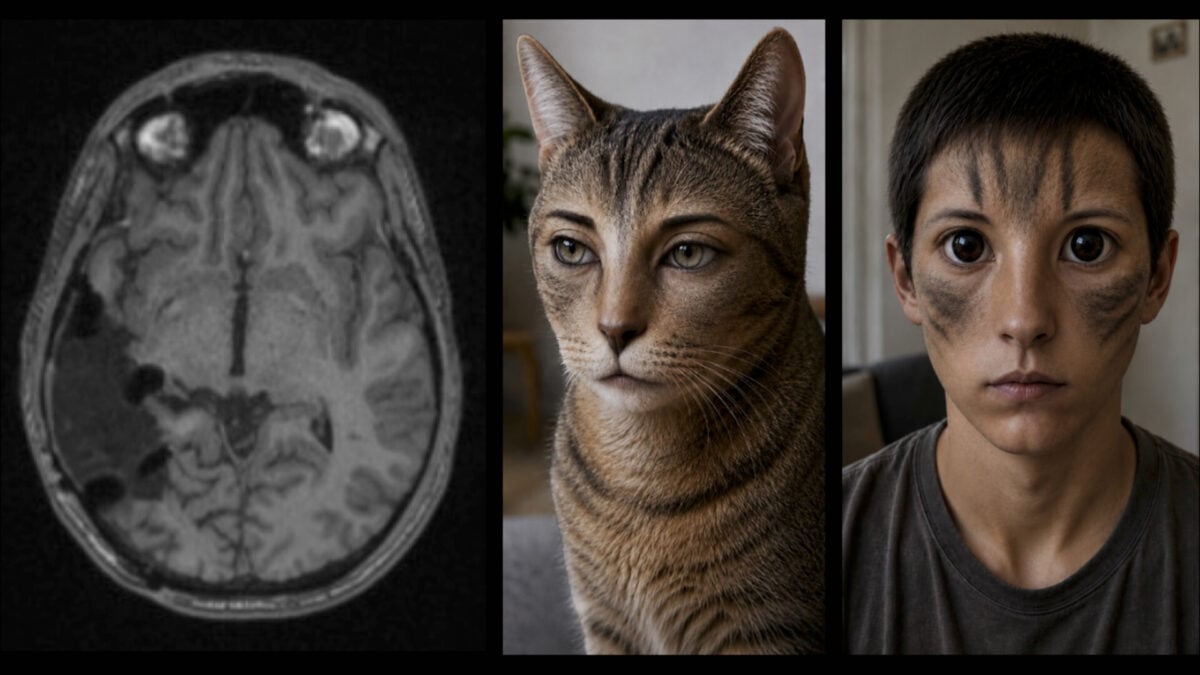
Identified in reports as Karl, the 28-year-old underwent surgery two years ago to remove an arteriovenous malformation in his right posterior temporal lobe, an area of the brain critical for recognizing and understanding faces.
The procedure was necessary to treat the irregular collection of arteries and veins, which carries a risk of brain bleeding if left untreated. Following the operation, Karl developed palinopsia, a neurological symptom causing earlier visual perceptions to linger or reappear in the field of view.

In Karl’s case, the condition manifests as prosopometamorphopsia, or PMO, which alters facial perception. Often, the first face Karl sees in the morning is that of Luna, his tabby cat. Throughout the day, features such as Luna’s almond-shaped eye sockets, enlarged pupils, and coat stripes reappear on the human faces he encounters in person or online.
The transfer also occurs in reverse. When Karl sees a human face first thing in the day, those facial features can subsequently appear on other people or on Luna’s face. Episodes typically persist for several hours and sometimes last an entire day.
Documenting the Condition in Cortex
Researchers documented Karl’s case in a report published in the journal Cortex. Spearheaded by Dartmouth University doctoral student Antônio Mello and Brigham and Women’s Hospital in Boston neuropsychologist Jennifer Nosker alongside Brad Duchaine—who serves as principal investigator of the Social Perception Lab and as a professor and chair of psychological and brain sciences at Dartmouth—the research was a collaborative effort.
“Seeing a friend's eyes in your cat's face, or vice versa, is extraordinary, but it tells us something about how all of us process faces,” Brad Duchaine, a professor and chair of psychological and brain sciences at Dartmouth, told Gizmodo.
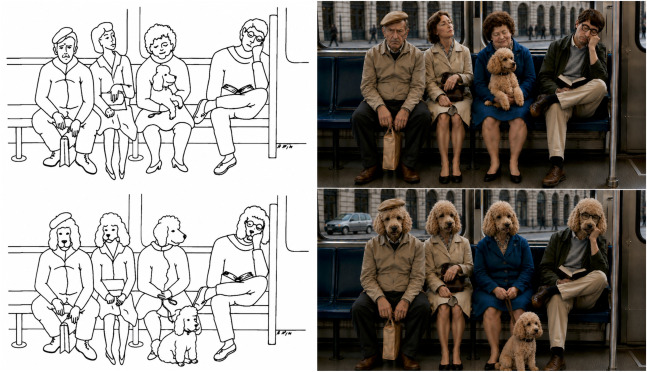
The authors said that Karl’s experience parallels a documented medical case from 1986 involving a woman who, following a stroke, saw a poodle’s face on every passenger while riding a bus.
While the 1986 patient experienced whole-face substitutions, Karl’s case involves specific features—primarily the eye region, coloring, and texture—transferring while the rest of the observed face remains otherwise normal. Duchaine explained that memories of familiar faces are being retrieved from long-term storage and blended into ongoing perception.
This case of Karl seeing his cat’s features in human faces and vice versa demonstrates that individual features can be pulled from memory and influence our ongoing perception.
Brad Duchaine, professor of psychological and brain sciences and principal investigator of the Social Perception Lab at Dartmouth
Using Artificial Intelligence to Visualize Perceptions
To convey what Karl experiences, the research team turned to artificial intelligence. Duchaine prepared an initial sketch based on Karl’s descriptions, then used generative AI tools to produce a baseline visualization. Karl subsequently refined the images using editing software until the resulting pictures matched his actual perceptions.
Duchaine said that generating accurate visualizations assists researchers in studying visual disorders and finding ways to control them. The approach also gives patients a tangible method to explain their symptoms to healthcare professionals, friends, and family. Dartmouth’s laboratory has heard from more than 250 individuals reporting face distortions, with some patients previously misdiagnosed with psychiatric conditions or prescribed antipsychotic medications when experiencing neurological visual problems.
Specialists Praise Unique Patient Contributions
Characterizing the conclusions as wonderfully innovative, Jan Dirk Blom—a clinical psychiatrist at Parnassia Psychiatric Institute and Leiden University in the Netherlands who did not take part in the study—offered his perspective on the work. Blom said that clinical psychiatry relies entirely on accurate patient descriptions and praised the work as an excellent example of patient participation.
Blom also pointed out that the study reveals how a cat’s eyes can be transposed from memory banks onto observed human faces and vice versa. He added that the work provides a rough idea of the brain areas making such perceptual shifts possible.
This research is supported by the academic infrastructure at Dartmouth University, which hosts specialized facilities for studying human perception. The institution includes the Social Perception Lab, where Brad Duchaine serves as principal investigator, and the department of psychological and brain sciences, where Duchaine also holds the role of professor and chair.
Clinical Observations and Patient Participation
Specialists emphasize the importance of clinical descriptions provided directly by patients experiencing rare neurological phenomena. Researchers highlight that individual patient participation offers vital insights into complex visual processing systems that standard statistical analyses might otherwise overlook. For individuals dealing with unusual visual distortions, consulting qualified medical professionals and specialists remains an essential step toward obtaining accurate diagnoses and appropriate care.