Published in Nature on October 21, 2026, a new study reveals that moderate cold exposure extends lifespan and preserves protein health in the nematode Caenorhabditis elegans by triggering an intertissue metabolic network that links muscle cells to distant organs through dihydrobiopterin signaling.
Moderately cold exposure extended lifespan and improved health in the nematode Caenorhabditis elegans by engaging a biological communication channel between distinct organ systems.
Researchers investigating how temperature changes influence animal physiology discovered that moderate cold exposure initiates a coordinated metabolic cascade throughout the organism.
Muscle Cells Produce Dihydrobiopterin
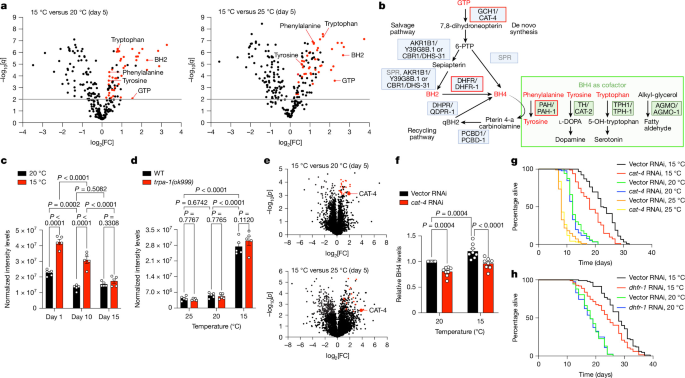
The pathway begins inside muscle tissue. Untargeted metabolomic experiments conducted across adult worms maintained at 15 °C, 20 °C, and 25 °C identified a distinct set of cold-induced metabolites. Chief among them was dihydrobiopterin, commonly known as BH2. This initial production phase depends heavily on the enzyme CAT-4, the worm counterpart of the human GCH1 protein involved in biopterin synthesis.
Experiments manipulating CAT-4 demonstrated that increasing its activity raised BH2 levels directly. Experimentally elevating CAT-4 specifically within muscle tissue successfully replicated several physiological effects of cold exposure, even while the animals remained at normal or elevated ambient temperatures.
Molecules Travel to Intestine and Nervous System
Once synthesized in the muscle, BH2 does not remain localized. BH2 then travels to organs including the intestine and nervous system, acting as a mobile metabolic precursor. Upon reaching these distant recipient tissues, a salvage enzyme designated as DHFR-1 converts the transported BH2 into tetrahydrobiopterin, or BH4.
The investigative team found that disrupting this transport and conversion chain weakened the typical phenotypic benefits associated with cold exposure. Restoring enzyme activity in targeted tissues successfully re-established the protective physiological responses, confirming that intertissue communication is essential for the pathway to function.
Tyrosine Supports Longevity
The conversion into BH4 serves a downstream biochemical purpose. BH4 operates as an essential cofactor for phenylalanine hydroxylase, known as PAH-1, which facilitates tyrosine synthesis in the organism. Experimental results showed that the longevity benefits generated by the BH2-to-BH4 pathway required this connection to PAH-1.
Supplementing the worms directly with tyrosine reproduced the same lifespan extension observed under cold conditions, establishing tyrosine as a downstream mediator rather than treating BH2 as the final endpoint of the longevity mechanism.
Cells Stop Protein Aggregation
Beyond extending lifespan, activating the BH2 metabolic network delivered improvements in protein quality control. Elevated BH2 synthesis in muscle cells measurably reduced disease-related protein aggregation in distant tissues throughout the ageing process.
Analyses of ageing populations showed decreased accumulation of aggregation-prone proteins, while preserving overall neuronal and intestinal function. Tyrosine supplementation successfully mimicked part of this protective proteostatic effect, demonstrating that the entire network coordinates systemic protein health alongside longevity, building on the initial baseline established when adult worms were maintained at 15 °C, 20 °C, and 25 °C.


