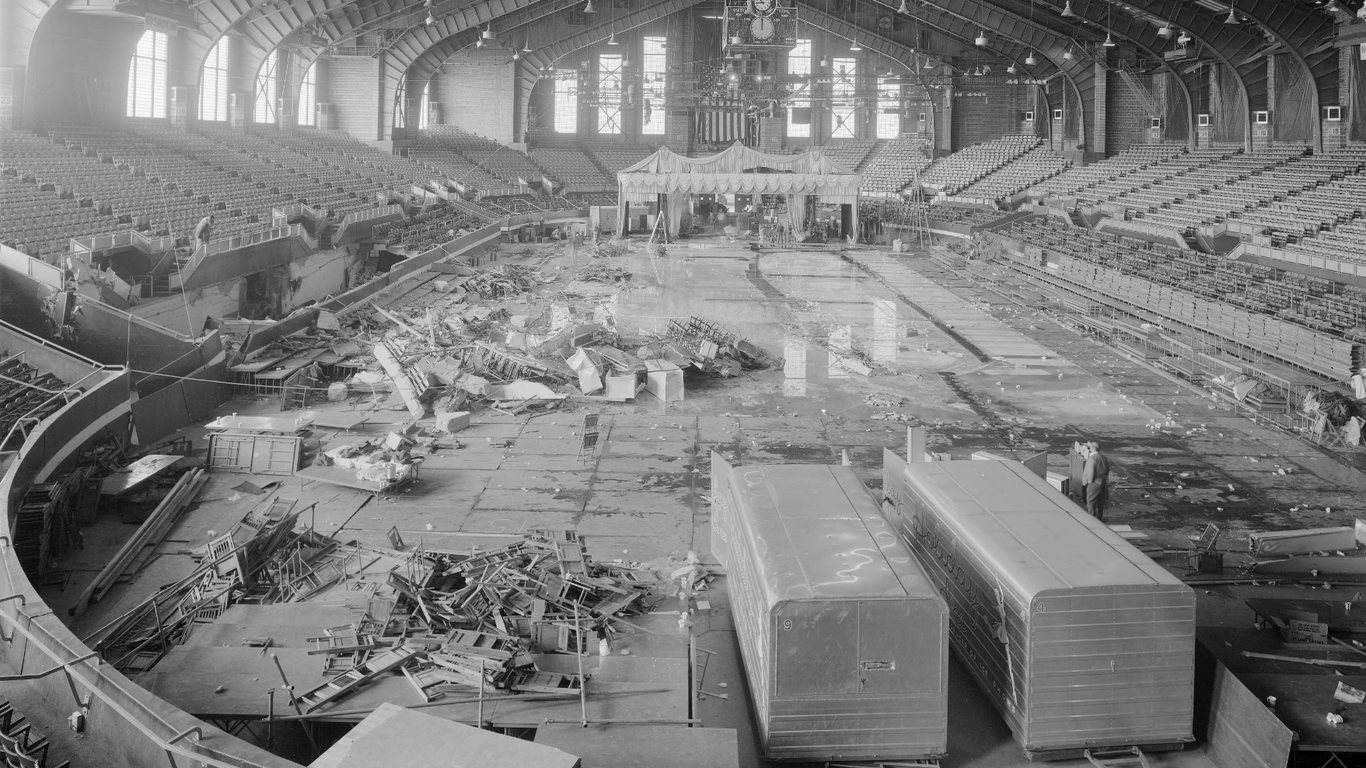
On Halloween night in 1963, the Indiana State Fairgrounds Coliseum was filled with the laughter of families and the smooth glide of skaters during a “Holiday on Ice” performance. It was Shriners Night, a festive local tradition that drew more than 4,000 spectators into the arena. Shortly after 11:00 p.m., that atmosphere of celebration was shattered by a catastrophic explosion that remains one of the darkest chapters in Indianapolis history.
A Night of Unimaginable Loss
The tragedy began in the south-side seating area, where a faulty valve on a rusted propane tank—improperly stored in an unventilated concession-area storeroom—allowed gas to leak into the space. The gas ignited near an electric popcorn machine, creating a blast that shook the building. A second explosion followed as additional propane tanks erupted, turning a night of entertainment into a mass-casualty event.
Historical records from Indianapolis document the staggering toll: 54 people lost their lives at the scene, and another 20 succumbed to their injuries later. The scale of the disaster was instantaneous and overwhelming, forcing a city that lacked modern emergency protocols to improvise under duress.
The Response That Redefined Emergency Planning
When the dust settled, the response effort was a chaotic but heroic scramble. Police, firefighters, the Red Cross, the Salvation Army, and hundreds of volunteers converged on the fairgrounds. With no centralized system for casualty management, first responders and volunteers used whatever vehicles were available—ambulances, buses, and private cars—to transport victims to local hospitals. The nearby cattle barn was quickly repurposed into a makeshift hospital, while the ice floor itself became a temporary morgue.
The city’s struggle to coordinate that night became the subject of a landmark disaster-research case study titled Disaster in Aisle 13. The study highlighted the fatal lack of mass-casualty planning and the inefficiency of patient distribution among area hospitals. As a direct result of these failures, Indianapolis overhauled its inter-hospital communication system the following year, setting a new standard for how the city would handle large-scale emergencies.
The Long Road to Accountability and Renewal
The aftermath of the explosion moved from the fairgrounds to the courtroom. The disaster triggered years of intensive litigation, involving more than 400 separate lawsuits. Plaintiffs sought roughly $70 million in damages, a massive sum for the era, though the legal process eventually concluded with $4.6 million in total settlement payouts.
The fairgrounds themselves eventually recovered, though the memory of the event remained etched into the city’s identity. The Coliseum underwent extensive repairs and, because the community wanted to move forward, reopened to the public. In a strange turn of history, the venue hosted the Beatles in 1964, less than a year after the tragedy, marking a transition from a site of mourning to a space of public gathering once again.
While the Coliseum was eventually repaired and reopened, the lessons learned from the “Holiday on Ice” disaster regarding emergency coordination and communication remain a subject of study.



