Nashville Film Festival Sparks Campus Momentum at Belmont University
Step onto the Belmont University campus at ten o’clock at night, and you might just stumble upon the future of Tennessee’s entertainment economy. Following this year’s Nashville Film Festival, film and television writing instructor Stephen Hauser issued a late-night, impromptu invitation to a handful of curious students, challenging them to bypass the waiting game and simply start building.
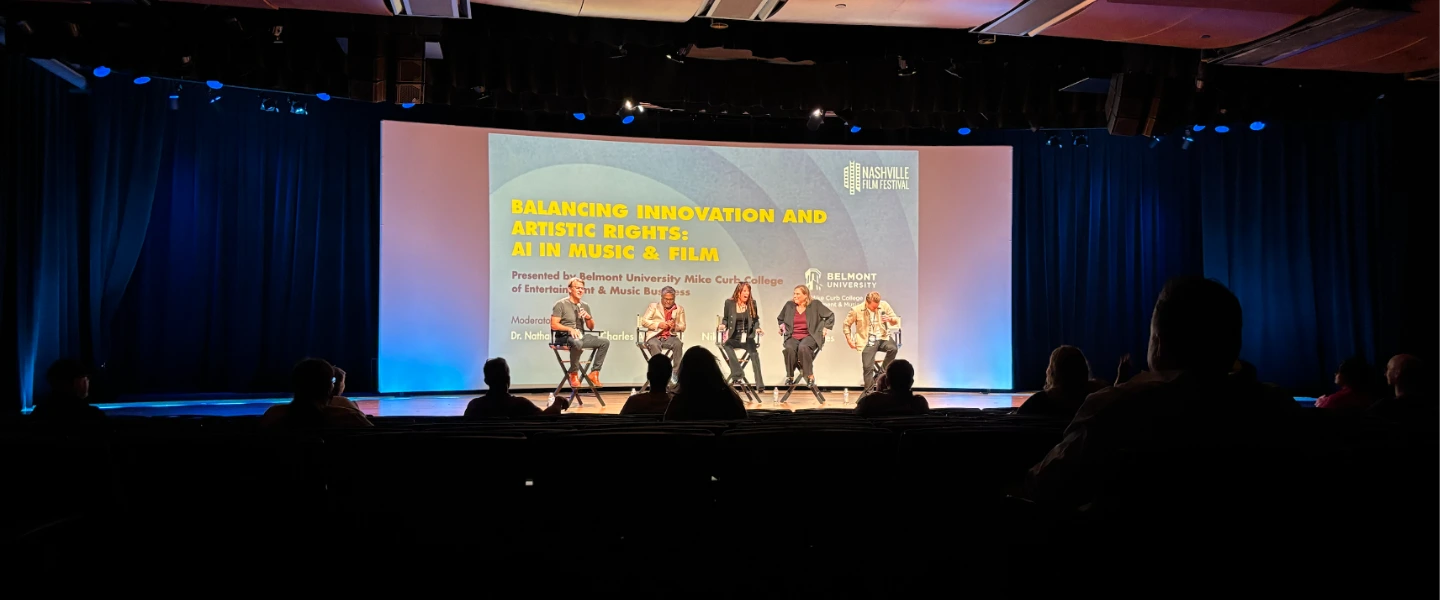
Alongside Hauser, associate professor of media production Dr. Nathan Adam and Rick Rekedal, creative arts collective for Christian life & faith thought leader, represented the university on festival panels. While their respective disciplines cover everything from screenwriting and classroom instruction to digital production and creative leadership, their conversations converged around a single, persistent reality: Nashville is maturing into a self-sustaining ecosystem where media professionals can launch, build, and sustain lifelong careers.
Building a Local Creative Economy and Retaining Talent
For years, the unspoken rule for aspiring southern storytellers was an eventual departure for the coasts. Rick Rekedal, who moderated a festival panel titled “Growing Tennessee’s Creative Economy” alongside industry voices Gisela Moore, Brian Loschiavo, Chris Conner, and Bob Raines, sees that migration pattern reversing in real time. The ultimate goal goes far beyond simply wooing big-budget Hollywood productions to shoot against a Tennessee backdrop. It requires cultivating the individual storytellers who live and work here year-round, treating filmmaking with the same institutional dedication Nashville has historically lavished on its legendary songwriter community.
“There might have been past generations where students felt like all they could do in Tennessee was get their degree before moving to one of the coasts for work. We’re actually now finding the opposite to be true,” said Rick Rekedal.
To quantify and project these shifts, Belmont Innovation Labs is currently leading an impact study examining the future of media and film throughout Tennessee, partnering directly with industry leaders statewide. During those panel discussions, fellow speaker Bob Raines shared a telling observation that immediately resonated with the Belmont team: young creatives who secure tangible professional traction during their first or second year in the field tend to stay. That exact data point drives Belmont’s academic philosophy, pushing undergraduates into professional, project-based work while students are still undergrads.
Technology, Proximity, and the Cocoon of Talent
The practical mechanics of modern media production are shifting rapidly, largely driven by the integration of artificial intelligence into everyday workflows. Dr. Nathan Adam, whose students have gone on to build careers with the Nashville Predators, CMT, local television stations, and in-house creative teams, recognizes that the technological baseline is moving faster than ever. Yet he argues that software and automated tooling cannot replace fundamental artistic judgment.
“Using AI will absolutely be one fundamental tool in any media producer’s toolkit,” Adam noted. “But you still need somebody that knows what good video looks like.”
Beyond hardware and software licenses, Adam points to an intangible asset that routinely sets the university apart: physical and creative proximity. Placing ambitious young artists shoulder-to-shoulder creates an organic incubator where collaboration happens naturally. Students find themselves surrounded by peers who possess complementary skill sets, removing the friction traditionally associated with crewing up an independent production.
A Shift Toward Independent Infrastructure
That local infrastructure feels entirely natural to Stephen Hauser, who spent years writing screenplays in Los Angeles before relocating to Nashville more than a decade ago. Watching the city’s infrastructure expand has convinced him that local creatives no longer need to look outward for validation or technical execution.
“There is something here that feels like Los Angeles,” Hauser said. “We are set up to handle each step of the creative process right here, with little that we still have to outsource.”
Hauser frequently points to the philosophy of independent filmmaker Pete Ohs, another prominent voice at the festival who discussed making movies with a small, trusted group of collaborators. Armed with technology to create and the means to distribute, today’s students possess the exact tools required to find their audience.
For the students currently gathering on Belmont’s campus late at night to draft sketch comedy scripts, outline narrative series, and shoot horror shorts, the theoretical future of Tennessee entertainment is already operating in the present tense. They are building their portfolios, testing their creative chemistry, and proving that the next generation of film and media careers can take root and thrive right here in Nashville.