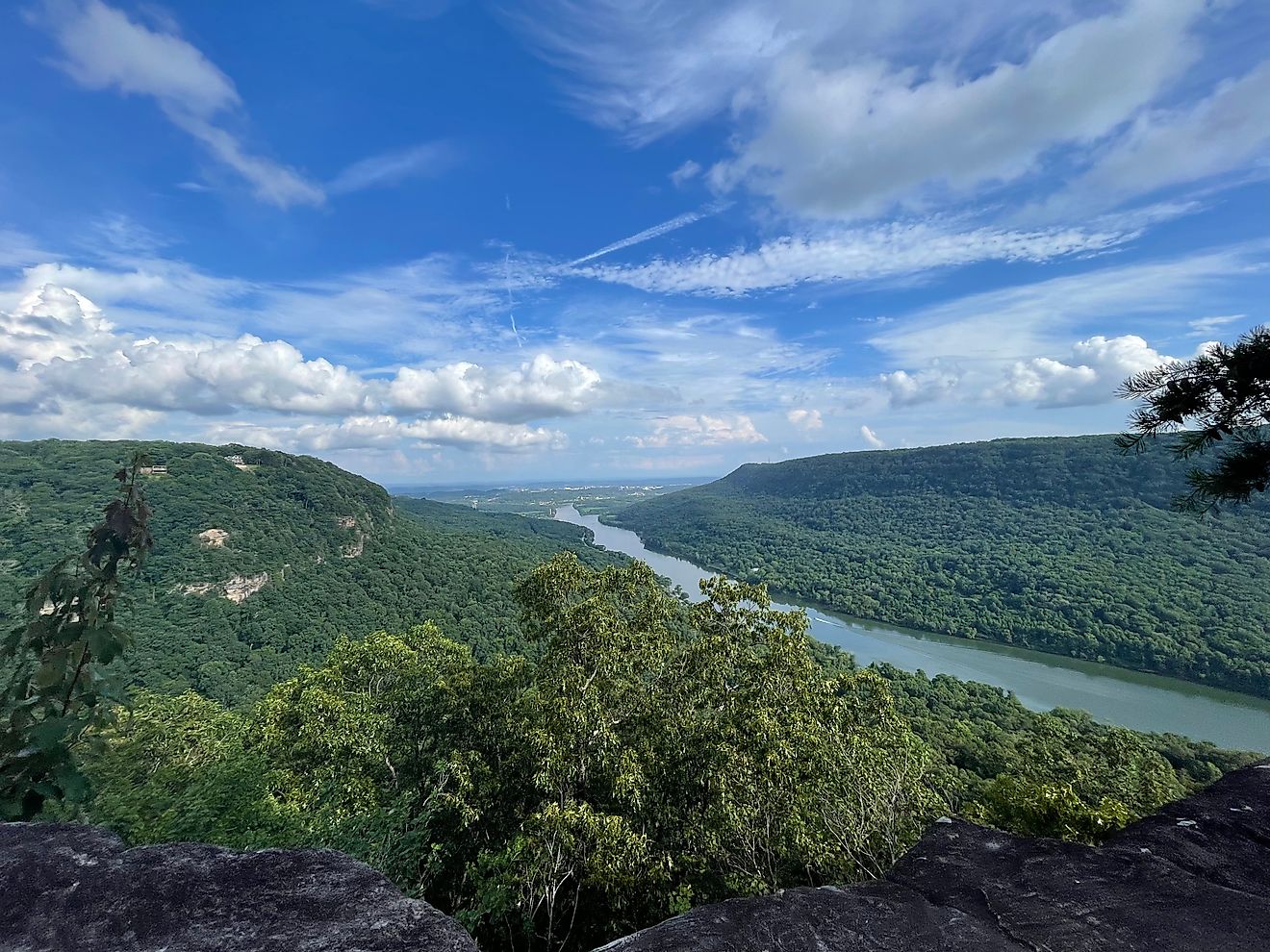
Tracing Quiet Corridors Across Tennessee
During the coldest months in Big Sandy, less than 500 inhabitants observe portions of the adjacent wildlife reserve restrict boat traffic so that migrating geese and ducks can find undisturbed rest. These seasonal closures, set to take effect on November 15, mark just one version of tranquility found far from Tennessee’s busiest tourist centers. These hidden pockets, including small towns, feature free-flowing rivers, wooded reservoirs, and protected mountain valleys that dictate a much slower rhythm of life.
Understanding these communities requires looking past standard vacation guides and examining how deliberate land conservation, state parks, and historical preservation shape daily existence.
Tennessee Valley Authority Designed Norris Around Greenbelt Principles
Norris was designed to be calm from its inception. The Tennessee Valley Authority built the community beginning in 1933 to house workers on Norris Dam, its first dam project. Planners laid the town out on greenbelt principles, with undeveloped land surrounding the town.
Houses followed the natural contours of the hills, and builders avoided cutting trees wherever possible. Today, about 1,600 people live in this Anderson County city, where the Norris Municipal Watershed covers 2,300 acres with roughly 30 miles of trails, and ATVs are banned throughout. Clear Creek Trail runs 4.1 miles through the woods, passing the Rice Gristmill, which was built in 1798 and moved to Clear Creek in 1935. Meanwhile, Norris Dam State Park covers more than 4,000 acres, featuring hiking trails and cabins built by the Civilian Conservation Corps in the 1930s.

Stargazing in Jamestown and Wilderness Preservation
Further east, Jamestown sits near a certified International Dark Sky Park. In 2015, Pogue Creek Canyon State Natural Area and Pickett CCC Memorial State Park jointly achieved the certification, and Pickett maintains a year-round astronomy field beneath some of the Southeast’s lowest light-pollution skies.
The Fentress County seat houses about 1,900 residents amid heavily wooded surroundings. Pickett State Forest covers 20,858 acres with an extensive network of hiking trails, while the Civilian Conservation Corps constructed the park’s sandstone cabins and 12-acre Arch Lake. Spanning 3,000 acres on the Cumberland Plateau, Pogue Creek Canyon safeguards a sandstone gorge, forest, and rock shelters while linking visitors directly to the adjacent Big South Fork National River and Recreation Area.
Buffalo River and State Parks Shape Linden Region
The Buffalo River explains Linden’s pace. At 125 miles long, it is one of Middle Tennessee’s longest undammed rivers, supporting nearly 85 species of fish. Outfitters around the Perry County seat rent canoes and kayaks for float trips, serving a town of about 1,000 residents.

Ascending approximately 2.7 miles round-trip, the path at Lady’s Bluff Small Wild Area leads hikers to limestone cliffs elevated far above the Tennessee River. Mousetail Landing State Park occupies 1,247 acres on the river’s east bank, offering roughly 11 miles of trails and a swimming beach. Back in town, the Commodore Hotel, built in 1939 and restored in 2007, remains one of Linden’s most recognizable historic buildings.
In Erwin, roughly half of Unicoi County is federal land, much of it within Cherokee National Forest. Situated among mountains covered in trees, this community of 6,100 people sees the Appalachian Trail run through the county close to the Nolichucky River. The Erwin National Fish Hatchery, founded in 1897, produces approximately 16 to 20 million eggs a year, offering free admission and fish food to visitors exploring the half-mile nature trail behind the Unicoi County Heritage Museum.
Deep Waters and Historic Squares in Celina and Tracy City
Celina sits where the Obey River meets the Cumberland, a short drive from Dale Hollow Lake. The U.S. Army Corps of Engineers describes the lake as exceptionally clear, operating as a designated no-discharge zone where boats may release no sewage. Its 27,700 acres of water wind past 620 miles of forested shoreline.
With Celina serving as the seat and housing roughly 1,400 people, Clay County maintains a population density of about 32 residents per square mile. Dale Hollow produced the world-record smallmouth bass—an 11-pound, 15-ounce fish caught on July 9, 1955. Near where Cordell Hull established his initial law office, the 1873 Clay County Courthouse stands on the town square and holds a place on the National Register of Historic Places.
Tracy City opens straight onto the woods. Grundy Forest State Natural Area, spanning 234 acres on the town’s southwest side, serves as the northern trailhead of the Fiery Gizzard Trail, running about 12 miles south to Foster Falls. About 1,400 people live in town, where Grundy Lakes features a swimming beach alongside the Lone Rock coke ovens, built in 1883. The Dutch Maid Bakery has baked in town since 1902, recognized by Grundy County as the oldest family bakery in Tennessee.
Refuges, Rivers, and Remote Waterfalls
Big Sandy relies heavily on its surrounding protected wildlife land. Comprising 21,348 acres within a broader 51,000-acre reserve, the Big Sandy Unit of the Tennessee National Wildlife Refuge rests directly next to the town near Kentucky Lake. President Harry Truman established the refuge in 1945 along 65 miles of the Tennessee River. Winter brings peak bird activity, with the refuge recording more than 316 species before boat restrictions take hold from November 15 to March 15.
In Elizabethton, much of eastern Carter County lies inside Cherokee National Forest, with the Doe and Watauga rivers running through toward the town. Its 1882 covered bridge, a 154-foot wooden span over the Doe River, carries only foot traffic today. Having withstood the destructive 1901 floods that washed away all other spans on the river, it also endured the impact of Hurricane Helene in 2024. Situated more than 1,900 feet above sea level and encircled by timbered mountains, Watauga Lake spans 6,430 acres as the highest reservoir within the Tennessee Valley Authority network.
Further west, Sparta features natural areas and waterfalls like Lost Creek State Natural Area, where a 40-foot waterfall is reached by a short trail beside a cave with seven miles of mapped passages. The White County seat of 5,000 residents also hosts Lost Creek State Natural Area, featuring a 40-foot waterfall and a cave with seven miles of mapped passages that served as a filming location for The Jungle Book in 1994.
Sanctuary Protects Elephants in Lewis County
Hohenwald offers protection of a different scale. The 3,060 acres of The Elephant Sanctuary are closed to visitors, giving its resident elephants a large landscape away from public disturbance. Settlers from Switzerland and Germany founded the town in the late 1800s, naming it for the German term for “High Forest.” The Lewis County seat of about 3,700 residents sits near the Natchez Trace Parkway, where the Meriwether Lewis Death and Burial Site marks where the explorer died in 1809.
Pikeville, the Bledsoe County seat, sits in the Sequatchie Valley with Fall Creek Falls State Park roughly 18 miles west. Plunging 256 feet down into a timbered canyon, its signature waterfall ranks among the highest single-drop cataracts in the eastern region of the United States.