A Pioneer in Agoura Hills: The First Mammal to Scale the 101 Crossing
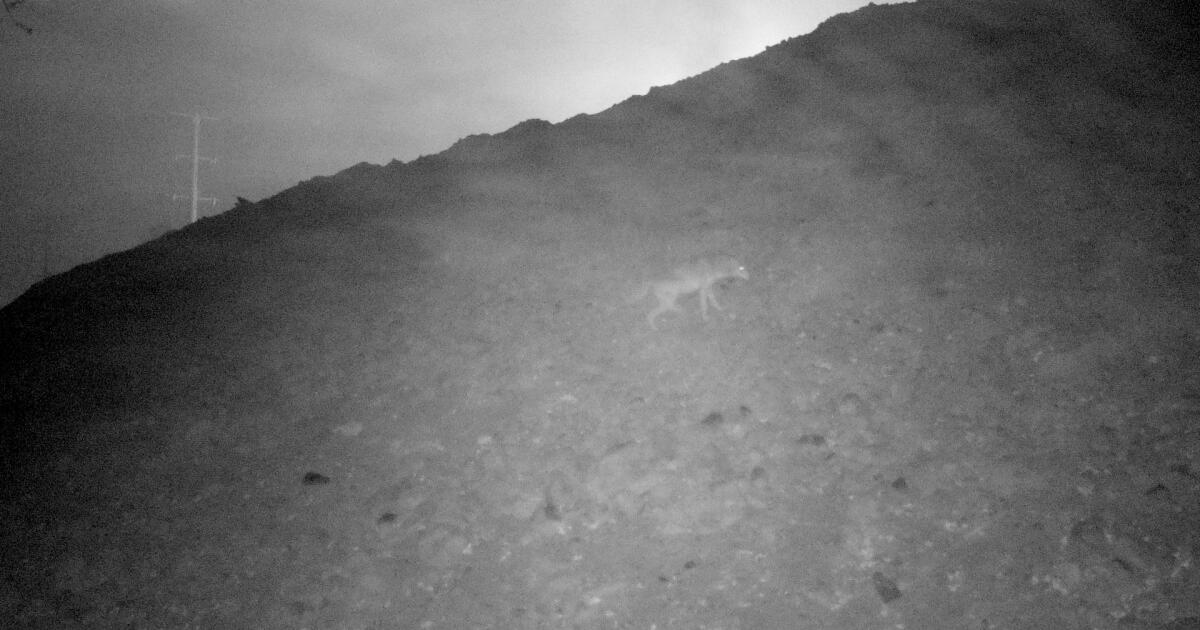
On a brisk October morning in Agoura Hills, a coyote turned a mound of dirt into a landmark. The animal, captured on a black-and-white trail camera at 6 a.m., became the first large mammal known to ascend the gargantuan wildlife crossing nearing completion over the 101 Freeway. While the coyote could not complete the full transit—the soil for the overpass had not yet been built up to create a seamless connection—the image of the creature navigating the slope provided the first tangible proof that the structure is already drawing interest from local wildlife.
The Wallis Annenberg Wildlife Crossing is a roughly $114-million infrastructure project designed to provide safe passage for wildlife locked in the Santa Monica Mountains by freeways and development. The crossing is set to officially open on Dec. 2, provided that fierce winter storms do not force a delay. For the National Park Service and the conservationists who have spent years advocating for the project, this early visitor is more than just a data point; it is a validation of a massive, long-term civic investment.
The Existential Stakes for Santa Monica Mountain Lions
This project is not merely an aesthetic addition to the California landscape. For the mountain lions of the Santa Monica Mountains, the crossing represents a potential lifeline. Since 2002, researchers have been tracking mountain lions in the area. The lack of connectivity has led to a dangerous rise in inbreeding, with scientists documenting physical abnormalities such as kinked tails and deformed testicles.
The crossing aims to facilitate the movement of big cats between the Santa Monica Mountains and the Simi Hills. According to National Park Service wildlife biologist Jeff Sikich, even the successful migration of a single mountain lion to breed with the local population could significantly improve the genetic diversity of the range. The stakes are existential; without this corridor, the local lion population faces a precarious future defined by a shrinking gene pool and limited resources.
Monitoring the Migration
The discovery of the coyote was the result of persistent collaboration between conservationists and field scientists. Beth Pratt, president of the Wildlife Crossing Fund, noted that after an Oct. 8 news conference, she began playfully texting Sikich with daily requests to install a camera on the southern approach. By Oct. 14, a camera was in place. The resulting image showed the coyote with its eye shining bright white, a fleeting but critical glimpse into the animal’s behavior.
“We’ve been spending decades, literally decades, documenting how wildlife has become isolated in the Santa Monica Mountains, and what makes us scientists excited is now we have this opportunity to study what happens when we reconnect it,” said Jeff Sikich, a National Park Service wildlife biologist.
The monitoring plan is extensive. Scientists intend to employ more than 50 cameras and four thermal video units to track movement across the site. Beyond simple observation, researchers are also using GPS radio collars and internal biologgers in deer and mountain lions to measure physiological data, including heart rate and body temperature. This will allow the National Park Service to determine if the crossing effectively reduces the physiological stress animals experience when moving near high-traffic human corridors.
Pratt Defends $114 Million Crossing Cost
While the project is a win for regional ecology, it remains a significant public expenditure. At roughly $114 million, the crossing has drawn attention to the cost of mitigating the environmental impact of suburban development and the freeway network. However, proponents like Pratt argue that the project addresses a human-made problem, stating, “There’s a lot of wrongs in the world, but we righted this one. We actually fixed this one for the wildlife.”
The project’s success will ultimately be measured by whether the animals actually use it to traverse the freeway safely, rather than attempting to cross the asphalt below. As crews work to finish the grading and soil buildup, the focus remains on the looming December opening. For now, the sight of a single coyote on the slope serves as a quiet, early signal that the path is being recognized by those it was intended to serve.


