The Architecture of Anxiety on Michigan Golf Courses
In a newly published column, golf writer Craig LeVasseur shares a compilation of the scariest golf holes in Michigan.
The compilation examines specific hazards ranging from blind water crossings guarded by snapping turtles to fairways running dangerously parallel to active public thoroughfares.
From Blind Hazards to Public Roads
Among the top contenders for architectural distress is the 18th hole at Brae Burn Golf Course, which transforms a historic Wilfrid Reid design into a sprawling 666-yard double dogleg par 5. The hole features a blind water hazard in the second-shot landing area—reportedly populated by snapping turtles—and is actively marketed by the facility as the “Home of the Monster.”
Property damage risks introduce an entirely different category of fear for golfers playing through tight routings. Plum Hollow Country Club’s 4th hole forces players to contend with 9 Mile Road running parallel just beyond the trees to the right. LeVasseur notes watching a playing partner drive a ball directly onto the roadway, prompting an intentional bailout toward an adjacent fairway to avoid a repeat occurrence. Similar roadside vulnerabilities appear at the Manistee Golf & Country Club, which features at least three points where a wayward slice can reach nearby traffic.
At Petoskey-Bay View, the former 6th hole required players to cross a regular public road situated squarely in the landing area, completely hidden from both tee and green.
Forced Carries and Tight Landing Zones
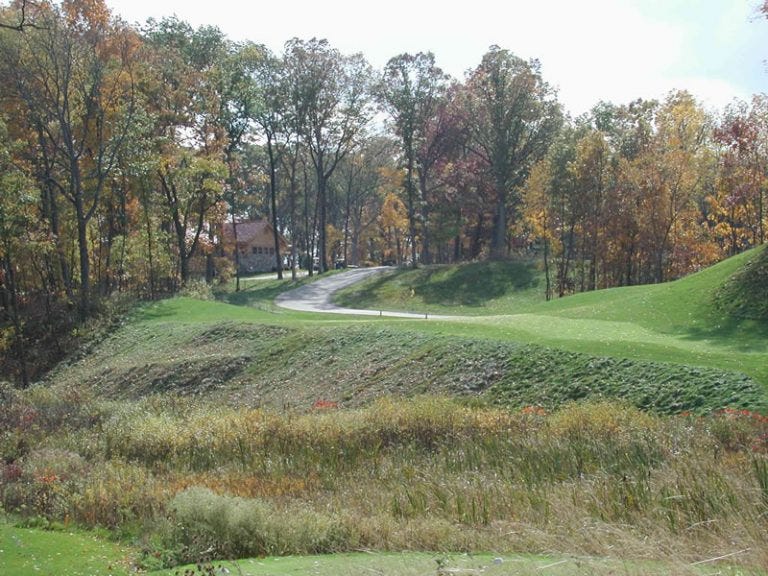
The 9th hole at Moose Ridge Golf Course requires a carry ranging from 183 to 191 yards from the back three tees, spanning a deep marsh and a steep ridge before reaching the putting surface. LeVasseur observes that shots missing right typically vanish into the forest, while those missing left tumble back down the ridge into the wetlands.
Meanwhile, the closing stretch at PohlCat drew sharp criticism from co-author Brendan Aumann, cited in the piece. Aumann describes the 18th hole as requiring players to hit a precise right-to-left trajectory to avoid the clubhouse and driving range, intersecting a cart path that cuts directly across the fairway toward an uphill green. The configuration embodies a 1990s style of forced carries and target golf that contrasts sharply with modern design preferences.
Additional mentions on the roster include the 1st hole at Rackham Golf Course for its heavy concentration of left-side danger, the continuous out-of-bounds stretch along the front nine at Edgewood Country Club, and the deep ravines flanking the 16th hole at Diamond Springs.



