Georgia O’Keeffe’s Architectural Works Take Center Stage in Detroit
When most people picture Georgia O’Keeffe, they imagine vivid blossoms unfolding across a canvas or bleached animal bones resting against the stark backdrop of the American Southwest. Barns, factories, and skyscrapers rarely come to mind, a gap in public perception that a new exhibition aims to correct. A collection titled “Georgia O’Keeffe: Architecture” has opened at the Detroit Institute of Arts, casting light on an unfamiliar side of the painter.
Curator Ben Colman pointed out the surprising scope of this lesser-known subject matter. Flower pictures actually represent about 10% of the artist’s artwork. By contrast, O’Keeffe completed about 140 architectural paintings over the course of her career, exploring the physical structures that shaped her life and work.

Challenging Expectations From Wisconsin to New York
Born in 1887 on a Wisconsin dairy farm, O’Keeffe drew early inspiration from the built environment of her youth. As her career progressed, she actively pushed back against what she considered misunderstandings of her art. When she painted My Shanty, Lake George in 1922, she deliberately sought to challenge those perceptions. She was very conscious, and maybe self-conscious, about selecting subjects that would not be perceived as typically feminine in their composition, according to Colman.
That deliberate shift in subject matter followed her to Manhattan during the 1920s as skyscrapers began to redefine the city. Rather than focusing solely on the sheer height of the buildings, O’Keeffe trained her eye on the negative spaces carved out by the architecture. She paid special attention to what she called the sky shapes—the negative space of sky, moon, and clouds that she saw around the buildings.
From Urban Canyons to Adobe Structures
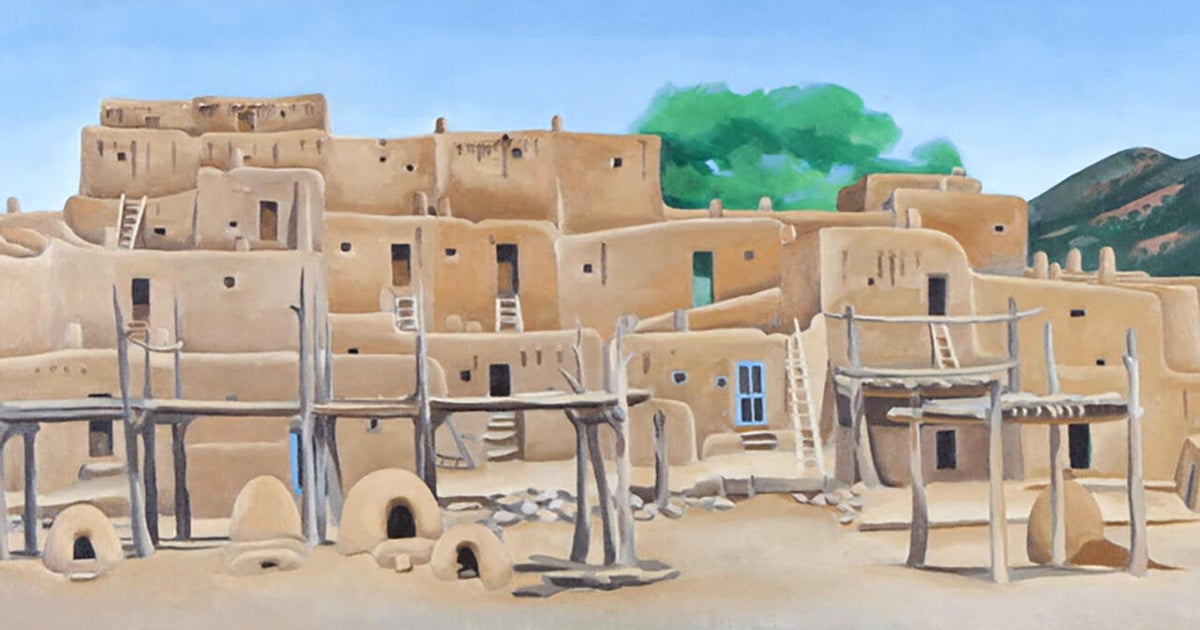
O’Keeffe eventually moved to New Mexico, immersing herself in an environment defined by adobe structures and desert landscapes. In works like Taos Pueblo (1929/1934) and her 1932 painting Stables, she investigated the nature of the places where she lived, about the qualities of light, atmosphere, and texture of the buildings that she painted.
These architectural pieces serve as an autobiographical window into the spaces where she lived and worked, highlighting environments that proved formative to her development as an individual and as a painter. Decades after her death in 1986 at 98 years old, exhibitions like the one currently running in Detroit continue to expand our understanding of an artist whose vision extended far beyond the garden gate.