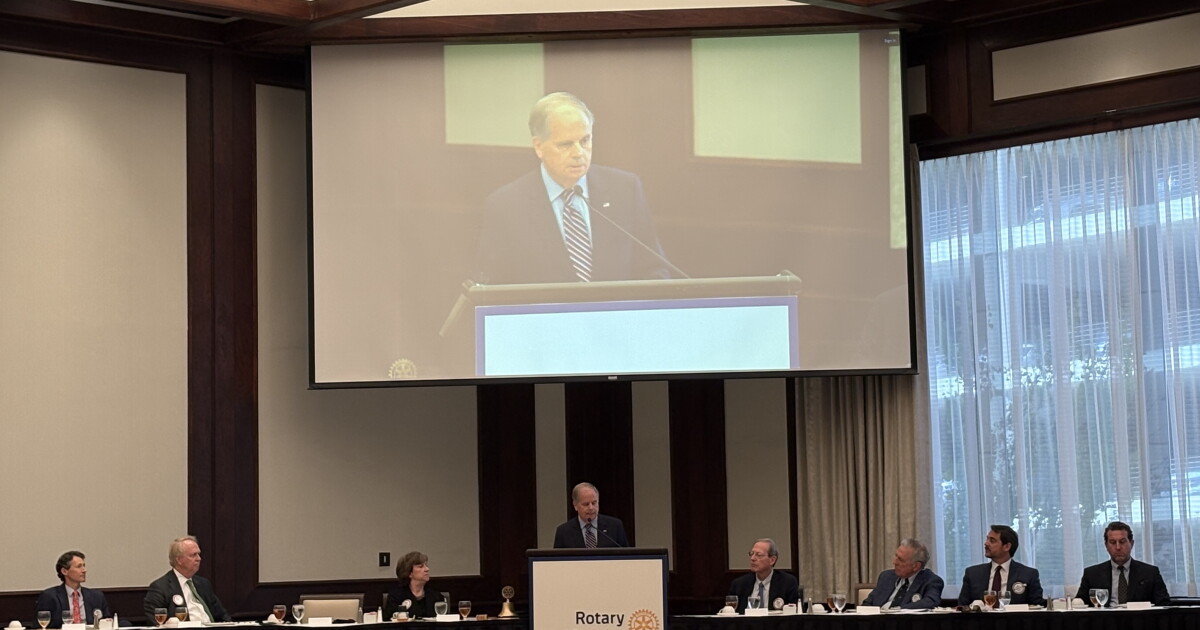
Doug Jones, a former U.S. Senator and Democratic candidate for governor, is pitching a vision for Alabama centered on Medicaid expansion, education funding via a state lottery, and a crackdown on “self-service” public office. Speaking to the Rotary Club of Birmingham, Jones framed the state’s struggle with poverty and health as an economic failure, arguing that Alabama cannot build a competitive workforce if its citizens are too sick to work.
The speech served as a direct counter-narrative to a presentation given two weeks earlier by Republican opponent and U.S. Senator Tommy Tuberville. While Tuberville has declined to debate, Jones used the platform to contrast his policy goals with Tuberville’s record, specifically targeting the Senator’s votes on housing assistance and his rhetoric regarding new residents in North Alabama.
Jones Proposes Medicaid Expansion to Fix Rural Healthcare
Jones anchored his healthcare argument in the reality of rural collapse. He pointed to the closure of rural hospitals and a high infant mortality rate as evidence that the current system is failing. For Jones, the solution is the expansion of Medicaid, a move he framed not as a social luxury but as an economic necessity.
When addressing the perennial question of affordability, Jones pointed to a specific spending contrast in Montgomery. He noted that the state found $2 billion to build two prisons that are not yet functioning, suggesting that if the state can allocate billions to dormant correctional facilities, it can find the funds to keep hospitals open and residents healthy.
The stakes here are immediate for the “coverage gap” population—those who earn too much to qualify for Medicaid but not enough to afford private insurance. Jones argued that this gap creates a workforce instability that hinders overall economic prosperity.

Shifting Power Away from Montgomery
A recurring theme in Jones’ pitch is the belief that Alabama is run by a “small circle of people” who maintain power by keeping ordinary citizens out of the decision-making process. To break this cycle, Jones proposed several structural changes to how the state governs itself:
- Citizen-Led Initiatives: Supporting ballot initiatives that allow the public to vote directly on specific measures when the legislature refuses to act.
- Local Empowerment: Increasing the authority of cities and counties to reduce the current heavy reliance on Montgomery.
- Ethics Reform: Strengthening ethics laws to require lawmakers to disclose conflicts of interest regarding stock trading.
Jones was blunt about the intersection of money and power, stating that those who wish to get rich should start a business rather than run for public office. He characterized the current state of ethics laws as “weak as water.”
Jones Suggests Tax Relief and a Lottery for Funding
On the economic front, Jones proposed a combination of tax relief and new revenue streams. He advocated for the full elimination of the state sales tax on groceries and the exemption of tips and overtime pay from state income tax. To fund public services, he positioned himself as a “statewide champion” for a lottery dedicated to education and Medicaid.

The debate over education funding also touched on the CHOOSE Act, the Alabama law directing state funds toward private school tuition or homeschooling. Jones expressed opposition to the act, stating he would phase out the tuition portion to return funds to public schools, though he clarified he would leave homeschooling provisions intact.
To address Alabama’s low workforce participation rate, Jones floated the creation of a state earned income tax credit and expanded credits for childcare. He also suggested amending the state constitution to allow gas tax money to be used for public transit, arguing that transportation is a primary barrier to employment.
The “Chief Recruiter” Argument
The final segment of the speech shifted from policy to persona. Jones challenged Tuberville’s fitness to serve as the state’s “chief recruiter” for business investment. He cited Tuberville’s comments suggesting that people moving to North Alabama from other states were products of “government-educated schools” teaching socialism and communism.
Jones questioned how a global CEO would view a governor who makes such comments, or who has spoken on the Senate floor about “commercial airline pilots who are suffering from a deranged fetish of dressing up like an animal, a furry.”

The tension culminated in Jones’ reaction to a mailer from ProgressPAC, the political arm of the Business Council of Alabama. The mailer used manipulated imagery to depict Jones with Soviet symbols and the Kremlin. Jones read the fine-print disclaimer—which admitted the media had been “manipulated by technical means”—to the audience, calling the tactic “pathetic” and an example of prioritizing victory over truth.
The Business Council of Alabama did not respond to requests for comment on the mailer.
“You deserve a governor who builds bridges and not burns them,” Jones told the crowd.