The Lakota Sioux called it mako shika.
To Spanish explorers encountering similar broken terrain in New Mexico, it was malpais. French fur trappers navigating the upper reaches of the Missouri River dubbed it les mauvaises terres à traverser. Every label translates to the same unsparing reality: difficult land to cross on foot or horseback.
Badlands. It is not an aesthetic judgment of the terrain, but a pragmatic warning to travelers.
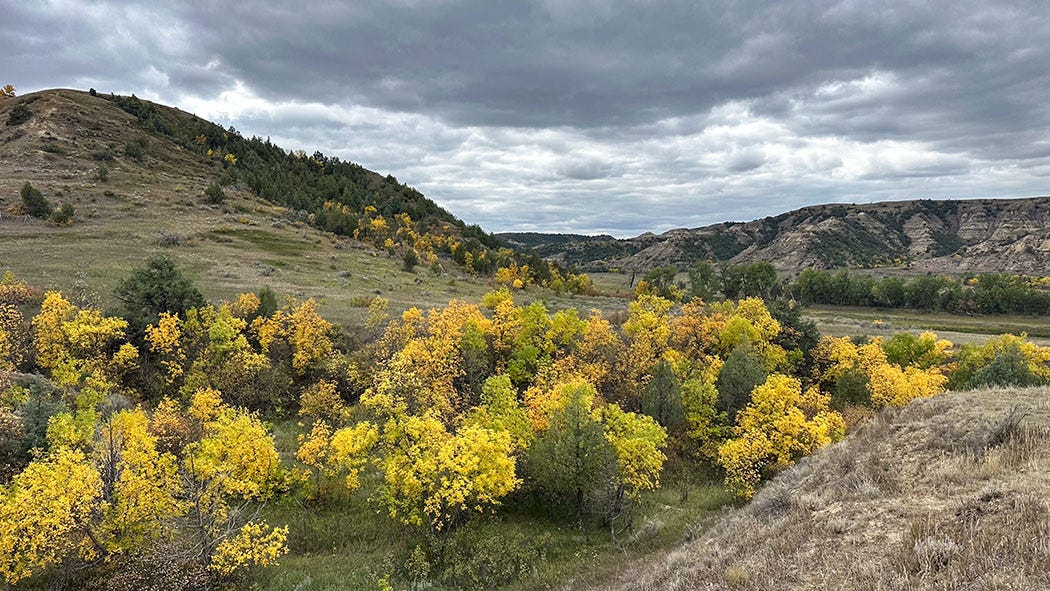
That wind-carved chaos of sandstone, shale, and clay spans large swaths of the American West. Krist embarked on a 4,000-mile September road trip across five states to explore North Dakota’s Theodore Roosevelt National Park. The journey traced an immense loop from California through Nevada, Idaho, and Montana before arriving at the rugged badlands that fundamentally shaped the nation’s 26th president.
Theodore Roosevelt did not grow up steeped in a conservationist ethos. Instead, his transformation into a visionary steward of the natural world was forged during his punishing years in the North Dakota badlands.
As a child, Roosevelt suffered from debilitating asthma attacks that left him frequently bedridden. Seeking to conquer his physical vulnerabilities through sheer willpower, he embraced a strenuous life of boxing, weightlifting, and exploration. That relentless drive eventually pulled him west to the Dakota Territory in 1883 at age 24, initially on a mission to hunt buffalo. What he found instead was a setting of stark, silent beauty that rewired his philosophy entirely.
During his seven and a half years in office (1901-1909), Roosevelt utilized executive orders and statutory authorities—including the Antiquities Act—to establish 150 national forests, 18 national monuments, four federal game preserves, and 51 federal bird reserves. Working alongside Congress to designate five national parks.
The modern gateway to the North Dakota badlands is Medora, a small town flanked by the disjunct units of Theodore Roosevelt National Park. Encompassing 70,000 acres, the park’s South Unit gets most of the attention and crowds. The North Unit is a much-less-visited place with no meaningful tourist amenities but equally captivating topography and wildlife. The third unit, Elkhorn Ranch, is the smallest and most remote.
Just outside town sits the Theodore Roosevelt Presidential Library, which officially opened on July 4, 2026. Built and managed by a private nonprofit foundation for $450 million, the striking facility breaks entirely from traditional presidential library models.
The architecture itself feels woven directly into the topography. A curving roof covered in native prairie grasses mimics the rolling hills, while an extensive boardwalk guides visitors through 400,000 native seedlings planted by volunteers.
Splitting the building’s two wings is an enormous breezeway framing a panoramic view of the badlands, complete with rocking chairs that invite travelers to sit and linger in the exact silence that captured Roosevelt’s imagination over a century ago.