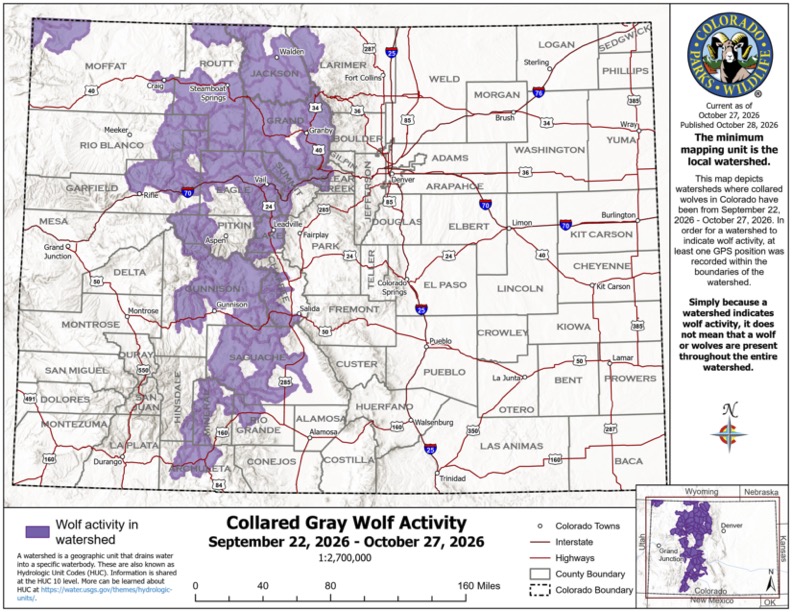
Colorado’s collared gray wolf population is pushing deeper into the Western Slope this October, with movement recorded across a vast stretch of watersheds from the northwest corner of Moffat County down to Pagosa Springs. The latest activity map from Colorado Parks and Wildlife (CPW) shows that these predators are now spanning nearly every major county in the region, including Pitkin, Eagle, and Gunnison.
As of September 24, CPW estimates there are 45 wolves in the state, but nearly half of that population consists of pups born this spring.
The Winter Survival Gap
In the western United States, typically only 50% to 60% of wolf pups survive their first winter. With 20 pups currently integrated into four packs—the Piney Ridge, One Ear, Copper Creek, and Three Creeks packs—the state is bracing for a significant natural dip in numbers.
The risk isn’t limited to the young. Adult survival rates in Colorado for the last full biological year sat at 61%, which is notably lower than the 75% survival rate typically seen in other western wolf populations. When you combine these figures with reported disease concerns in two of the packs, the margin for error disappears.
The movement seen in October is partly driven by the aging of these pups. Now six months old, the agency notes that these wolves are finally mobile enough to travel broadly with adults rather than remaining tied to their summer homesites. This increased mobility is why the October map shows more expansive activity through the middle of the Western Slope compared to previous months.
Wyoming Hunting Laws Risk Colorado Wolf Lives
While the GPS data tracks movement within Colorado, the state line is a hard boundary for legal protection. Wolves are highly mobile, and their journeys often take them into neighboring jurisdictions where the rules change instantly.
To the west, interstate agreements allow wolves that wander into Utah, New Mexico, or Arizona to be captured and returned to Colorado. However, the northern border tells a different story. In Wyoming, wolves can be legally hunted across the vast majority of the state, turning a routine territorial exploration into a lethal risk for any Colorado wolf that crosses the line.
This volatility is compounded by the struggle to source new wolves from other states—a move CPW identifies as critical for building the population. Political challenges have hindered these imports, leaving the state reliant on a fragile, homegrown population that is currently struggling to meet typical western survival benchmarks.

The Livestock Conflict Trade-off
The tension between wolf recovery and the ranching community has forced a shift in how the state manages conflict. Between August 4 and September 9, CPW killed four wolves that were preying on livestock. Following those incidents, the agency announced it would take a more conservative approach to euthanizing wolves involved in livestock conflicts.
The agency still considers euthanization on a case-by-case basis, but the priority has shifted toward population preservation to ensure the species doesn’t collapse during the winter.
The instability of the packs is already evident. The King Mountain Pack in Routt County lost both of its breeding adults this year—one during a collaring operation and another reportedly killed by a ranch hand defending cattle. While four yearlings from that pack are still traveling together, the loss of breeding adults cripples the pack’s immediate reproductive potential.
A Fragile Biological Balance
The agency is attempting to balance the mandates of the voters with the realities of the terrain and the demands of the agricultural sector.
| Metric | Colorado Current/Recent | Western US Average |
|---|---|---|
| Adult Survival Rate | 61% | 75% |
| Pup Winter Survival | Expected 50-60% | 50-60% |
| Estimated Population | 45 Wolves | N/A |



