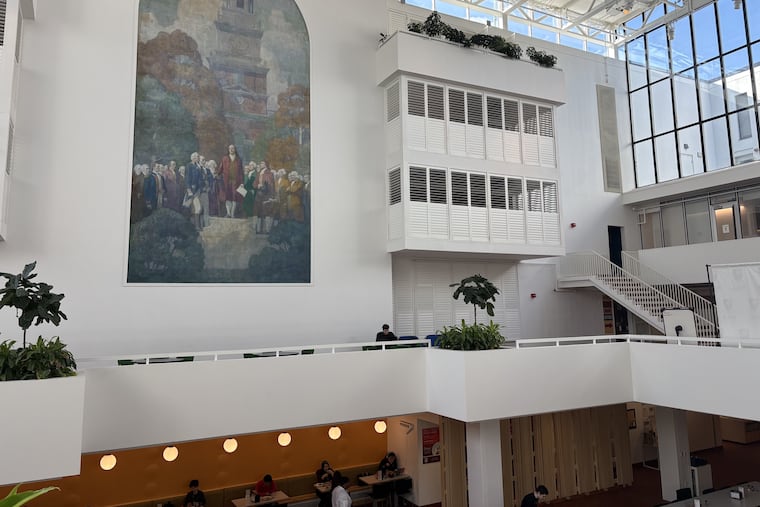
The 30-Foot N.C. Wyeth Ben Franklin Hidden Inside a Penn Dormitory
Hanging in the airy atrium of Hill College House near 34th and Walnut Streets at the University of Pennsylvania, a 16-foot-long and 30-foot-high mural titled An Apotheosis of Franklin presents a ceremonial, worshipful view of America’s founding era. Executed in 1926 by N.C. Wyeth through oil applied to burlap, the gigantic painting features Benjamin Franklin elevated on a plinth close to Independence Hall, in the company of Founding Fathers George Washington, John Adams, Thomas Jefferson, and others. The piece shares a lineage with another massive N.C. Wyeth mural, Apotheosis of the Family, which reappeared for public consumption in Wilmington this past December after long being hidden from view, as reported by the Philadelphia Inquirer.
Art History Professor Compares Mural Style to Classic Book Illustrations
The visual vocabulary of An Apotheosis of Franklin—heroism framed by puffy white clouds and trees, rendered in a distinct palette—carries the unmistakable look of N.C. Wyeth. Gwendolyn DuBois Shaw, a Penn art history professor, notes that having Independence Hall rise up in the background like a big church window emphasizes national identification with Independence as the birthplace of American democracy. Shaw compares the visual feel to Wyeth’s illustrations for the Scribner’s Classics book series, creating historical scenes that are both mythical and fictionalized.
Despite its monumental scale, the artwork remains largely hidden from everyday art lovers. Visitors to Hill College House are not welcome, as access to the dormitory building is restricted. Nevertheless, a secondary option is provided by the university: a fifty-percent-scale copy of An Apotheosis of Franklin is currently exhibited nearby inside Penn’s Arthur Ross Gallery, running through Dec. 13 as part of the exhibition “At Liberty: Life in the City of Brotherly Love During the Early Republic.”
The mural is just one of more than 9,000 works of art owned by Penn, distributed across roughly 130 spots on campus. Lynn Smith Dolby, director of the Penn Art Collection, points out that the university operates a campus loan program making artworks available to faculty and staff for their offices, noting that lacking a traditional fine arts museum allows the institution to remain nimble.
Journey to Campus and Interpreting the Statesman
Originally commissioned to embellish a bank alongside Apotheosis of the Family, An Apotheosis of Franklin passed from New York’s Franklin Savings Bank to the Independence Hall Association. It was subsequently conserved, installed at Penn in 1978, and gifted to the university in 1990. Finding a wall capable of accommodating its massive dimensions presented a major logistical challenge for the institution.
The mural forms part of a broader campus tradition of interpreting Franklin, Penn’s primary founder, focusing squarely on the patriot and statesman rather than the printer or scientist. This lens breaks away from the beneficent, ribald, or portly portraits of Franklin frequently found in images and prose, presenting instead a figure Professor Shaw describes as looking quite heroic.