Moving a 3.2-Million-Pound World War II Submarine From an Oklahoma Riverbank
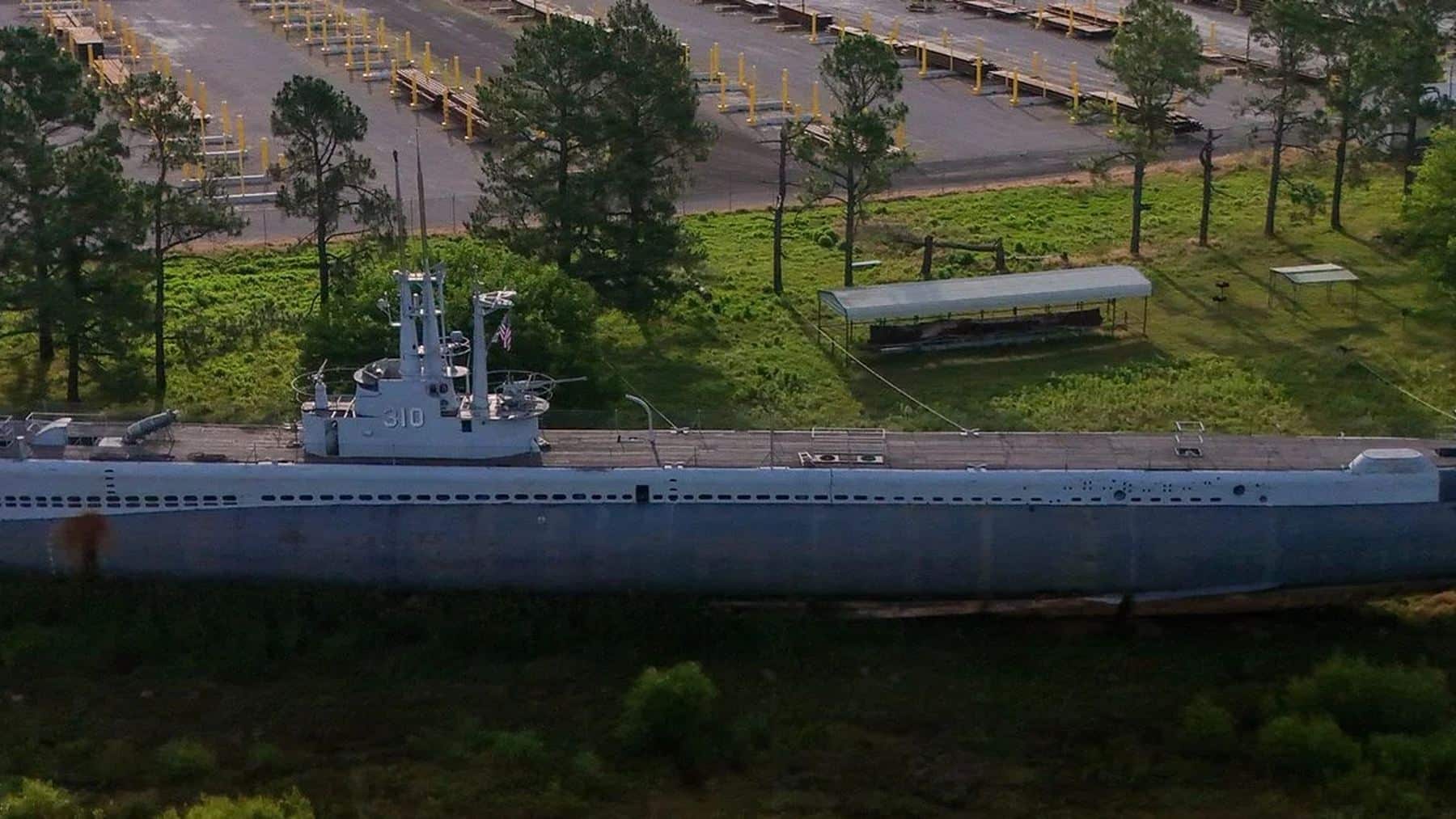
Most World War II submarines rest comfortably in coastal saltwater ports like Mobile, Alabama, or San Francisco. The USS Batfish spent the last several decades parked firmly on the bank of the Arkansas River in Muskogee, Oklahoma. Now, a flood-control project is about to squeeze the spot she’s on and her lease on the land has run out, so the 311-foot relic has to move.
The Muskogee War Memorial Authority secured $7 million by mid-September to figure out how to relocate the massive Balao-class submarine. Chairman James Gulley told the authority that the authority needs bids to get a price and “find out if we need more money.” With a complex over land and water route ahead, officials are bracing for a much heavier price tag than what they currently have in hand.
Getting the submarine to Muskogee back in May 1972 involved the Army Corps of Engineers dropping the river 3 feet and a fleet of helper barges. Getting her out is proving difficult.
River Flooding Causes Submarine to Float and Settle on Slope
The trouble really started when the Arkansas River swelled in May 2019, reaching 520 feet above sea level. Resting at roughly 500 feet, the submarine suddenly had around 20 feet of water to sit in. With all of her lead ballast bars removed at some point in her post-Navy life, the 3.2-million-pound vessel floated, drifted between 50 and 75 feet, and settled on a slope.

Museum volunteers attempted to secure the massive boat by tying her to pine trees. That improvised mooring failed to stop environmental damage. In January 2021, a scour hole turned up under nearly a third of her forward section, leaving her bow with under 18 inches of dirt underneath it. Fixing that void cost about $210,000, and the site has remained closed to the public ever since. Visitor numbers went from about 50,000 a year to about 500.
Digging a new trench to float her out is off the table. The navigation channel has been realigned, the old stretch of river that once connected her to the channel has pretty much filled up with silt, and cutting a 16-foot-deep, 2,000-foot-long trench through archaeologically sensitive ground would require a Corps permit.
Counting the Costs of an Overland and Water Haul
Moving a 3.2-million-pound artifact across land and water requires engineering. Gulley summarized the plan simply to News On 6: “raise it up, put it on a trailer, float it down the Arkansas River.”
Heavy-haul companies studying the logistics suggested using a multi-axle trailer equipped with custom cradles, estimating at least 110,000 pounds per axle.
A feasibility study outlines financial realities for the project:
| Project Phase | Estimated Cost |
|---|---|
| Overland Transport (Lifting, hauling, crossings, road repairs, foundation) | $9.95M |
| Channel Leg (Launch ramp, raising the water, barges or pontoons, exit ramp) | $9.75M |
| Harbor Sites (Combined legs, design, management, 30% contingency) | $25.4 to $28 million |
| New Museum Construction | Approx. $10 million |
State lawmakers approved $4 million via HB2794 on May 22, 2025, and FEMA provided a $2.7 million grant plus $198,000 for construction manager fees. That adds up to $6.898 million. While the authority prepares to evaluate actual contractor bids, past estimates reported by the Tulsa World suggest the full undertaking could be $28 million, with $8 million of it for the museum.
For now, Vice Chairman Ronnie Chandler notes that the authority is working with BKL Engineers to find a project manager. Port Muskogee Executive Director Kimbra Scott has indicated that the port’s Oakley terminal could supply a barge for a reasonable price. Whether one barge will suffice this time—unlike the multiple vessels required during her initial voyage—depends entirely on the engineering plans that contractors finally submit.