The New York Road Runners Face a Backlash Over Marathon Entry Rules
This August, marathon hopefuls across New York City opened their email inboxes to find an unpleasant surprise. Race fees were climbing, and a popular selection process known as 9+1—which guaranteed entry to anyone who ran nine races and volunteered at another—was being overhauled to include a lottery just for the chance to participate in the following year’s program. Thousands of available slots were also being cut.
The resulting anger rippled quickly through local run clubs and online forums, targeting a single organization: New York Road Runners. Held annually on the first Sunday in November, the race represents one of the city’s most democratic mass athletic events. This year marks the 50th anniversary of its populist five-borough course. Yet, NYRR increasingly finds itself perceived as an authoritarian gatekeeper.
As the marathon’s parent organization, NYRR handles the difficult task of deciding who earns a spot on the starting line. Driven by a worldwide running boom, that job has grown intensely contentious. A record number of people applied to run the race this year, and a record number were rejected. That trend is fueling fierce frustration not simply about the mechanics of the process, but about who actually holds the financial resources to participate in NYRR-run events.
“Between watching your computer all day to try to get into races before they sell out and all the fees, it feels like these races are becoming more elite all the time,” says Stephanie Fidis, a 33-year-old publishing worker who has run NYRR races since 2018. Another runner put it more bluntly: “Unfortunately, the way NYRR is organizing things, it’s starting to feel a little bit more like a money grab.”
NYRR CEO Defends Race Pricing Against Profit Claims
NYRR CEO Rob Simmelkjaer sits inside his fifth-floor office across the street from Carnegie Hall, fully aware of the public griping. While polite and genial, he shows clear irritation at the suggestion that he leads a cold-blooded financial machine. “If we were a for-profit organization that was focused on maximizing our revenue, we could charge twice or more for races,” Simmelkjaer says. “And there’s probably enough price elasticity that we could do that and still be sold out, and we could probably have revenues that are close to double what we have now. But we don’t make that choice, because that’s not what we are. We’re a nonprofit organization. Accessibility is a huge part of what we want to achieve.”

Simmelkjaer, 55, insists the recent adjustments are essential to address escalating demand. The phenomenon is not unique to New York. Applications to the London Marathon jumped 35 percent from 2025 to 2026, dropping the lottery acceptance rate to a slim 1.5 percent. New York has experienced a parallel surge, climbing from a 2020 high of 185,000 applicants to more than 240,000 this year.
For roughly four decades, the 9+1 program gave local runners a reliable advantage over the general population for securing a marathon berth. The recent downgrading of that pathway favored other entrants, including participants more capable of paying their way in. Simmelkjaer defends the strategy, noting that unchecked growth threatens other crucial elements of the event. “If it was allowed to grow in an unlimited way, it really starts to threaten other important groups in the marathon, most notably the charity program,” he explains, pointing to the thousands of marathoners who gain entry by pledging donations to philanthropic groups. This year, the organization aims to raise $100 million for nonprofits.
Grassroots Crews versus Corporate Sponsorships
Operating as a major economic engine for the city—generating an estimated $800 million in spending—the marathon often invites comparisons to the U.S. Open: a glamorous annual event that funds dozens of lower-key community programs year-round. NYRR funnels millions of dollars into free school-based running programs for thousands of children, builds new public tracks, and constructs playgrounds. Because it cannot sell spectator tickets to watch its central competition, the organization relies heavily on sponsorships, which has further fueled perceptions of commercialization.
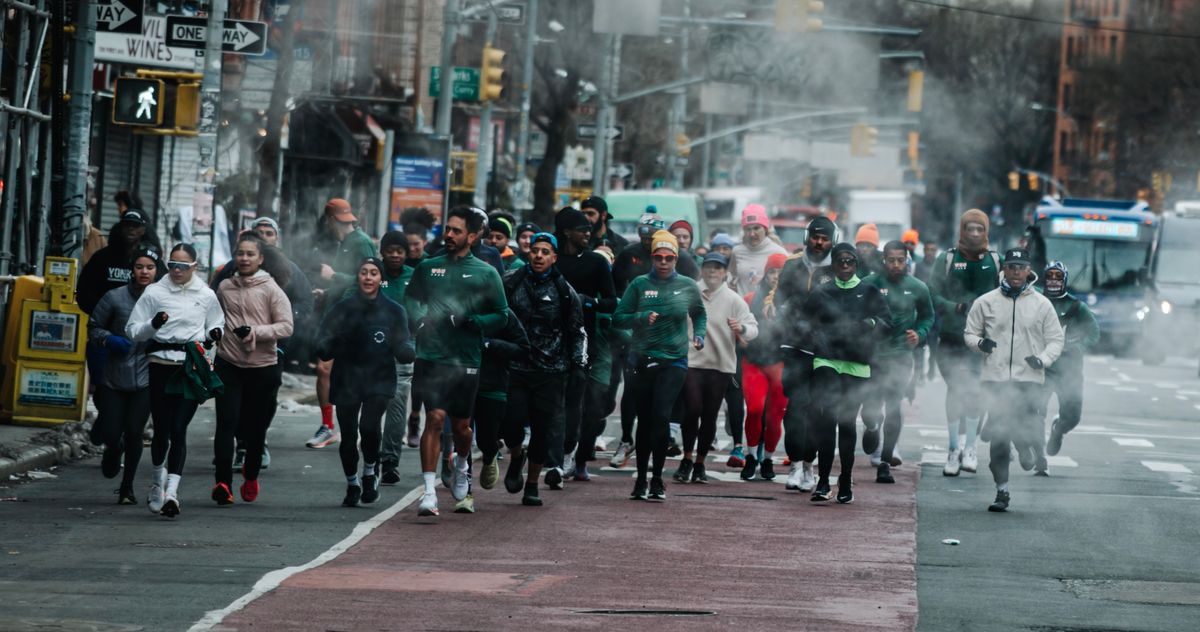
Corporate backers span a wide commercial spectrum, ranging from Tata Consultancy Services, New Balance, and Citizens Bank down to an official pain topical sponsor. Among the regulations drawing complaints this year was a strict ban on cheer-zone banners advertising brands that have not paid NYRR for visibility. That edict highlighted the tension between the large-scale institution and the scrappy neighborhood crews defining New York’s grassroots running culture.
New York Road Runners wants to make the marathon more inclusive. So why does it keep getting harder — and more expensive — to participate? https://t.co/dISECmdhSa
While some group leaders acknowledge that NYRR’s efforts to diversify the running community have improved, others voice deep skepticism. Amir Muhammad Figueroa of Harlem Run notes positive changes, but Parmila Philips, leader of the Manhattan-based New York Flyers club, views NYRR as a wealthy near-monopoly that cannibalizes sponsorship dollars available to smaller nonprofits.
“They’re denying more regular people access to the marathon and allocating more bibs to charities. They can make a lot more money from the charity entries and look good at the same time.” — Maria Solis Belizaire, Founder of Latinas Run
Simmelkjaer bristles at the accusations. Pointing to the crowded running paths in Central Park and along the West Side Highway, he emphasizes that the city’s thriving independent training groups operate largely outside NYRR’s umbrella. Last year, NYRR brought in a record $133 million in revenue, plowing 87 percent of that income back into program services. The organization also protects its turf aggressively; two years ago, it sued smaller for-profit rival NYCRuns over trademark infringement regarding the name “Brooklyn Half Marathon.” Both sides later reported an amicable settlement, though peace may be tested soon as NYCRuns founder Steve Lastoe discusses launching a new multi-borough marathon with city officials.
A Path Forward After Leadership Turmoil
Simmelkjaer stepped into his role in 2022 following a turbulent era for NYRR. Michael Capiraso had led the organization through a rapid growth phase that hit a sudden halt in 2020. When the pandemic forced the cancellation of the marathon, NYRR laid off roughly half its staff. A furloughed employee subsequently launched an Instagram page, RebuildNYRR, serving as a forum for anonymous accusations that Capiraso oversaw a toxic work culture—allegations he has consistently denied.
Simmelkjaer credits interim head Kerin Hempel with doing the heavy organizational lifting before his arrival, including the addition of a chief diversity officer. Simmelkjaer, who has completed the New York City Marathon twice, has worked to push inclusivity further. In January, he unveiled NYRR’s first rebranding in 15 years, replacing an old logo featuring a thin male runner’s silhouette with an abstract torch and flame inspired by the Statue of Liberty. “That figure is clearly a man, a thin man, right? That doesn’t represent us,” Simmelkjaer says. “Running is people with a million different body types. Half of them are female. A lot of them are running in groups, or they’re kids. None of them are represented in that.” Fifty years after founding president Ted Corbitt established the five-borough course to promote integration, the organization manages the ongoing friction between institutional scale and grassroots heritage.



