Wilmington-based artist and writer Oscar Eduardo de Paz grew up on the north side of Chicago, living in a neighborhood he describes as marked by both gang violence and police violence. At 13 years old, de Paz experienced that second force firsthand while taking household trash out to the alley. A black sedan with tinted windows sped into the space, and two officers exited with drawn weapons, demanding to know what was inside the garbage bag and whether he possessed illegal drugs. His panicked grandmother rushed outside shouting that he was a good boy, and officers departed after finding only ordinary household waste in the dumpster.
Spotlight Delaware reported that this adolescent encounter fundamentally shifted how de Paz viewed his place in society, realizing that his ethnicity caused some individuals to perceive him as an expendable threat. Years later, those memories resurfaced as he watched television coverage of the 2014 shooting of 18-year-old Michael Brown by a white police officer in Ferguson, Missouri, an event that catalyzed the modern Black Lives Matter movement. Sitting with his own young children at the time, de Paz reflected on how differently his life might have unfolded if the officers in that Chicago alleyway had pulled the trigger.
Those formative experiences eventually shaped his 2024 book A Violent Break, which began as an audio essay titled “After Dinner.” De Paz submitted that piece to a 2018 contest hosted by the University of Delaware Center for Political Communication and won. At the time, he was pursuing a doctoral degree at the Biden School of Public Policy and Administration, entering academia with the explicit goal of driving systemic reform across policing, healthcare, and immigration policy.
From Public Policy Doctoral Studies to Visual Arts
Disillusionment with institutional reform set in as de Paz worked on his doctoral dissertation focused on environmental justice. His research required interviewing residents in vulnerable municipalities such as Chester, Pennsylvania, home to the nation’s largest trash incinerator, and Flint, Michigan, where cost-cutting measures by an emergency manager in 2014 switched the municipal water supply and contaminated drinking water with lead, as documented by the Centers for Disease Control and Prevention.
Through these interviews, de Paz observed a profound public distrust in foundational institutions like government agencies, universities, and nonprofit organizations. That skepticism eventually permeated his own academic outlook. The turning point for his doctoral pursuits arrived at an award ceremony where he performed his essay “After Dinner.” A member of the audience approached him afterward to express appreciation that the narrative shared a personal story rather than pushing a heavy-handed political argument, noting it changed how they thought about policing. Realizing that academic bureaucracy felt increasingly stagnant while creative work actively sparked dialogue, de Paz left his Ph.D. program during the COVID-19 pandemic to devote himself fully to writing and visual art.
I get a lot of side-eyes. I’m a little bit of an all-or-nothing person, and I think that’s partly because that’s what survival has taken. I was homeless at 16. I had to drop out of high school. There was no, ‘Let’s take our time.’ Maybe that’s why I paint the way I paint, too — like time will run out. — Oscar Eduardo de Paz
Colliding Pop Culture and Political Reality on Canvas
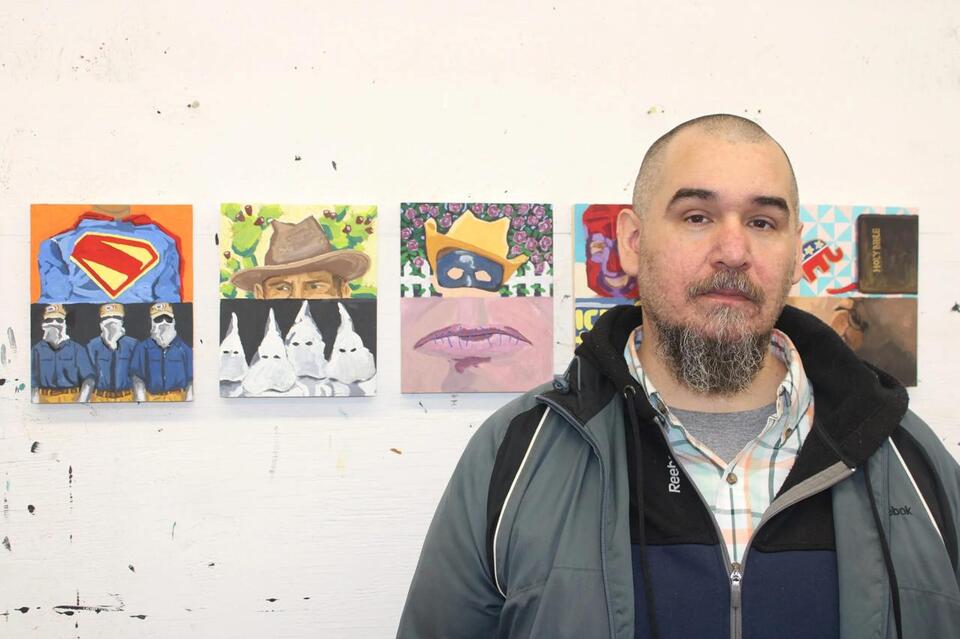
Operating out of a studio at The Delaware Contemporary, de Paz has maintained a prolific output, painting over 40 canvases over a six-month span for an ongoing series titled “Remixing Americana.” Each composition splits vertically or horizontally, pairing a recognizable icon from American mythology or pop culture with a stark political counterpart. One canvas juxtaposes a football helmet on its top half with a warzone military plane below, where billowing smoke is constructed from a collage of presidential portraits printed on fake currency. Another piece draws on a childhood fascination with comic books by placing Superman alongside masked members of the white supremacist organization the Patriot Front, while a separate work pairs Captain America beside a plantation house to examine national commitments to liberty.
De Paz’s “Remixing Americana” exhibition opens at the Create Magic Art Shop, located at 419 N. Market St. in Wilmington, with a public reception scheduled for Friday, November 6, from 5:00 p.m. to 8:00 p.m. The exhibition runs through November 28, with regular gallery hours operating from noon to 7:00 p.m., Wednesday through Saturday. De Paz is also scheduled to participate in the "Shifting Perspectives: Art in America" symposium at The Delaware Contemporary, located at 200 S. Madison St. in Wilmington, on Thursday, November 12, from 11:00 a.m. to 4:00 p.m., with admission priced at $25.
Another striking painting in the series features his 11-year-old son wearing a luchador wrestling mask positioned next to an U.S. Immigrations and Customs Enforcement agent. De Paz explained that the piece highlights the contradiction between children playing heroes who protect the vulnerable and actual institutions that project power downward onto the poor and marginalized, while also critiquing the political rhetoric that frames immigrant communities through criminal stereotypes.
Violence remains a central motif across the collection, connecting historical atrocities like the near-genocide of Native Americans to contemporary expansions of the prison system, the proliferation of detention facilities under immigration enforcement operations, and the rising tide of hostile rhetoric targeting transgender and homosexual individuals. While his visual art deliberately avoids prescribing policy solutions or neat answers, de Paz intends for the juxtaposition of cultural symbols and societal realities to provoke deep reflection on the dualities defining the American experience.